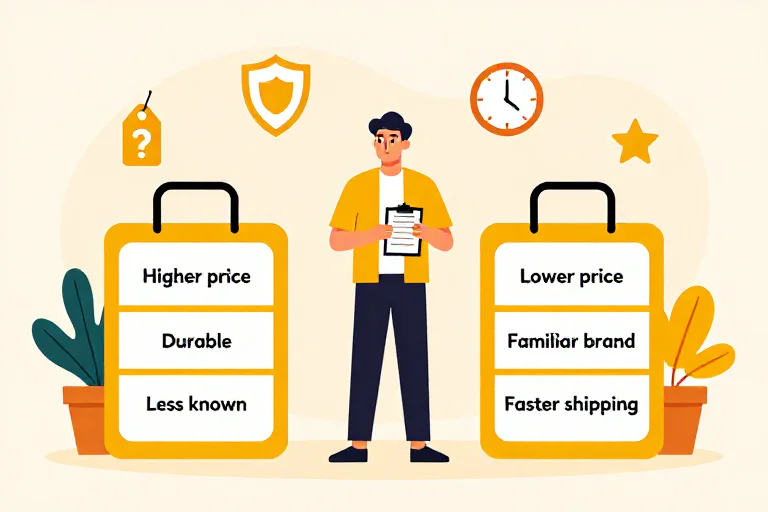
When customers choose a competitor, it is tempting to reduce the decision to one variable.
Maybe:
Their price is lower.
Or:
Their product is better.
Or:
Their website is better.
Those explanations can be true.
But a customer rarely evaluates a product in isolation.
They compare it with alternatives.
They consider their own situation.
They balance:
- price
- expected value
- risk
- trust
- product fit
- convenience
- availability
- familiarity
- timing
- alternatives
Two customers can choose different products for completely different reasons.
That is why the useful question is not:
“Why is the competitor better?”
It is:
“What decision was this customer making, and why did the competitor make more sense in that situation?”
Why Customers Choose Competitors
There is no universal list of reasons.
But common decision dimensions can include:
- price
- perceived value
- product quality
- product fit
- convenience
- trust
- availability
- delivery
- customer support
- brand familiarity
- features
- experience
- perceived risk
The problem is that these are categories, not explanations.
For example:
“Price”
does not tell you whether the customer:
- could not afford the product
- thought the competitor offered more value
- did not understand your differentiation
- only needed a basic option
- compared your offer with a substitute
So competitor choice needs context.
Start With the Alternative, Not the Competitor
A customer may think they are choosing between:
Your product vs Competitor A.
But they might actually be choosing between:
Your product vs a cheaper alternative.
Or:
Your product vs their existing solution.
Or:
Your product vs doing nothing.
Or:
Your product vs spending the money somewhere else.
This matters.
For example:
Your Product:
$120

Customer alternative:
$45 substitute

Observed:
Customer chooses substitute
The conclusion:
“We need lower prices.”
may be premature.
The real issue might be:
The customer does not need the additional value your product provides.
That is a customer-fit problem.
The Customer's Decision Is Contextual
Suppose two customers compare your product with the same competitor.
Customer A:
uses the product every day
Customer B:
uses it twice a year
The same price difference may lead to completely different choices.
Customer A may value:
durability
convenience
performance
Customer B may care mostly about:
upfront price
So:
Competitive advantage is often scenario-dependent.
A product does not need to beat competitors for every customer.
It needs to make sense for the customers you want.
Step 1: Identify What Customers Actually Compare
Look for explicit comparisons:
“I chose X because...”
“Compared with X...”
“X was cheaper.”
“X seemed easier.”
“I almost bought X.”
“I switched from X.”
These statements reveal actual alternatives.
They are more valuable than assumptions about who the competition is.
Step 2: Analyze What Changed the Decision
Ask:
What information, experience, or perception changed the customer's decision?
For example:
“I chose the competitor because the dimensions were clearer.”
That could mean:
- better product communication
- lower purchase uncertainty
- stronger fit confidence
Another:
“I bought the cheaper one because I only need it occasionally.”
That could mean:
- low usage frequency
- insufficient premium value
Another:
“I chose them because I trusted the warranty more.”
That could mean:
- lower perceived risk
- stronger trust
Different decisions.
Different problems.
Step 3: Separate Price From Perceived Value
A customer may choose a competitor because:
the competitor is cheaper.
But another possibility is:
the competitor's value is easier to understand.
Consider:
Your product:
$200
Competitor:
$150
Suppose customers repeatedly say:
“I don't understand why yours costs more.”
The problem is not necessarily the $50 difference.
It may be:
weak perceived differentiation.
This is why customer price objections should be analyzed alongside competitor choice.
Why Do Customers Say a Product Is Too Expensive? →
Step 4: Look for Product-Fit Differences
A competitor may win because it fits a particular customer scenario better.
For example:
Your product:
optimized for individual use
Competitor:
optimized for families
If families consistently choose the competitor, the conclusion is not necessarily:
Their product is better.
It may be:
Their offer fits that scenario better.
This distinction matters because you have different possible responses:
- build for that scenario
- create another configuration
- change positioning
- focus on a different customer group
Step 5: Investigate Trust
Customers sometimes choose the competitor because they perceive less risk.
Look for mentions of:
- warranties
- returns
- reviews
- reputation
- customer support
- brand familiarity
- proof
- guarantees
- third-party validation
A customer might say:
“I went with the better-known brand because I didn't want to take a chance.”
That is not necessarily a product-quality problem.
It is a trust problem.
Step 6: Compare Positive and Negative Evidence
Suppose competitor customers repeatedly praise:
ease of setup.
But also complain:
poor durability.
Your customers say:
durability is excellent.
but:
setup is difficult.
You now have a much more interesting competitive picture:
Your strength:
Durability

Competitor strength:
Ease of setup

Competitor weakness:
Durability

Your weakness:
Setup complexity
Now your decision depends on:
Which customers value which attribute?
That is more useful than:
Competitor has better UX.
Step 7: Look for Switching Stories
Switching stories are especially valuable.
Examples:
“I moved from Brand A because...”
“I replaced my old product with...”
“After using X for six months, I switched to Y.”
These reveal:
- previous solution
- trigger
- dissatisfaction
- desired outcome
- decision criteria
A switching story is effectively a mini customer journey.
Analyze it as:
Previous Solution
      ↓
Problem
      ↓
Trigger
      ↓
Alternative Search
      ↓
Comparison
      ↓
Decision
      ↓
New Product
That can reveal why customers move between competitors.
Step 8: Use Customer Behavior Alongside Customer Language
Customer language is powerful.
Behavior adds another dimension.
For example:
Customers say:
“The competitor is cheaper.”
But your analytics show:
many customers add your product to cart and leave only after viewing competitor comparisons.
That suggests comparison is part of the decision.
Or:
Customers say:
“The competitor has better quality.”
But repeat purchase data shows:
your existing customers stay loyal.
That may mean the quality perception is concentrated among new shoppers.
Again:
the segment matters.
Step 9: Cross-Validate the Reason
Suppose the working hypothesis is:
Customers choose the competitor because of price.
Check:
- customer reviews
- competitor reviews
- purchase behavior
- traffic behavior
- support questions
- discount response
- customer segments
You may discover:
Price matters mostly to occasional users, while frequent users care about durability.
Now you have a much more precise competitive insight.
Step 10: Do Not Try to Beat Competitors Everywhere
This is where competitor analysis can become strategically useful.
You do not necessarily want:
A better version of everything the competitor does.
You want:
A stronger reason for the customers you want to win.
For example:
Competitor:
cheaper and simpler
Your product:
more durable and higher performance
Then the strategic question is not:
How do we become cheaper?
It is:
Which customer scenarios make durability worth paying for?
That is a much better strategy question.
A Practical AI Prompt
Analyze customer evidence related to customers who choose our competitors.

For each recurring pattern:

1. Identify the competitor or alternative.
2. Identify the customer scenario.
3. Identify what the customer was trying to accomplish.
4. Identify the decision criteria.
5. Identify what the customer valued in the competitor.
6. Identify what they perceived as missing or weaker in our offer.
7. Separate direct evidence from interpretation.
8. Generate alternative explanations.
9. Identify supporting and contradictory evidence.
10. Identify what additional evidence should be investigated.

Do not assume that the competitor is simply “better”.

Explain why the competitor may fit this specific customer situation better.
A Useful Competitive Choice Table
| Dimension | Your Product | Competitor | Customer Meaning |
|---|---|---|---|
| Price | $200 | $150 | Competitor easier for occasional users |
| Durability | High | Medium | Your advantage for frequent users |
| Setup | 20 min | 5 min | Competitor wins convenience |
| Warranty | Strong | Strong | Not a major differentiator |
| Reviews | Fewer | More | Competitor may feel lower risk |
| Fit | Individual | Family | Different scenarios |
This is much more useful than a feature matrix.
Why Customers Switch Is Often More Valuable Than Why They Like You
A customer saying:
“Great product.”
is useful.
A customer saying:
“I switched from X because...”
is often more strategically informative.
The switching story tells you:
- what was wrong before
- what changed
- which alternative mattered
- what triggered action
- how customers evaluate the category
That can expose your real competitive environment.
The Goal Is Not to Copy the Competitor
Competitor intelligence should answer:
Why are customers choosing them?
Then:
Which of those reasons matter to our target customers?
Then:
Which can we realistically improve?
Then:
Which should we ignore?
That last question matters.
A competitor can be better at something that is irrelevant to your chosen market.
You do not need to win every dimension.
Final Framework
Customer Chooses Competitor
        ↓
What Alternative?
        ↓
Customer Scenario
        ↓
Decision Criteria
        ↓
Perceived Value
        ↓
Risk / Trust
        ↓
Product Fit
        ↓
Competitor Strength
        ↓
Your Weakness
        ↓
Supporting Evidence
        ↓
Alternative Explanations
        ↓
Strategic Decision
The important question is not:
“Why is the competitor better?”
It is:
“Why did this customer believe the competitor was the better decision for them?”
That distinction gives you much more useful competitive intelligence.
Related Competitor Research
How to Analyze Competitor Reviews for Customer Insights →
How to Find Product Gaps From Competitor Reviews →
How to Analyze Negative Reviews for Customer Insights →
Why Do Customers Say a Product Is Too Expensive? →
Why Do Customers Hesitate to Buy? →
What Does a Shopper Actually Do Before Buying From an Ecommerce Store? →
Related Product Research
How to Choose Product Ideas When AI Creates Too Many Options →
The Miyeta Approach
Do not ask:
“How do we beat the competitor?”
Ask:
“Why did this customer believe the competitor was the better choice?”
Then investigate whether the answer reveals:
a product gap,
a positioning gap,
an information gap,
a trust gap,
or simply a different customer fit.