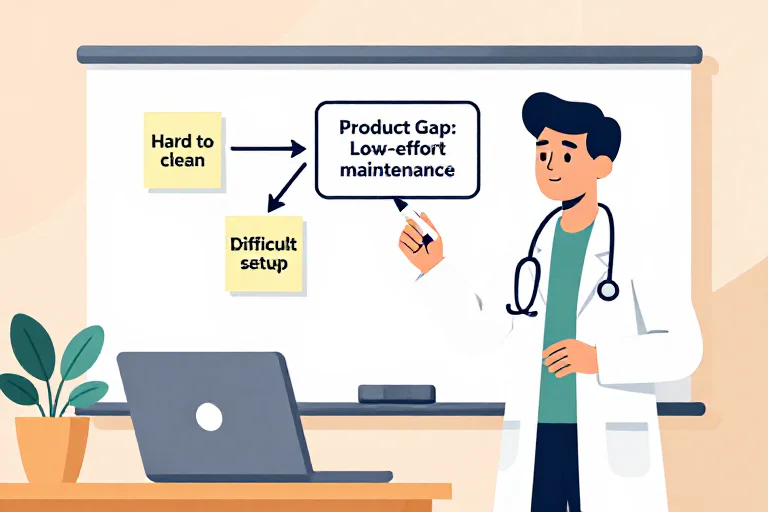
Your competitor's customers are already telling you where the product fails.
Sometimes they say it directly:
“I wish this had...”
Sometimes they describe the problem without asking for a solution:
“Every time I use it, I have to do this extra step.”
Sometimes they compare alternatives:
“I switched because the other product was easier.”
These statements can reveal product gaps.
But a competitor complaint is not automatically a product opportunity.
That is the distinction that matters.
A useful competitor-review process moves through:
Competitor Review
      ↓
Customer Problem
      ↓
Scenario
      ↓
Underlying Need
      ↓
Repeated Evidence
      ↓
Competitor Gap
      ↓
Market Importance
      ↓
Opportunity
      ↓
Validation
The goal is not to collect complaints.
It is to identify problems that may be important enough to solve.
What Is a Product Gap?
A product gap is a meaningful mismatch between:
what customers need
and:
what available products currently provide.
That does not necessarily mean:
missing feature.
A gap can involve:
- functionality
- usability
- configuration
- reliability
- convenience
- compatibility
- maintenance
- price-to-value
- customer fit
- information
- experience
For example:
Customers repeatedly struggle to clean every competitor's product.
The gap might not be:
“Add a removable part.”
It might be:
“Create a version designed around low-effort maintenance.”
The solution comes later.
The problem comes first.
Competitor Reviews Are Useful Because They Contain Market Evidence
Your own reviews tell you:
what your customers experience.
Competitor reviews add:
what customers experience with alternatives.
This helps answer:
- Is the problem specific to our product?
- Is it common across the category?
- Does one competitor solve it better?
- Are customers switching because of it?
- Is there an underserved scenario?
The combination can be more useful than studying either dataset alone.
Step 1: Collect Competitor Reviews
Choose competitors that customers actually consider.
Then collect reviews from public sources such as:
- ecommerce marketplaces
- retailer review pages
- product review platforms
- community discussions
- public Q&A
- public social discussions
For each item, retain enough context to understand:
- product
- competitor
- date
- rating
- customer statement
- usage scenario
- comparison if mentioned
Do not strip away the original language too early.
The exact wording can reveal expectations and emotions that a category label hides.
Step 2: Identify Recurring Customer Problems
Start broad.
Look for:
- complaints
- workarounds
- unmet expectations
- repeated questions
- comparisons
- requests
- frustration
- praise for alternative approaches
AI can help cluster similar statements.
For example:
300 competitor reviews
        ↓
Setup
Maintenance
Fit
Durability
Size
Price
Support
This is the map.
Now investigate the most important parts.
Step 3: Do Not Call Every Complaint a Gap
Suppose one customer says:
“I hate that the product is blue.”
That is a complaint.
It may not represent an important product gap.
Now suppose:
40 customers describe the same compatibility problem.
That is more interesting.
Still, you need to ask:
- Which customers experience it?
- Is it repeated across competitors?
- What are they trying to accomplish?
- Do they actively search for alternatives?
- Does the problem influence purchase or retention?
A gap needs more than repetition.
It needs importance.
Step 4: Find the Customer Scenario
Consider:
“The product is difficult to store.”
Who experiences that?
Perhaps:
- apartment residents
- frequent travelers
- small offices
- families with limited storage
A product gap may therefore be:
poor fit for space-constrained scenarios.
This can be more useful than:
storage problem.
The scenario tells you who might value a solution.
Step 5: Identify the Underlying Need
Suppose competitor customers say:
“I wish the product were easier to clean.”
Possible underlying needs:
- less maintenance
- lower time cost
- simpler ownership
- better hygiene
- fewer recurring tasks
The potential product opportunity depends on the underlying need.
Not the literal request.
This is why customer-needs analysis and competitor-review analysis should be connected.
Step 6: Separate Symptom From Cause
Suppose:
“It keeps breaking.”
The product gap might be:
durability.
But possible causes include:
- poor materials
- incorrect usage
- excessive load
- poor fit
- unrealistic expectations
- product design
Before deciding what to build, understand the problem.
This is especially important when using AI.
A model can summarize a complaint correctly while still misunderstanding its cause.
Step 7: Compare the Same Problem Across Competitors
This is one of the strongest techniques.
Suppose:
Competitor A:
“Hard to clean.”

Competitor B:
“Too many parts to wash.”

Competitor C:
“Cleaning takes forever.”
Now ask:
Is maintenance a category-wide gap?
Compare:
- frequency
- severity
- affected scenarios
- alternatives
- customer behavior
You may discover:
The category has not solved low-effort ownership well.
That is much more valuable than discovering that one competitor has a bad review.
Step 8: Compare Competitor Reviews With Your Reviews
Now bring your own data into the analysis.
For example:
Your customers:
“Easy to clean.”

Competitor customers:
“Cleaning is difficult.”
This is interesting.
It may reveal:
a strength you are not communicating strongly enough.
Alternatively:
Your customers:
“Difficult to clean.”

Competitor customers:
“Difficult to clean.”
Now it may be:
a category-level opportunity.
Or:
Your customers:
“Difficult to clean.”

Competitor B:
“Easy to clean.”
Now:
the competitor may have an actual advantage in that area.
This comparison is where competitor intelligence becomes strategic.
Step 9: Look for Workarounds
A workaround is often more informative than a direct complaint.
For example:
“I keep a separate container beside it because the included one is too small.”
This reveals:
- the limitation matters enough to change behavior
- the existing solution is inadequate
- the customer has already invented an alternative
- there may be an unmet need
AI can help find recurring workarounds across many reviews.
Step 10: Look for Customers Switching
Statements such as:
“I switched from...”
“After trying...”
“I replaced my old one with...”
are extremely valuable.
They tell you what changed the customer's decision.
Investigate:
- what they used before
- what disappointed them
- what attracted them to the new product
- which problem mattered most
- whether the switch was driven by price, quality, fit, convenience, or trust
This gets much closer to real competitive decision-making.
Step 11: Distinguish Competitor Weakness From Category Difficulty
Suppose every competitor receives complaints about:
battery life.
That does not automatically mean there is an easy opportunity.
The limitation may come from:
- physics
- cost
- weight
- battery technology
- safety
- manufacturing constraints
A product gap becomes valuable only when the problem is:
important
and:
plausibly solvable
and:
commercially worthwhile.
Step 12: Score the Opportunity Carefully
A simple framework is:
| Dimension | Question |
|---|---|
| Frequency | How often does it appear? |
| Severity | How much does it hurt? |
| Scenario | Who experiences it? |
| Switching | Does it change purchase behavior? |
| Alternatives | Are customers actively looking elsewhere? |
| Solvability | Can it realistically be improved? |
| Competition | Has someone already solved it? |
| Commercial value | Would customers pay for a better solution? |
Do not let frequency dominate everything.
A small but severe problem can matter more than a large but trivial complaint.
Use AI to Generate Hypotheses, Not Product Roadmaps
A useful prompt is:
Analyze these competitor customer reviews to identify potential product gaps.

For each recurring problem:

1. Show direct customer evidence.
2. Identify the customer scenario.
3. Identify the desired outcome.
4. Separate the symptom from possible causes.
5. Compare the problem across competitors.
6. Compare with our own customer feedback.
7. Identify alternative explanations.
8. Assess frequency and severity.
9. Identify whether customers appear to switch or search for alternatives.
10. State what evidence is still missing.

Do not automatically turn the finding into a feature recommendation.

First establish whether the underlying problem is meaningful.
That keeps the research honest.
A Useful Product-Gap Output
| Layer | Finding |
|---|---|
| Competitors | A, B, C |
| Scenario | Frequent travel |
| Customer problem | Difficult setup |
| Desired outcome | Fast deployment |
| Evidence | Repeated comments |
| Category pattern | Appears across 3 competitors |
| Your product | Better on setup |
| Customer importance | Moderate-high |
| Opportunity | Investigate positioning or new product |
| Missing evidence | Willingness to pay |
Now you have something you can validate.
Product Gap Does Not Mean "Build It"
This is probably the most important point.
Suppose you discover:
Customers repeatedly complain about a missing feature.
Possible next actions include:
- build it
- reposition an existing feature
- create a variant
- improve instructions
- target a different segment
- change pricing
- partner with another company
- do nothing
The review identifies a possible gap.
It does not choose the strategy.
From Competitor Gap to Product Research
Once a potential gap is found, move it into a separate validation process.
For example:
Competitor Evidence
      ↓
Potential Gap
      ↓
Customer Scenario
      ↓
Demand Evidence
      ↓
Willingness to Pay
      ↓
Competitive Density
      ↓
Feasibility
      ↓
Product Decision
That is where this article should connect to Miyeta's Product Research work.
How to Choose Product Ideas When AI Creates Too Many Options →
Final Framework
Competitor Reviews
      ↓
Recurring Problems
      ↓
Customer Scenarios
      ↓
Underlying Needs
      ↓
Repeated Evidence
      ↓
Cross-Competitor Comparison
      ↓
Own-Customer Comparison
      ↓
Potential Gap
      ↓
Commercial Validation
      ↓
Product Decision
A competitor review is not a product roadmap.
It is evidence.
The opportunity appears when multiple pieces of evidence point toward the same unresolved customer problem.
Related Research
How to Analyze Competitor Reviews for Customer Insights →
How to Analyze Customer Reviews With AI →
How to Find Customer Pain Points in Reviews With AI →
How to Find Customer Needs in Reviews With AI →
How to Choose Product Ideas When AI Creates Too Many Options →
The Miyeta Approach
Do not ask:
“What feature are competitors missing?”
Ask:
“What customer problem remains unresolved across the alternatives people are actually considering?”
That question produces much better product research.