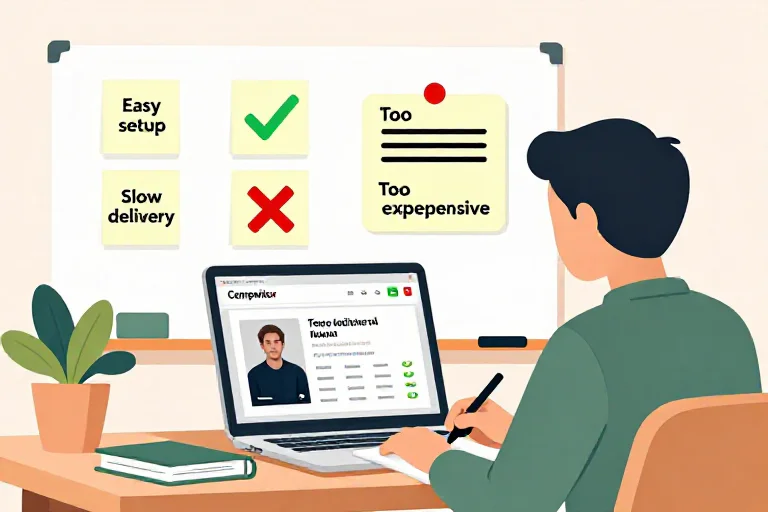
Your competitors have already paid to acquire customers.
Then those customers wrote down what they liked, disliked, expected, compared, and regretted.
That makes competitor reviews one of the most useful sources of public customer evidence available to an ecommerce business.
But most competitor research stops at:
- price
- product features
- ratings
- review count
- marketing claims
Those comparisons can be useful.
They still leave out an important question:
What did the competitor's customers actually experience?
A competitor may claim:
“Easy to use.”
Their customers may repeatedly say:
“It took me an hour to figure out.”
A competitor may position itself as:
“Premium quality.”
Its customers may repeatedly praise durability—but complain about delivery.
A competitor may have a lower price but poor support.
Another may charge more and still win customers because the perceived value is clearer.
That is why competitor review analysis should not be treated as a review-summary exercise.
It is a way to understand:
what customers value, what they struggle with, and where the market may still have unresolved problems.
What Is Competitor Review Analysis?
Competitor review analysis is the process of examining publicly available customer reviews about competing products or brands to identify:
- recurring complaints
- positive experiences
- customer expectations
- usage scenarios
- objections
- unmet needs
- competitor strengths
- competitor weaknesses
- customer comparisons
- potential gaps in the market
The important distinction is:
You are analyzing customers, not just competitors.
A competitor's product page tells you:
what the company wants you to believe.
A customer review can tell you:
what happened after someone bought it.
Those are different types of evidence.
Why Competitor Reviews Are Different From Your Own Reviews
When you analyze your own reviews, you are trying to understand:
What is happening with our customers?
When you analyze competitor reviews, you can ask:
What are customers rewarding or criticizing in alternatives to us?
That opens additional questions:
- Which problems already exist in the category?
- Which problems are competitors solving well?
- Which complaints repeat across brands?
- Which customer scenarios are competitors serving especially well?
- Which needs appear underserved?
- Which alternatives do customers compare?
- What language do customers use when they explain why they chose a competitor?
This makes competitor review analysis complementary to your own customer research.
Do Not Start With the Competitor's Product Features
Suppose a competitor has:
- five features
- three product versions
- a lower price
- a better rating
You could create a comparison table.
But that still does not tell you:
Why do customers prefer it?
Features become meaningful only in customer context.
For example:
Competitor has a removable part.
That is a product fact.
Customer reviews may reveal:
“I love being able to remove it because I clean it every day.”
Now the feature has meaning.
The customer is telling you:
maintenance effort matters in this usage scenario.
That is much more useful than a feature checklist.
A Better Competitor Review Analysis Framework
Use this sequence:
Competitor Reviews
      ↓
Customer Statements
      ↓
Themes
      ↓
Customer Scenarios
      ↓
Positive Experiences
      ↓
Complaints
      ↓
Expectations
      ↓
Competitor Strengths / Weaknesses
      ↓
Customer Alternatives
      ↓
Potential Gaps
      ↓
Cross-Validation
      ↓
Business Implication
The point is not to identify as many weaknesses as possible.
The point is to understand what the evidence means.
Step 1: Choose the Right Competitor
Do not compare against every company in the category.
Start with competitors that customers could realistically consider instead of you.
That can include:
- direct competitors
- lower-priced substitutes
- premium alternatives
- adjacent products
- existing solutions
- doing nothing
This matters because customers do not always compare products the way businesses do.
Your internal competitor list might be:
Brand A Brand B Brand C
The customer's alternatives might actually be:
cheaper product
existing product
DIY solution
another category
The latter can be more informative.
Step 2: Collect Public Customer Evidence
Useful public sources can include:
- product reviews
- retailer reviews
- marketplace reviews
- community discussions
- public social comments
- public forums
- product Q&A
- comparison discussions
The goal is not to collect every possible mention.
Start with the sources where customers are already describing real experiences.
For each source, record:
- source
- date
- product
- rating if available
- review text
- relevant customer scenario
- important claims
This makes later analysis much easier.
Step 3: Start With a Broad Analysis
Give AI the raw review set and ask:
Analyze these competitor customer reviews.

Identify:
- recurring themes
- positive experiences
- complaints
- customer scenarios
- repeated questions
- expectations
- objections
- competitor strengths
- competitor weaknesses
- alternatives customers mention

Do not recommend actions yet.

Focus first on what customers are actually saying.
The first pass is exploratory.
Do not ask AI:
“How can we beat this competitor?”
yet.
Step 4: Separate Product Attributes From Customer Value
Suppose customers frequently mention:
battery life.
That is a topic.
Now ask:
Why does battery life matter?
You may discover:
- frequent travel
- outdoor use
- limited charging access
- professional use
- long sessions
Now the finding becomes:
Customers in frequent-travel scenarios value reliability without access to charging.
That is customer intelligence.
The same product attribute can matter for completely different reasons.
Step 5: Analyze Positive Competitor Reviews
Competitor analysis often focuses too much on complaints.
That misses half the picture.
Positive reviews can tell you:
- what customers believe the competitor does exceptionally well
- which features actually matter
- what language customers use when describing value
- what expectations the competitor consistently meets
- what customer scenarios the competitor fits particularly well
For example:
“I love that I can set it up in under five minutes.”
This may reveal:
setup simplicity is part of the perceived value.
Another:
“It is expensive, but I use it every day.”
This may reveal:
frequent users accept a premium when the benefit is obvious.
Positive feedback can therefore expose competitor strengths more clearly than marketing pages do.
Step 6: Analyze Negative Competitor Reviews
Negative reviews can reveal:
- recurring friction
- unmet expectations
- poor fit
- product limitations
- support problems
- missing information
- competitor weaknesses
But remember:
Negative ≠ structural weakness.
One person having a bad experience is not automatically a competitor gap.
Look for:
- repetition
- scenario consistency
- specific details
- independent evidence
- consequences
For example:
One review:
“Setup was annoying.”

Twenty reviews:
“Setup takes 30–60 minutes.”

Support discussions:
Repeated setup questions.

Competitor comparison:
Customers praise another brand for easier setup.
Now you have a much stronger signal.
Step 7: Find Customer Scenarios
This is where competitor review analysis becomes much more interesting.
Suppose a competitor receives many positive reviews from:
first-time apartment renters.
That may mean the competitor has a strong fit for:
small-space, low-experience customers.
Your own customers may be different.
Now the question becomes:
Should we compete for that scenario?
Or:
Is there another scenario where we have a stronger advantage?
This is much more useful than:
Competitor's product is rated 4.7.
Step 8: Identify Customer Comparisons
Look for statements such as:
“I switched from X because...”
“Compared with Y...”
“I tried another brand first...”
“This is better than...”
These are extremely valuable.
They reveal the decision criteria customers actually use.
For example:
“I chose this because the other brand felt too complicated.”
That tells you:
simplicity matters.
Another:
“I paid more because the cheaper version felt unreliable.”
That tells you:
reliability can justify a price premium.
Customer comparisons can reveal competitive positioning directly from customer language.
Step 9: Separate Competitor Weakness From Customer Mismatch
Suppose a competitor receives complaints about:
product size.
That could mean:
competitor has a product problem.
But it could also mean:
a particular customer scenario is not a good fit.
If another segment loves the same size, the issue is not universal.
This distinction matters because the opportunity may be:
- a different size
- a different target market
- different positioning
- another product configuration
Do not convert every complaint into:
feature gap.
Step 10: Look for Category-Wide Problems
This is one of the most valuable uses of competitor reviews.
Suppose:
Competitor A:
Customers complain about setup.

Competitor B:
Customers complain about setup.

Competitor C:
Customers complain about setup.
Now you may have:
a category-wide friction.
That can mean two very different things.
Opportunity
Build a substantially easier solution.
Warning
The problem may be inherently difficult and expensive to solve.
The next question is:
Why does this problem exist across competitors?
That is where deeper product research begins.
Step 11: Look for Problems Your Product Already Solves
Competitor weaknesses are particularly interesting when your product already performs better in that area.
For example:
Competitor customers say:
“The setup instructions are confusing.”
Your customers consistently say:
“Setup was simple.”
That is not just a competitor weakness.
It may be a positioning opportunity.
Instead of saying:
“We have feature X.”
you may be able to say:
“Designed for setup without the usual hassle.”
The customer evidence gives the positioning more credibility.
Step 12: Look for Problems Nobody Is Solving Well
This is where competitor review analysis can connect to product research.
Suppose:
Your customers:
Complain about maintenance.

Competitor A:
Complain about maintenance.

Competitor B:
Complain about maintenance.

Competitor C:
Complain about maintenance.
Now you have a possible category gap.
But do not immediately conclude:
Build a maintenance-free product.
Ask:
- How severe is the problem?
- How often does it occur?
- Which customers experience it?
- Are customers actively searching for alternatives?
- Are they willing to pay for a solution?
- Can the problem be solved economically?
Competitor reviews help identify the possibility.
They do not validate the opportunity by themselves.
Cross-Validate Before Acting
An important competitor finding should ideally appear in more than one source.
For example:
Competitor Reviews
→ Customers complain about fit

Your Reviews
→ Customers also mention fit problems

Reddit
→ Users discuss the same compatibility issue

Competitor Product Page
→ Fit limitation is not clearly explained
Now the opportunity is much more interesting.
You are no longer relying on a single review platform.
A Useful Competitor Review Analysis Table
| Layer | Example |
|---|---|
| Competitor | Brand A |
| Customer scenario | Small apartment |
| Positive signal | Easy setup |
| Complaint | Limited capacity |
| Customer expectation | Simple daily use |
| Alternative | Brand B |
| Competitor strength | Setup simplicity |
| Competitor weakness | Capacity |
| Customer need | Easy use with more capacity |
| Evidence strength | Moderate |
| Opportunity | Investigate larger simple-to-use version |
This is far more useful than:
| Brand | Price | Rating | Features |
The second table describes competitors.
The first helps you understand the market.
How AI Helps
AI is useful for:
- clustering reviews
- identifying scenarios
- comparing competitors
- extracting customer language
- finding repeated objections
- comparing positive and negative experiences
- identifying alternatives
- generating hypotheses
- finding contradictions
- comparing competitor gaps
The key is to keep the analysis evidence-first.
A good instruction is:
Do not assume that a competitor weakness is a market opportunity.

For every potential gap:
1. Show customer evidence.
2. Identify the customer scenario.
3. Estimate whether the pattern is repeated.
4. Identify alternative explanations.
5. Compare the same issue across competitors.
6. Identify whether customers appear to care enough to change behavior.
7. State what evidence is still missing.
What Competitor Review Analysis Should Produce
A useful output should answer:
What do customers value?
What do they dislike?
In which scenarios?
What alternatives are they considering?
Where do competitors consistently perform well?
Where do they repeatedly disappoint?
Which problems are category-wide?
Which problems are competitor-specific?
Which gaps appear commercially meaningful?
That is competitor intelligence.
Not:
competitor A has 17 features.
Common Mistakes
Only comparing features
Feature tables tell you what exists.
They do not necessarily tell you what matters.
Looking only at negative reviews
Positive reviews reveal strengths and buying reasons.
Treating one complaint as a market gap
One review is an anecdote.
Ignoring customer scenarios
A problem for one segment may be a benefit for another.
Copying competitor weaknesses blindly
A problem may be expensive or impossible to solve.
Assuming customers want the same thing
Different alternatives attract different customer groups.
Asking AI for "the best strategy"
That encourages unsupported conclusions.
Investigate first.
Decide later.
Competitor Intelligence Should End With Questions
Good competitor research often produces better questions:
Why does this competitor win this customer scenario?
Why do their customers tolerate this weakness?
Is the weakness actually important?
Do our customers experience the same problem?
Are customers willing to change?
What alternative are they comparing?
Is this a product gap, positioning gap, or customer-fit gap?
Those questions are often more valuable than a single competitor score.
Final Framework
Competitor Reviews
      ↓
Customer Evidence
      ↓
Scenarios
      ↓
Strengths
      ↓
Weaknesses
      ↓
Comparisons
      ↓
Category Patterns
      ↓
Potential Gaps
      ↓
Cross-Validation
      ↓
Commercial Evaluation
      ↓
Decision
The goal is not to copy competitors.
It is to understand:
Why their customers choose them, what those customers struggle with, and where the market may still have room for a better answer.
Related Miyeta Research
How to Analyze Customer Reviews With AI →
How to Analyze Negative Reviews for Customer Insights →
How to Find Customer Pain Points in Reviews With AI →
How to Find Customer Needs in Reviews With AI →
How to Use AI to Discover Hidden Customer Scenarios →
Why Do Customers Say a Product Is Too Expensive? →
External Reference
For a broader ecommerce perspective on review analytics and competitive analysis, see Shopify's Review Analytics guide.
The Miyeta Approach
Do not start with:
“What does my competitor sell?”
Start with:
“What are their customers experiencing?”
Then compare:
Scenario → Need → Experience → Alternative → Gap → Evidence → Decision.