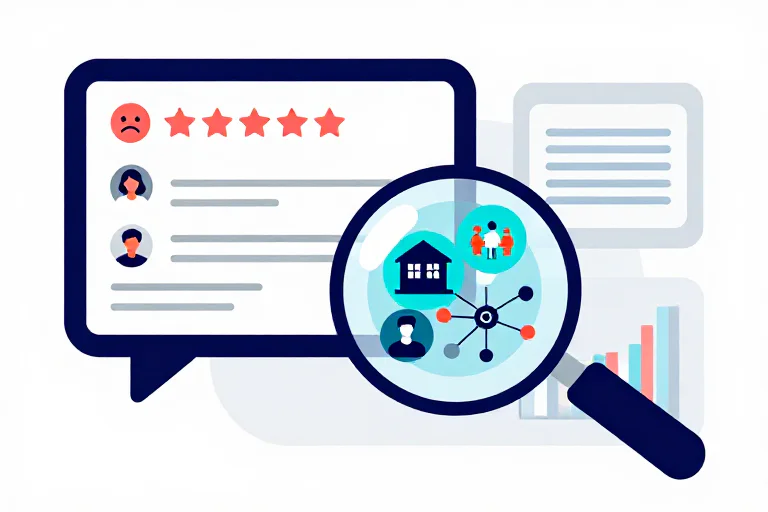
Negative reviews are often treated as evidence that something is wrong with a product. But a negative review does not automatically tell you what the problem is. The more useful question is: what happened between the customer's expectation and their actual experience?
A customer writes:
“I wouldn't buy this again.”
It sounds negative.
But what does it actually tell you?
Maybe the product stopped working after a few months.
Maybe the customer expected something different.
Maybe they used it in a situation the product was never designed for.
Maybe a competitor offers a better solution.
Maybe the product itself is fine, but the positioning created the wrong expectation.
Or maybe the customer simply had one frustrating experience that does not represent a broader product problem.
The sentence tells you that something went wrong from the customer's perspective.
It does not tell you why.
That distinction is what makes negative reviews so interesting for customer intelligence.
A Negative Review Is a Signal, Not a Diagnosis
Consider a review like:
“Too small. Very disappointed.”
A basic review analysis might classify this as:
Negative sentiment → Size problem
That is a reasonable first observation.
But it is not yet a diagnosis.
You still don't know:
- Who found it too small?
- How were they using it?
- How many people were using it?
- Where were they using it?
- What size did they expect?
- What did they need the product to accommodate?
- Did they understand the dimensions before purchasing?
- Was the product actually smaller than described?
- Did a competitor provide a better solution?
The negative review is therefore the beginning of the investigation.
A useful process is:
Negative Review
      ↓
What happened?
      ↓
Who experienced it?
      ↓
In what scenario?
      ↓
What did they expect?
      ↓
What actually happened?
      ↓
Why is there a gap?
      ↓
What should be validated?
The goal is not to make the negative review sound less negative.
The goal is to understand what it actually represents.
Negative Reviews Often Reveal Expectation Gaps
One of the most useful ways to think about negative feedback is through the idea of an expectation gap.
A customer enters a purchase with some expectation.
They then experience the product.
If the experience does not match what they expected, dissatisfaction can occur.
Conceptually:
Customer Expectation
        ↓
     Product
        ↓
Customer Experience
        ↓
Expectation Gap
        ↓
Negative Reaction
But the gap can come from different places.
For example:
The product may have a real problem
The customer expected the product to work in a particular way, and it failed to do so.
The positioning may be wrong
The product works well for one customer group, but the business presented it as suitable for another.
The usage scenario may be wrong
The product may work perfectly under its intended conditions but poorly in another situation.
The customer's expectation may be wrong
The product may accurately match its description, but the customer expected something different.
The product information may be insufficient
The customer may not have understood important limitations before purchasing.
A competitor may simply provide a better solution
The product may work adequately, but another product fits the customer's situation better.
All of these can produce a negative review.
They do not all require the same response.
“Too Small” Is Not a Product Diagnosis
Let's return to the simple example:
“It's too small.”
Suppose 143 customers make similar comments.
It would be easy to conclude:
The product should be larger.
But before changing the product, you could isolate those 143 customers and examine their scenarios.
Perhaps you discover:
| Scenario | What “too small” means |
|---|---|
| Families | Not enough capacity for shared use |
| Couples | Difficult to use together |
| Small apartments | They expected more usable space without increasing footprint |
| Individual users | Less comfortable than expected |
Now there is no single “size problem.”
There are several different customer situations producing a similar complaint.
That creates very different potential solutions.
For family users, a larger version might make sense.
For small-apartment users, simply making the product larger could actually make the product worse.
They may need a different design rather than a larger one.
This is why:
Customer scenario should come before product diagnosis.
The Same Negative Statement Can Have Different Causes
Consider another review:
“I wouldn't buy this again.”
This statement is almost useless if analyzed in isolation.
But suppose you investigate further.
Scenario A
The customer has used the product for years and simply no longer needs another one.
The negative statement may have little to do with product quality.
Scenario B
The product did not meet the customer's expectations.
Now you have an expectation problem.
Scenario C
The customer discovered that a competitor offered a better solution.
Now you have a competitive issue.
Scenario D
The customer found the product difficult to use.
Now you may have a usability problem.
Scenario E
The customer experienced a product defect.
Now there may be a genuine product problem.
The same sentence can therefore represent very different realities.
This is why customer intelligence cannot stop at sentiment classification.
Don't Confuse Complaints With Root Causes
A complaint describes the customer's experience.
A root cause explains why that experience happened.
Consider:
“It's difficult to clean.”
The complaint is clear.
But several explanations are possible:
- The product has too many difficult-to-reach areas.
- The customer uses it more frequently than expected.
- The customer expected a lower-maintenance product.
- The cleaning instructions are unclear.
- The customer's usage environment creates additional cleaning requirements.
- A competing product is significantly easier to maintain.
These possibilities require different actions.
You should therefore treat:
Complaint → possible explanation
as a hypothesis, not a fact.
This distinction becomes especially important when using AI.
How AI Can Help Investigate Negative Reviews
AI is particularly useful here because negative reviews can be analyzed in multiple rounds.
For example, imagine you have hundreds of reviews mentioning:
“Difficult to clean.”
Instead of asking AI:
“What is the problem?”
you could start with:
Round 1 — Identify the customers
Who is making this complaint?
Round 2 — Identify their scenarios
Where and how are they using the product?
Round 3 — Analyze the experience
What specifically makes cleaning difficult?
Round 4 — Analyze expectations
What did customers appear to expect before purchasing?
Round 5 — Compare groups
Do different customer scenarios experience the same problem?
Round 6 — Cross-check
Do returns, support questions, usage data, or other signals support the finding?
Round 7 — Explore opportunities
Could the problem be addressed through:
- Product design
- Product information
- Instructions
- Positioning
- A new variant
- A different target customer
This is much more useful than asking AI to generate a summary of negative reviews.
Negative Reviews Can Reveal Positioning Problems
Not every negative review means you should improve the product.
Sometimes the product is being sold to the wrong customer.
Imagine a product designed primarily for individual users.
A group of families buys it because the marketing suggests that it is suitable for everyone.
They then complain:
“It's too small.”
You could respond by redesigning the product.
But perhaps the better first question is:
Should this product actually be positioned for family use?
There may be several options:
- Keep the existing product and focus on individual users.
- Create a larger family version.
- Offer multiple sizes.
- Change the product positioning.
- Change the messaging so customers understand who it is designed for.
The negative review has therefore revealed something about product-market positioning, not necessarily a simple product defect.
Negative Reviews Can Also Reveal Expectation Problems
Suppose customers repeatedly complain:
“I thought it would be larger.”
Before changing the product, examine what customers saw before purchasing.
Did the product page clearly communicate:
- Dimensions?
- Capacity?
- Intended use?
- Recommended customer?
- Usage limitations?
If the information was clear and the product matched the description, the problem may not be the physical product.
The problem could be:
The customer's mental model did not match the product.
That might require better communication rather than product redesign.
This is particularly important because changing the product to accommodate every expectation can create unnecessary complexity.
Negative Reviews Can Reveal Competitive Problems
Another possibility is that customers are making comparisons.
A customer might say:
“It works, but I prefer another brand.”
This is not necessarily a product failure.
The customer may be telling you:
Your product is acceptable, but another product fits my situation better.
That raises different questions:
- What does the competitor do better?
- For which customer scenario?
- Is the difference important enough to affect purchasing?
- Can your product realistically close the gap?
- Should you instead target a different scenario where your product has an advantage?
This is why competitor intelligence can become an important second layer of customer analysis.
Customer feedback can tell you:
Where customers perceive a gap between your product and alternatives.
Not Every Negative Signal Deserves a Product Change
This is an important business principle.
Suppose 200 customers complain about something.
The immediate reaction might be:
“We need to fix it.”
But the correct response depends on what the complaint represents.
You should consider:
- How many customers experience it?
- Which customer groups experience it?
- How important is it to those customers?
- Does it affect actual usage?
- Does it affect returns?
- Does it affect repeat purchases?
- How much would fixing it cost?
- How much additional revenue could it create?
- Is the affected market large enough?
- Are competitors already solving it?
A customer problem is not automatically a business opportunity.
And a small customer segment is not automatically unimportant.
A small segment can be highly valuable if its customers have strong needs and high commercial value.
The point is to understand the problem before deciding whether it deserves a solution.
Negative Reviews Should Be Compared With Positive Reviews
Negative reviews are useful, but analyzing them alone can create another problem.
You may end up understanding what dissatisfied customers dislike without understanding what satisfied customers value.
Suppose some customers say:
“Too small.”
But satisfied customers repeatedly explain that:
“It fits perfectly in my small apartment.”
Now you have discovered something much more interesting.
The same physical characteristic may be:
A benefit in one scenario and a problem in another.
That suggests the product may not have a universal size problem.
It may have a customer-scenario fit problem.
This distinction can influence:
- Targeting
- Product positioning
- Product variants
- Messaging
- Customer expectations
In other words:
Negative feedback becomes more meaningful when compared with the experiences of customers who are satisfied.
Negative Reviews Can Help You Find Better-Fit Customers
This leads to another useful insight.
A negative review can sometimes tell you not only:
Who is unhappy?
but also:
Who might not be the right customer?
Imagine a product consistently performs well for:
Individual users in small spaces
but poorly for:
Large families requiring shared use.
You could interpret this in two ways.
Product perspective
The product needs improvement.
Positioning perspective
The product already fits a specific customer very well.
The second interpretation may lead to:
“We should become much better at serving the customers this product is naturally suited for.”
That can be just as valuable as changing the product.
A Better Framework for Analyzing Negative Reviews
When you encounter a significant negative pattern, work through these questions:
1. What happened?
        ↓
2. Who experienced it?
        ↓
3. In what usage scenario?
        ↓
4. What did they expect?
        ↓
5. What actually happened?
        ↓
6. What is the expectation gap?
        ↓
7. What could explain the gap?
        ↓
8. Can the explanation be validated?
        ↓
9. Is this a product, positioning,
   usage, expectation, or competitive issue?
        ↓
10. Is there a commercially meaningful
    opportunity to act?
This framework prevents a common mistake:
Jumping directly from complaint to solution.
Where AI Helps—and Where It Doesn't
AI is particularly useful for the volume and complexity of this process.
It can help you:
- Find relevant reviews
- Group similar complaints
- Identify usage scenarios
- Compare customer groups
- Detect recurring patterns
- Connect different customer signals
- Generate possible explanations
- Analyze large subsets of reviews
- Repeat the analysis with different questions
But AI should not be treated as an unquestionable source of truth.
For example, if AI concludes:
“Customers dislike the product because it is too small.”
That is an interpretation.
You should still ask:
Why did the AI reach that conclusion?
What evidence supports it?
Which customers does it apply to?
What alternative explanations exist?
Can another source validate it?
This distinction between evidence and interpretation is critical.
From Negative Review to Business Action
The final purpose of analyzing negative reviews is not to produce a better complaint report.
It is to improve your understanding of what the business should consider doing.
A negative pattern might eventually lead to:
Product improvement
Change the product itself.
Product variant
Create another size, format, or configuration.
Positioning change
Target the product toward the customer scenario where it performs best.
Messaging change
Set better expectations before purchase.
Product education
Help customers use the product correctly.
Competitive strategy
Improve the areas where competitors have a meaningful advantage.
No action
Sometimes the correct decision is to do nothing.
A problem may be too small, too expensive to solve, commercially insignificant, or restricted to a segment the business does not want to serve.
Good customer intelligence should make the decision clearer—not force the business to change something.
The Important Difference Between a Negative Review and a Product Problem
A useful mental model is:
Negative Review
      ↓
Customer Experience
      ↓
Context
      ↓
Expectation
      ↓
Gap
      ↓
Possible Cause
      ↓
Validation
      ↓
Business Interpretation
Only after this process should you ask:
“Is there actually a product problem here?”
Sometimes the answer is yes.
Sometimes it is:
A positioning problem.
Sometimes:
An expectation problem.
Sometimes:
A usage problem.
Sometimes:
A competitive problem.
And sometimes:
Nothing worth changing.
That is why negative reviews should not simply be counted.
They should be investigated.
Final Thought
A negative review is not the conclusion.
It is the beginning of a question.
“Too small.”
asks:
For whom?
In what situation?
Why does size matter?
What were they trying to accomplish?
What did they expect?
What actually happened?
And eventually:
Does this reveal something the business should act on?
AI can make this investigation dramatically more scalable.
But the goal is not to have AI tell you that customers are unhappy.
You already know that from the review.
The real value is using AI to move from:
Complaint → Context → Explanation → Validation → Opportunity
That is where a negative review becomes useful customer intelligence.
Continue exploring
What Is Customer Intelligence? A practical introduction to using customer signals, context, scenarios, and AI to support better ecommerce decisions.
How to Analyze Customer Reviews With AI A step-by-step framework for moving from raw reviews to customer scenarios, needs, and potential opportunities.
AI Review & Customer Insight Analyzer Analyze reviews, feedback, comments, and other customer text to uncover recurring signals, needs, pain points, motivations, and opportunities.