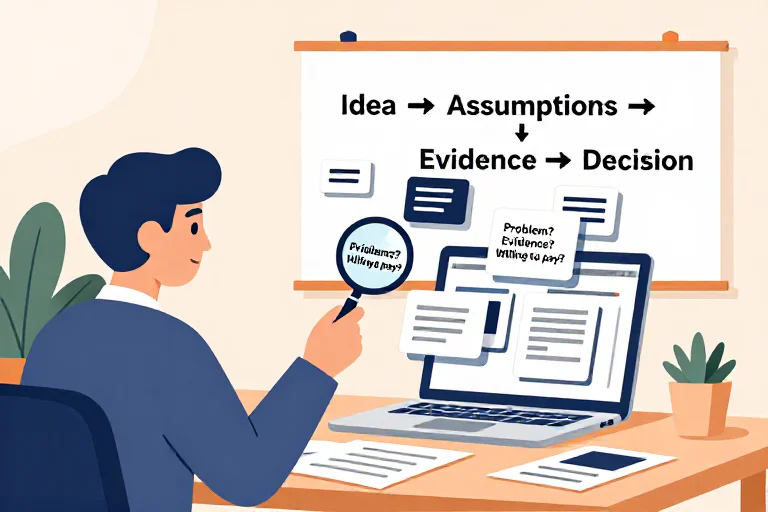
Building a product has become easier.
Coming up with product ideas has become even easier.
With AI, you can generate dozens of product concepts in minutes.
That creates a strange problem:
The cost of generating ideas has collapsed, but the cost of building the wrong idea has not.
So the important question is no longer:
“Can we come up with a product idea?”
It is:
“What evidence would justify spending more resources on this idea?”
That is what product validation should answer.
What Does Product Validation Actually Mean?
Product validation is the process of testing whether a product idea has enough evidence behind it to justify further investment.
That usually means investigating several assumptions:
- Is the problem real?
- Who experiences it?
- How often does it happen?
- How painful is it?
- What do people use today?
- Are existing alternatives good enough?
- Are customers actively looking for something better?
- Would they change behavior?
- Would they pay?
- Can the proposed solution actually solve the problem?
Validation does not mean proving:
“This product will definitely succeed.”
That is impossible before launch.
The purpose is to reduce uncertainty.
Start With the Problem
The first validation question should usually be:
Does the problem actually matter?
Not:
“Do people like my product idea?”
Those are very different questions.
Suppose the idea is:
A product that makes daily cleaning easier.
Before building it, investigate:
- Who struggles with cleaning?
- In which situations?
- How often?
- What do they currently do?
- What makes the current process difficult?
- Have they tried alternatives?
- Do they complain about it?
- Have they paid for alternatives?
The product is a proposed solution.
The problem is the starting point.
Step 1: Define the Customer Scenario
Do not validate:
“Everyone who hates cleaning.”
Define a concrete situation.
For example:
People who use this product every day and spend several minutes cleaning it after each use.
Now the research becomes measurable.
You can investigate:
- frequency
- time cost
- frustration
- workarounds
- alternatives
- willingness to change
Specific scenarios produce better evidence.
Step 2: Find Existing Evidence
Before asking people hypothetical questions, look at what they already do.
Useful evidence can include:
- customer reviews
- competitor reviews
- Reddit discussions
- product Q&A
- support conversations
- search behavior
- marketplace questions
- existing purchases
- switching stories
For example:
100 customers complaining about a problem they already paid to solve
is stronger evidence than:
100 people saying they would probably buy your idea.
Behavior and existing experience provide context that hypothetical answers often lack.
Step 3: Analyze Competitor Solutions
If the problem is real, someone may already be trying to solve it.
Study:
- competitors
- substitutes
- DIY solutions
- accessories
- services
- existing workflows
Ask:
What are customers using today?
Then:
Why isn't the current solution good enough?
This question is critical.
If customers already have a satisfactory solution, the new product needs a strong reason to exist.
For competitor research, see How to Analyze Competitor Reviews for Customer Insights.
Step 4: Identify the Gap
A potential opportunity exists when:
Customer Problem
+
Existing Solution
+
Persistent Dissatisfaction
=
Potential Gap
But this is still only a hypothesis.
You need to understand:
- who experiences the gap
- how severe it is
- whether it changes behavior
- whether alternatives exist
- whether customers are willing to pay for improvement
Step 5: Test the Most Dangerous Assumption First
Every product idea contains assumptions.
For example:
Customers have problem X.
Customers care enough about X.
Current solutions are insufficient.
Customers want solution Y.
Customers will pay $100.
We can build Y economically.
Do not test them in arbitrary order.
Ask:
Which assumption could kill the idea fastest?
If customers do not care about the problem, product design does not matter.
If customers will not pay enough, technical feasibility may not matter.
If the problem is already solved by a cheap alternative, your differentiation may not matter.
Validation should attack uncertainty.
Step 6: Separate Problem Validation From Solution Validation
These are different.
Problem validation
Do customers actually experience this problem?
Solution validation
Would this particular solution solve it?
For example:
Customers hate cleaning.
        ↓
Problem validated
        ↓
Will a self-cleaning mechanism solve it?
        ↓
Separate question
Do not treat them as one.
Step 7: Use Customer Language
If customers repeatedly describe a problem in their own words, retain those words.
They reveal:
- what they notice
- what they care about
- how they describe the problem
- what outcome they want
This is useful for both validation and later positioning.
A customer saying:
“I don't want another thing that needs maintenance.”
is very different from:
“I want a self-cleaning mechanism.”
The first describes an outcome.
The second proposes a solution.
Step 8: Look for Behavioral Evidence
The strongest signals are often actions.
Examples:
- switching products
- paying for alternatives
- buying accessories
- returning products
- abandoning purchases
- repeatedly searching for solutions
- using workarounds
- purchasing multiple competing products
Actions tell you that the problem has consequences.
That is more informative than a simple statement of interest.
Step 9: Test Willingness to Pay Carefully
Asking:
“Would you pay $100 for this?”
is weak evidence.
A better approach is to investigate:
- what customers pay today
- what alternatives cost
- whether they already spend money solving the problem
- what they consider expensive
- what makes the higher price worthwhile
For example:
Current solution:
$70

Alternative:
$100

Customers already switch to $100 products
when durability improves.
That is more meaningful than:
“80% said they would pay $100.”
Step 10: Test the Concept Before Building the Full Product
You do not always need to build the complete product.
Depending on the product, you can test:
- landing page
- prototype
- mockup
- sample
- pre-order
- waitlist
- manual service
- limited pilot
- product configuration
The appropriate test depends on the assumption being tested.
Do not build a prototype simply because prototypes feel productive.
Build the smallest test that answers the important question.
Step 11: Look for Contradictory Evidence
Good validation is not about collecting positive signals.
Search for reasons the idea may fail.
For example:
Positive:
Customers complain about maintenance.

Contradiction:
Most customers still repurchase the existing product.
That contradiction matters.
Maybe maintenance is annoying but not important enough to switch.
Or:
Positive:
Customers say they want a cheaper product.

Contradiction:
Premium products dominate the category.
Maybe price is not actually the primary decision criterion.
Contradictory evidence prevents confirmation bias.
Step 12: Define What Would Change Your Mind
Before validating, write down:
What evidence would make us stop?
For example:
Stop if:
- customers do not experience the problem frequently
- existing alternatives satisfy most customers
- the problem does not affect purchase behavior
- customers will not pay enough
- the solution has no meaningful differentiation
This makes validation a decision process rather than a search for encouragement.
AI Can Accelerate Validation Research
AI can help analyze large amounts of evidence.
For example:
Analyze this customer and competitor evidence.

Determine:

1. Which customer problems recur?
2. Which scenarios experience them?
3. What alternatives are currently used?
4. What evidence indicates dissatisfaction?
5. What evidence indicates customers are willing to change?
6. What evidence supports willingness to pay?
7. What evidence contradicts the opportunity?
8. Which assumptions remain untested?
9. Which assumption represents the greatest risk?
10. What evidence would most efficiently reduce that uncertainty?

Separate:
- direct evidence
- inference
- hypothesis
- missing evidence
That last distinction is essential.
AI should not turn weak evidence into false certainty.
A Product Validation Evidence Matrix
| Assumption | Evidence | Strength | Missing |
|---|---|---|---|
| Problem exists | Repeated reviews | Moderate | Behavioral data |
| Problem matters | Switching stories | Moderate | Larger sample |
| Current solutions fail | Competitor complaints | Moderate | Scenario segmentation |
| Customers want improvement | Search + discussions | Moderate | Purchase intent |
| Customers will pay | Existing premium purchases | Weak-moderate | Price testing |
| Solution works | Prototype test | Not yet | Real usage |
This makes uncertainty visible.
What Not to Do
Ask only friends
Friends often want to be supportive.
Ask "Would you buy this?"
Hypothetical purchase intent is not the same as behavior.
Build first
Development creates sunk-cost pressure.
Look only for positive evidence
You can validate almost anything if you ignore contradictions.
Let AI decide
AI can structure evidence.
It cannot remove commercial uncertainty.
Confuse attention with demand
People discussing a problem does not automatically mean they will pay to solve it.
A Better Validation Sequence
Product Idea
      ↓
Customer Scenario
      ↓
Problem Evidence
      ↓
Existing Alternatives
      ↓
Unresolved Gap
      ↓
Behavioral Evidence
      ↓
Economic Evidence
      ↓
Solution Hypothesis
      ↓
Smallest Useful Test
      ↓
Contradictory Evidence
      ↓
Decision
The decision can be:
continue
modify
narrow the customer
change the solution
or stop.
Stopping is also a successful result of validation if it prevents wasted resources.
Product Validation in the AI Era
AI changes the economics of product research.
It makes it cheap to:
- generate ideas
- summarize markets
- analyze reviews
- compare competitors
- create prototypes
- draft landing pages
That means these activities become less valuable as differentiators.
The scarce resource becomes:
knowing which assumptions deserve to be tested.
The advantage is not:
generating more ideas.
It is:
discarding weak ideas faster and developing stronger evidence around the ones that remain.
Related Miyeta Research
How to Find Product Opportunities From Customer Reviews →
How to Find Product Gaps From Competitor Reviews →
How to Analyze Customer Reviews With AI →
How to Use AI to Discover Hidden Customer Scenarios →
How to Choose Product Ideas When AI Creates Too Many Options →
The Miyeta Approach
Do not ask:
“Can we build this?”
Ask first:
“What would have to be true for this product to make sense, and what evidence would tell us whether those assumptions are actually true?”