Most customer feedback tells you what happened.
It doesn't always tell you where, when, or why it happened.
A customer might write:
“This is difficult to install.”
Another might say:
“I don't use it as much as I expected.”
Another:
“I bought this for my parents.”
Another:
“This works great in my apartment.”
At first glance, these look like unrelated comments.
But together, they may contain something much more valuable:
customer scenarios.
The problem is that customers rarely describe their scenarios in a neat format.
They don't write:
“I belong to customer segment B, living in an older apartment, using this product under constraint C.”
They tell stories.
They mention situations.
They complain about things.
They describe what they were trying to do.
They explain why something worked or didn't work.
That messy information is exactly where AI can be useful.
Instead of forcing customer feedback into predefined categories, you can ask AI to explore the situations hiding inside the language.
And you can do this even when you don't have a huge dataset.
A Customer Segment Is Not the Same as a Customer Scenario
This distinction is important.
Traditional customer analysis often asks:
Who are my customers?
You might end up with:
- age
- gender
- location
- income
- device
- purchase history
Those attributes can be useful.
But they don't always explain why a customer behaves differently in a particular situation.
Consider two customers.
Both are:
35 years old living in the same city with similar incomes.
But one buys a product because:
they need a quick solution before leaving for work.
The other buys the same product because:
they are setting up a new home.
Their demographic profiles may look similar.
Their needs are completely different.
This is why it can be useful to investigate:
What situation is the customer actually in?
rather than only:
What kind of person is the customer?
What Is a Customer Scenario?
A customer scenario is the combination of circumstances surrounding a customer's problem, need, or purchase.
It can include:
- what the customer is trying to accomplish
- where they are
- who they are with
- what happened immediately before
- what constraints they have
- what alternatives they considered
- what they expected
- what frustrated them
- what outcome they wanted
For example:
Customer
↓
Situation
↓
Goal
↓
Constraint
↓
Problem
↓
Emotional response
↓
Desired outcome
A customer saying:
“I don't have time to set this up every morning.”
contains much more information than simply:
“Setup is difficult.”
The first statement potentially reveals:
- a recurring use case
- a time constraint
- a daily routine
- a desired level of convenience
- an expectation about effort
That's a scenario.
Why Traditional Analysis Can Miss This
Suppose you have 500 customer reviews.
A traditional text analysis might tell you:
| Theme | Mentions |
|---|---|
| Installation | 74 |
| Price | 62 |
| Quality | 48 |
| Battery | 31 |
| Size | 25 |
Useful?
Yes.
But there is another question:
What situations are hidden inside those complaints?
Maybe the 74 installation complaints aren't one problem.
They could include:
- customers installing in older homes
- customers installing alone
- customers with limited tools
- customers expecting instant setup
- customers using the product somewhere unusual
- customers who aren't technically confident
The category:
Installation
doesn't tell you that.
The scenario does.
AI Gives You a Different Way to Read the Same Data
You don't have to start by deciding what categories exist.
Give AI the raw feedback and ask it to explore the situations represented inside it.
For example:
Analyze these customer reviews to identify recurring
customer usage scenarios.

For each scenario, identify:

1. What the customer was trying to accomplish
2. Where or when the product was being used
3. Relevant environmental conditions
4. Customer constraints
5. Problems encountered
6. Customer expectations
7. Desired outcome

Do not force every review into a scenario.

If the evidence is insufficient, mark the scenario as uncertain.

Separate explicit customer evidence from your interpretation.
This is very different from:
“Classify these reviews into categories.”
You're asking AI to discover the dimensions first.
Start Broad Before You Start Segmenting
One mistake I often see with AI customer analysis is trying to create detailed segments immediately.
For example:
“Find five customer personas.”
That sounds sophisticated.
But it can create artificial categories.
Instead, start with a much simpler question:
What situations are customers describing?
Ask AI to make a first-pass map.
For example:
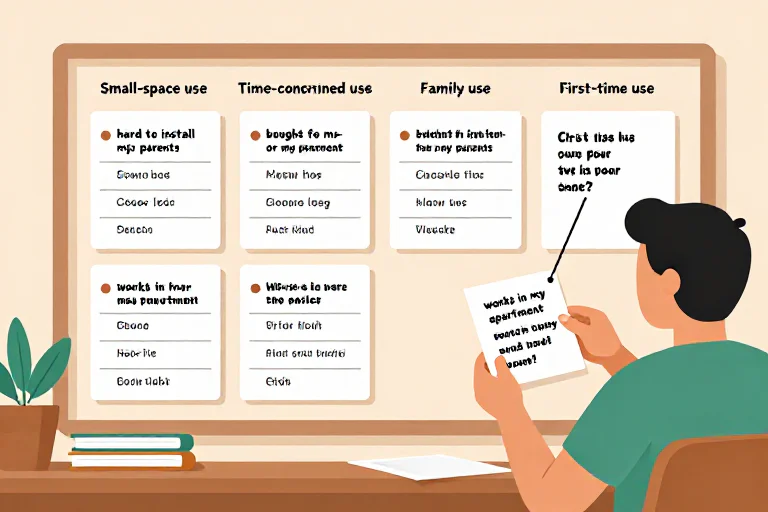
Customer feedback
│
├── Small-space use
├── Time-constrained use
├── Family use
├── Travel use
├── First-time use
├── Frequent use
└── Occasional use
You don't need to decide beforehand that these are the right categories.
Let the evidence suggest them.
Then investigate the interesting ones.
The Power of Progressive AI Analysis
This is one of the most useful ways to work with an LLM.
Don't expect one prompt to solve the entire problem.
Instead:
Broad → Narrow → Deeper → Validate
For example:
Pass 1
What scenarios appear in this feedback?
Pass 2
Which scenario appears to have the strongest recurring evidence?
Pass 3
What problems are specific to this scenario?
Pass 4
What needs appear underneath those problems?
Pass 5
What alternative explanations exist?
Pass 6
Can another source support this scenario?
This allows you to explore the data without needing to know the answer beforehand.
Example: “Difficult to Install”
Let's take a simple customer complaint:
“Installation was much harder than I expected.”
A basic analysis might produce:
Problem: difficult installation.
AI-assisted scenario analysis can go further.
Ask:
Analyze customers who mention installation difficulty.

First identify the different situations in which
installation becomes difficult.

Look for differences in:

- physical environment
- customer experience
- available tools
- whether they were installing alone
- expectations before purchase
- urgency
- intended use

Do not assume the problem has a single cause.
Suppose AI finds:
Several complaints came from customers installing the product in older homes.
Now you have a new question:
Is the product difficult to install?
Maybe.
But another possibility is:
The product is difficult to install in a particular environment.
That distinction can completely change the next investigation.
Scenario Discovery Can Reveal Positioning Problems
Imagine your product was designed for:
modern apartments.
But your customer feedback repeatedly describes:
older houses.
That's not simply a customer complaint.
It may be a market-positioning signal.
You can ask AI:
Compare the customer scenarios found in the feedback
with the intended use cases described in our product positioning.

Identify:

- scenarios that match the intended audience
- scenarios that are adjacent
- scenarios that appear unexpected
- scenarios that conflict with the current positioning

For each mismatch, show the customer evidence.
This can reveal something traditional analytics may not make obvious.
Your problem might not be:
poor conversion.
It might be:
you're attracting people with a different problem context than the product was designed around.
AI Can Connect Scenarios With Emotions
A scenario isn't only about physical circumstances.
It can also contain emotional context.
For example:
“I bought this because I was exhausted and needed something simple.”
That's not merely:
convenience.
It may reveal:
- fatigue
- low cognitive bandwidth
- urgency
- desire for simplicity
- reduced tolerance for complexity
You can ask AI:
For each recurring customer scenario,
identify the emotional context that appears in the feedback.

Look for signals such as:

- frustration
- anxiety
- urgency
- confidence
- uncertainty
- relief
- excitement
- embarrassment
- desire for control

Only identify emotional patterns when supported by
customer language.

Separate explicit emotional statements from inference.
Again, AI isn't reading minds.
It's examining language in context.
The Same Product Can Serve Completely Different Scenarios
This is where scenario analysis becomes especially interesting.
Imagine you sell a home product.
Customer A says:
“I bought this because I'm moving into my first apartment.”
Customer B says:
“I bought this because my elderly parents needed something easier to use.”
Customer C says:
“I bought this for our vacation home.”
They purchased the same product.
But their:
- motivations
- environments
- constraints
- expectations
- decision criteria
may be completely different.
If you only look at:
purchase
you miss that.
If you only look at:
demographics
you may still miss it.
If you analyze the language around the purchase, AI can help expose those differences.
Don't Create Personas Too Early
AI is very good at generating convincing personas.
That's precisely why you need to be careful.
Give an LLM 20 reviews and ask:
“Create five customer personas.”
You may get:
The Busy Professional
The Budget-Conscious Parent
The Tech-Savvy Early Adopter
The Convenience Seeker
They sound plausible.
But plausibility is not evidence.
Instead, start with scenarios.
Ask:
What situations are repeatedly represented in the data?
Then, only if the evidence supports it, investigate whether those scenarios correspond to meaningful customer groups.
This keeps your analysis grounded.
Scenario Analysis Works With Small Data
This is another reason AI is interesting for small ecommerce businesses.
Suppose you have only:
40 reviews.
You probably shouldn't claim:
“40% of our customers are this type of person.”
The sample is too small for that conclusion.
But you can still discover:
“Several customers describe the same unusual usage situation.”
That is valuable.
Because your next question can be:
Is this scenario also appearing in customer support?
Then:
Does it appear in competitor reviews?
Then:
Are people discussing the same problem on Reddit?
The small dataset becomes a starting point.
Not a statistical endpoint.
Don't Treat Every Pattern as a Market Segment
This is another important boundary.
Suppose AI finds:
three customers using the product while traveling.
That doesn't mean:
“Travelers are our new customer segment.”
It means:
Travel use appears as a possible scenario worth investigating.
Ask:
Evaluate this proposed customer scenario.

Determine:

- how many independent pieces of evidence support it
- whether the examples are meaningfully similar
- whether there are contradictory examples
- whether the scenario appears intentional or incidental
- what additional evidence would validate it
This keeps AI from turning weak signals into confident conclusions.
Use AI to Find Scenario Differences
You can also investigate why customers experience the same product differently.
For example:
Some customers love the product.
Others hate it.
Instead of simply comparing:
positive vs negative reviews
ask:
Compare customers with strongly positive and negative
experiences.

Identify differences in:

- usage scenario
- customer goal
- expectations
- environment
- frequency of use
- prior experience
- alternatives considered
- desired outcome

Which scenario differences appear to explain
the different experiences?
This can uncover something important:
The product isn't necessarily bad.
It may work extremely well in one scenario and poorly in another.
That's a much more useful discovery.
Scenario + Need Is More Powerful Than Either Alone
Once you've discovered scenarios, you can connect them with underlying needs.
For example:
Scenario:
Customer uses the product during a rushed morning routine.

        ↓

Problem:
Setup requires repeated manual adjustments.

        ↓

Need:
Low-effort operation.

        ↓

Emotional context:
Frustration with unnecessary complexity.

        ↓

Desired outcome:
Start using the product immediately without thinking about it.
Now you've moved from:
“Customers complain about setup.”
to:
“A particular customer scenario appears to create a strong need for low-effort operation.”
That's Customer Intelligence.
Scenario Discovery Can Also Reveal New Product Opportunities
Suppose you discover:
Customers are repeatedly using your product in a situation you never designed for.
That's interesting.
Ask AI:
Based on the customer scenarios identified,
look for situations where customers appear to be
solving a problem that the product was not explicitly
positioned to solve.

For each opportunity:

- describe the scenario
- explain the customer need
- show supporting evidence
- identify limitations
- explain what additional evidence is needed

Do not recommend building a new product yet.
You may discover:
an adjacent use case.
Or:
a different customer need.
Or:
a completely different product opportunity.
The important thing is that you found it from the customers themselves.
You Can Apply the Same Process to Competitors
This method isn't limited to your own reviews.
You can collect publicly available competitor customer feedback and ask AI to identify:
- competitor usage scenarios
- customer problems
- unmet needs
- complaints
- expectations
- alternative products
- emotional responses
Then compare them.
For example:
Compare customer scenarios found in our reviews
with scenarios found in competitor reviews.

Identify:

- shared scenarios
- scenarios unique to us
- scenarios unique to competitors
- unmet needs
- differences in customer expectations
- areas where competitors appear vulnerable
Now scenario analysis becomes part of Competitor Intelligence.
The question changes from:
“What features does competitor X have?”
to:
“Which customer situations does competitor X serve well or poorly?”
That's much more useful.
You Can Also Use Social Media as Scenario Evidence
Reviews tell you about customers who bought.
Social discussions can tell you about people who:
- haven't bought yet
- are considering alternatives
- are frustrated with existing solutions
- are searching for solutions
- are describing problems before purchasing
That makes social data particularly interesting.
Suppose your reviews show:
customers struggle with installation.
You can search public discussions for:
installation problems
Then ask AI:
Compare these public discussions with our customer reviews.

Identify whether similar customer scenarios appear
in both sources.

Do not assume that similarity means the same market segment.

Explain:

- shared situations
- different situations
- shared needs
- different needs
- contradictions
Now you're not simply mining reviews.
You're connecting different pieces of customer evidence.
Cross-Validation Is More Important Than Data Volume
Imagine:
100 reviews
say:
“Installation is difficult.”
You know the complaint is common.
But you may still not know why.
Now imagine:
15 reviews
mention installation problems,
and:
8 support conversations
describe the same issue,
and:
several public discussions
describe the same environmental constraint.
The second situation can be more informative.
Why?
Because different sources are pointing toward the same scenario.
This is why AI-assisted Customer Intelligence should not simply become:
“Feed more data into the model.”
The better question is:
“Can this interpretation survive different sources and different perspectives?”
Ask AI to Tell You What It Cannot Know
This is one of the most useful prompts you can use.
Based on this customer scenario analysis:

1. What do we know with reasonable confidence?
2. What is strongly suggested?
3. What is only a hypothesis?
4. What evidence is missing?
5. What could make our interpretation wrong?
6. What should we investigate next?
This forces the model to acknowledge uncertainty.
And it keeps you from turning AI output into fake certainty.
A Better Way to Think About AI Customer Research
You don't need to tell AI:
“Find the five most important customer segments.”
You can instead start with:
“Show me what I haven't noticed.”
Then progressively investigate.
For example:
Raw feedback
      ↓
What is happening?
      ↓
What situations appear?
      ↓
Which situation is interesting?
      ↓
What is different about it?
      ↓
What need exists inside it?
      ↓
What explains that need?
      ↓
Can another source validate it?
      ↓
What should I investigate next?
This is much closer to how you would work with a human researcher.
The difference is that AI dramatically reduces the cost of each iteration.
You Don't Need to Become a Data Analyst
This is one of the most important opportunities for small ecommerce teams.
You don't necessarily need to learn:
- advanced NLP
- clustering algorithms
- sentiment models
- vector databases
- complex statistical segmentation
Those technologies can be useful for specific applications.
But if your immediate goal is:
understand what customers are telling you
you can start much more simply.
Give an LLM the evidence.
Define what you want to investigate.
Ask it to explore.
Challenge the result.
Bring in another source.
Then decide.
The difficult part isn't typing a prompt.
The difficult part is knowing:
what question to ask next.
AI Doesn't Replace Customer Judgment
This is the boundary that should never disappear.
AI can identify:
a possible scenario.
It can explain:
why the scenario might matter.
It can find:
evidence supporting the interpretation.
It can identify:
contradictory evidence.
It can suggest:
what to investigate next.
But it cannot decide:
“This is definitely your market.”
That remains a human decision.
The model doesn't know your margins.
It doesn't know your operational constraints.
It doesn't know your strategic priorities.
It doesn't carry the consequences of a bad decision.
AI provides intelligence.
You make the decision.
A Simple Workflow You Can Use Today
If you have customer reviews sitting in a spreadsheet, CSV, support inbox, or document, try this.
1. Give AI the raw feedback
Don't over-process it.
2. Ask for scenario discovery
What situations are customers describing?
3. Select an interesting scenario
Don't investigate everything.
Pick something surprising or commercially important.
4. Go deeper
Ask:
What is happening inside this scenario?
5. Connect it to needs
Ask:
What is this customer actually trying to accomplish?
6. Explore the psychology
Ask:
What concerns, motivations, or emotions appear relevant?
7. Challenge the interpretation
Ask:
What else could explain this?
8. Cross-check another source
Use support, social discussions, competitor feedback, surveys, or other evidence.
9. Make the decision yourself
Decide whether the insight deserves action.
The Bigger Opportunity
The interesting thing about AI isn't that it can summarize 1,000 reviews in a few minutes.
That's useful, but relatively obvious.
The bigger opportunity is that you can repeatedly ask new questions of the same messy customer evidence.
You can ask:
What problems appear?
Then:
What scenarios produce those problems?
Then:
What needs exist inside those scenarios?
Then:
What psychological factors might explain those needs?
Then:
Which scenarios are different from our intended audience?
Then:
Which scenarios appear in competitor feedback?
Then:
What opportunities might exist?
The data didn't change.
Your questions did.
And AI lets you explore those questions at a cost that would previously have been difficult for a small ecommerce team to justify.
Final Thought
Customer data doesn't always tell you who your customer is.
Sometimes it tells you:
what your customer was trying to do.
That's often more useful.
A customer doesn't experience your product as a row in a database.
They experience it:
on a rushed morning,
in an old apartment,
while traveling,
with a child nearby,
while trying to solve an urgent problem,
after trying three alternatives,
or while worrying that they made the wrong purchase.
Those situations shape what the customer values.
They shape what frustrates them.
They shape what they are willing to pay for.
And they shape whether your product actually fits their life.
AI can help you uncover those situations from the messy language customers already leave behind.
You don't need to know the scenarios beforehand.
You don't need to build a perfect segmentation model.
You don't even need a huge dataset to begin.
You need customer evidence and better questions.
The opportunity isn't to make AI tell you who your customers are.
It's to use AI to discover the situations your customers are actually living in.
Frequently Asked Questions
What is customer scenario analysis?
Customer scenario analysis examines the situations surrounding a customer's problem, purchase, or product usage. It can include the customer's goal, environment, constraints, expectations, problems, and desired outcome.
How can AI identify customer usage scenarios?
AI can analyze unstructured customer feedback and look for recurring combinations of context, goals, problems, expectations, and environmental conditions. The resulting scenarios should be treated as evidence-based hypotheses rather than automatically validated customer segments.
Can AI find customer scenarios from reviews?
Yes. Reviews often contain information about how, where, and why customers use a product. AI can extract and connect these contextual signals even when customers do not explicitly describe them as “scenarios.”
Do I need thousands of reviews for AI customer research?
No. Small datasets can reveal useful early scenarios and hypotheses. They are not necessarily large enough to establish statistical representativeness, but they can help determine what deserves further investigation.
Should I create customer personas before analyzing reviews?
Usually not. Starting with predefined personas can cause AI to force customers into categories that aren't actually supported by the evidence. It is often better to discover recurring scenarios first and investigate customer groups afterward.
Can AI discover new product opportunities from customer scenarios?
AI can help identify unexpected usage situations, recurring unmet needs, and problems that existing products don't appear to solve well. These are opportunities for investigation, not automatic proof that a new product should be built.
How do you validate an AI-generated customer scenario?
Compare the scenario with independent sources such as customer support conversations, surveys, public discussions, social media, or competitor feedback. Look for both supporting and contradictory evidence.
What is the difference between customer segmentation and scenario analysis?
Customer segmentation primarily asks who the customer is. Scenario analysis asks what situation the customer is in and what they are trying to accomplish. The two approaches can complement each other, but they answer different questions.
The Miyeta Approach
Don't begin with:
“What are my customer segments?”
Start with:
“What situations are hidden inside the customer evidence I already have?”
Then investigate:
Scenario → Context → Need → Motivation → Alternative explanations → Cross-validation → Human decision
That's where AI becomes more than a review summarizer.
It becomes a low-cost way to investigate customer intelligence that small ecommerce teams previously had little time or budget to explore.