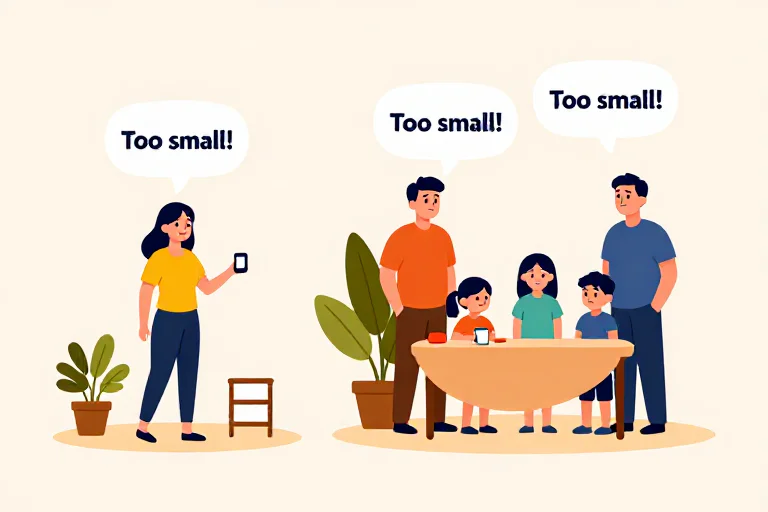
Two customers can make exactly the same complaint and mean completely different things.
One customer says:
“It's too small.”
Another says:
“It's too small.”
The words are identical.
The customer problems may not be.
One may live in a small apartment and actually love the compact size.
Another may be buying the product for a family and need more capacity.
Another may have misunderstood the dimensions before purchasing.
Another may be comparing the product with a larger competitor.
Another may be complaining because the product didn't match the image they expected.
If you analyze these comments only as:
Size complaint
you've removed most of the useful information.
This is one of the biggest problems with customer feedback analysis.
The words are easy to classify.
The meaning is much harder.
A Customer Complaint Exists Inside a Situation
Customer feedback doesn't happen in a vacuum.
A useful way to think about it is:
Customer
    ↓
Situation
    ↓
Goal
    ↓
Expectation
    ↓
Product experience
    ↓
Reaction
    ↓
Complaint
The complaint is the final expression.
The earlier parts of the chain often explain what it actually means.
For example:
Small apartment
    ↓
Need to save space
    ↓
Expects compact product
    ↓
Product fits perfectly
    ↓
“I wish it were bigger”
At first glance:
Negative size feedback.
But the customer may still be satisfied overall.
Now compare:
Large family
    ↓
Needs shared capacity
    ↓
Expects product to fit everyone
    ↓
Product capacity is insufficient
    ↓
“It's too small”
Same words.
Different problem.
Why Simple Theme Analysis Can Mislead You
Imagine 1,000 reviews produce:
Size: 180 mentions
Price: 150 mentions
Quality: 120 mentions
Shipping: 90 mentions
This looks useful.
But the category:
Size
could contain several completely different experiences.
For example:
- too small for family use
- small enough for apartment use
- smaller than expected
- larger than expected
- difficult to store
- dimensions unclear
- size is ideal for travel
Counting mentions hides these differences.
The category tells you:
What customers talked about.
It doesn't tell you:
Why they talked about it.
Theme Is Not Meaning
This distinction is fundamental.
A theme answers:
What is being discussed?
Meaning asks:
What does this issue represent in this customer's situation?
For example:
Theme
Price
Possible meanings
- unaffordable
- poor perceived value
- competitor is cheaper
- customer doesn't understand differentiation
- customer doesn't trust the product
- customer expected more
- customer is highly price-sensitive
The word is the same.
The business problem is not.
The Same Complaint Can Reveal Different Needs
Consider:
“Difficult to clean.”
One customer may mean:
“I use this every day and need something extremely quick to clean.”
Another:
“I have children, so food gets stuck in the corners.”
Another:
“I expected the product to be dishwasher safe.”
Another:
“The product is easy to clean, but the instructions are unclear.”
The complaint:
Difficult to clean
is only the beginning.
The useful question is:
What made cleaning difficult in this customer's situation?
Context Changes the Meaning
Customer context can include:
- where the product is used
- who uses it
- how often it is used
- what the customer is trying to accomplish
- what constraints exist
- what alternatives are available
- what the customer expected
- what happened before purchase
- what happened after purchase
You don't need every possible variable.
You need the variables that actually matter to the question.
For example, if you're investigating:
Why do customers complain about size?
then:
- household size
- room size
- storage constraints
- intended use
may matter more than:
- age
- gender
- location
Context should follow the business question.
AI Is Good at Finding These Hidden Differences
This is one of the more interesting uses of AI customer analysis.
Suppose you give AI 3,000 reviews.
Instead of:
“Group these reviews by topic.”
ask:
Find recurring customer situations inside these reviews.

For each situation, identify:

- what the customer was trying to accomplish
- relevant constraints
- what they expected
- what happened
- what complaint or reaction resulted
- what need appears to be behind the complaint

Pay special attention to cases where customers
use similar language but appear to have different situations.
Now AI isn't just classifying language.
It is looking for differences in context.
Don't Force Every Complaint Into One Explanation
Suppose AI finds:
“Many customers complain about installation.”
There is a temptation to conclude:
Installation is the problem.
Instead, ask:
Are these actually the same installation problem?
You may discover:
Scenario A:
Customer installs alone

Scenario B:
Customer has no specialized tools

Scenario C:
Customer expects five-minute installation

Scenario D:
Customer installs in an unusual environment

Scenario E:
Instructions are unclear
Now you have five possible problems.
The original category:
Installation
was hiding them.
This Matters for Product Decisions
Imagine a business sees:
18% of negative reviews mention size.
The obvious response might be:
Make the product larger.
That could be a mistake.
What if:
- 60% of those complaints come from one unusual customer scenario
- most customers actually value the compact size
- making the product larger would damage its primary use case
The aggregate number alone doesn't tell you what to do.
You need to understand:
Who wants what, and why?
The Same Attribute Can Be Positive and Negative
This is particularly important.
Take:
Small.
For one customer:
“Small enough to fit my apartment.”
Positive.
For another:
“Too small for my family.”
Negative.
The attribute didn't change.
The customer's situation did.
The same applies to:
- weight
- speed
- complexity
- capacity
- price
- durability
- firmness
- size
- automation
- customization
An attribute isn't automatically good or bad.
Its value depends on the customer's goal.
This Is Why Customer Segmentation Alone Isn't Enough
Segmentation asks:
Who is the customer?
Scenario analysis asks:
What situation is the customer in?
These are related but different.
Two customers can belong to the same demographic segment and have completely different needs.
And two customers from different demographic segments can share the same situation.
For many ecommerce problems, the second distinction can be more useful.
Customer Scenarios Can Be Discovered From Messy Language
Customers rarely write:
“My use case is scenario B.”
They tell stories.
For example:
“I bought this because I was moving into a smaller apartment.”
Or:
“I needed something my parents could use.”
Or:
“I take this with me when traveling.”
Those statements contain scenario information.
AI can extract it.
The challenge is not merely finding the words.
It's connecting:
Situation
    ↓
Goal
    ↓
Constraint
    ↓
Need
    ↓
Product expectation
    ↓
Experience
    ↓
Reaction
A Better Customer Feedback Workflow
If the goal is to understand a recurring complaint, use several rounds.
Round 1 — Find the surface pattern
What are customers saying?
Round 2 — Find contexts
What situations are represented?
Round 3 — Separate scenarios
Which customers appear to have different circumstances?
Round 4 — Find the underlying need
What is each group trying to accomplish?
Round 5 — Find the friction
What makes that difficult?
Round 6 — Compare outcomes
Which groups:
- buy
- abandon
- return
- complain
- repurchase
Round 7 — Cross-check
Does another source support the interpretation?
Round 8 — Decide
Which findings actually matter to the business?
This prevents the analysis from stopping at:
“Customers complain about X.”
Contradictory Feedback Is Often Valuable
Suppose you see:
“Too small.”
and:
“Perfect size.”
You might think the reviews are inconsistent.
Maybe.
But another possibility is that you're looking at multiple customer scenarios.
For example:
Small apartment:
Perfect size

Large family:
Too small
The contradiction is telling you something.
There may not be one universal customer preference.
There may be different jobs the product is being hired to perform.
That is much more interesting.
AI Should Surface Contradictions, Not Remove Them
This is one place where I think AI analysis can easily go wrong.
A model may try to summarize conflicting feedback into:
“Customers have mixed opinions about size.”
That's technically true.
But it's not very useful.
A better analysis asks:
Who thinks it's too small?
Who thinks it's the right size?
What situations do they represent?
What outcomes are they trying to achieve?
The disagreement may contain the insight.
The Goal Is Not to Find the “Real” Customer
Another common mistake is trying to identify:
The average customer.
But averages can hide meaningful differences.
Suppose:
Group A:
Needs compactness

Group B:
Needs capacity

Group C:
Needs portability
There may be no single answer to:
What size should the product be?
The business may need to decide which scenario it wants to prioritize.
That's a business decision.
AI can help reveal the scenarios.
It shouldn't make the strategic decision for you.
Cross-Validation Makes the Interpretation Stronger
Suppose AI identifies:
Small-apartment customers value compactness.
Look for supporting evidence.
Reviews
Do customers explicitly mention apartment constraints?
Product questions
Do shoppers ask about dimensions?
Search behavior
Are people searching for the product in apartment-related contexts?
Sales
Does this group convert differently?
Competitors
Are competing products positioned around compact living?
No individual signal has to prove the entire conclusion.
The value comes from seeing whether independent evidence points in a similar direction.
This Is Where AI Customer Intelligence Becomes More Than Sentiment Analysis
Sentiment tells you:
Positive or negative.
Themes tell you:
What customers are talking about.
Context tells you:
What situation they are in.
Needs tell you:
What they are trying to accomplish.
Friction tells you:
What makes that difficult.
And behavior helps answer:
What happened as a result?
A useful customer analysis can therefore look like:
Feedback
   ↓
Theme
   ↓
Context
   ↓
Scenario
   ↓
Need
   ↓
Friction
   ↓
Behavior
   ↓
Business implication
That is much richer than:
Positive: 72%
Negative: 18%
Neutral: 10%
The Right Question Is Usually One Level Deeper
Instead of:
“Why are customers complaining about size?”
ask:
“Which customers are complaining about size, in what situations, and what are they trying to accomplish?”
Instead of:
“Why do customers think we're expensive?”
ask:
“What does the price represent in the customer's purchase decision?”
Instead of:
“Why is installation difficult?”
ask:
“For which customers, in which environments, does installation become difficult?”
Instead of:
“Why don't customers like the product?”
ask:
“What expectation did the product fail to meet, and for whom?”
The deeper question usually produces more useful evidence.
You Don't Always Need More Data
This is an important consequence.
If you have:
500 reviews
you may not need another 50,000 reviews.
You may simply need to ask a better question of the 500 you already have.
AI makes this particularly practical because it can repeatedly examine the same evidence from different analytical angles.
For example:
First:
Find recurring complaints.
Then:
Find the customer scenarios behind those complaints.
Then:
Compare scenarios where the same complaint has different meanings.
Then:
Identify which scenarios are associated with purchase failure.
Then:
Cross-check the finding against another source.
The data didn't change.
The investigation did.
The Business Decision Still Comes Last
Suppose you discover:
Small-apartment customers love the compact size.
and:
Large-family customers dislike the limited capacity.
AI can reveal that trade-off.
But AI doesn't need to decide:
Make the product larger.
Maybe the business should:
- keep the existing product
- create another variant
- target one scenario more clearly
- change positioning
- improve product information
Those are strategic decisions.
The job of customer intelligence is to make the decision better informed.
Don't Flatten Customers Into Categories
This is ultimately the problem I'm trying to avoid.
A customer isn't just:
positive
or:
negative.
They aren't just:
price-sensitive.
They aren't just:
dissatisfied.
They aren't even just:
customer segment A.
They are people making decisions inside particular situations.
The same product attribute can create value in one situation and friction in another.
The same complaint can represent different underlying needs.
And the same customer can value the same feature differently depending on what they are trying to accomplish.
That's why context matters.
The Miyeta Framework
When analyzing customer feedback, I would move through:
What did they say?
        ↓
What are they talking about?
        ↓
What situation are they in?
        ↓
What are they trying to accomplish?
        ↓
What did they expect?
        ↓
What happened?
        ↓
Why did that matter?
        ↓
What did they do?
        ↓
What evidence supports this interpretation?
        ↓
What should the business investigate next?
AI can help with much of the evidence processing.
But the framework matters.
And the final business judgment remains human.
The Same Words Don't Always Mean the Same Problem
This is why I don't think good customer intelligence is simply about extracting more themes.
It is about preserving meaning.
If ten customers say:
“Too expensive.”
don't collapse them into:
Price problem.
Ask what “too expensive” means in each situation.
If ten customers say:
“Too small.”
don't immediately conclude:
Need a larger product.
Ask who needs more capacity, who values compactness, and who simply misunderstood the dimensions.
If ten customers say:
“Difficult to use.”
don't assume there is one usability problem.
Find the situations behind it.
The deeper you go, the more the customer language starts to make sense.
And that is where AI becomes useful.
Not because it can magically understand customers.
But because it can help you investigate a large amount of messy customer evidence without flattening everything into a few generic categories.
Related Research
- How to Use AI to Discover Hidden Customer Scenarios From Customer Feedback
- How to Discover Hidden Customer Needs From Reviews Using AI
- How to Find Customer Pain Points With AI From Reviews, Feedback, and Support Messages
- AI Customer Feedback Analysis: What to Extract and Why It Matters
- What Do Negative Reviews Really Tell You About Your Customers?
The Miyeta Approach
Don't flatten customer language into categories too early.
The same words can describe different situations, different needs, and different business problems.
The job of customer intelligence is to understand the difference.