AI can analyze thousands of customer reviews in seconds.
But that is not the interesting part.
The interesting question is:
What can AI actually learn from those reviews that can help an ecommerce business make a better decision?
The answer is more than:
- positive sentiment
- negative sentiment
- common keywords
- frequently mentioned features
- a summary of what customers said
Those outputs can be useful.
But customer reviews contain much richer information.
A review can reveal:
- what situation the customer is in
- what they were trying to accomplish
- what they expected
- what surprised them
- what frustrated them
- what created value
- what created doubt
- what alternatives they considered
- what they would change
- what language they naturally use
- what purchase concerns existed before the purchase
The challenge is that these signals are mixed together inside natural language.
AI can help separate them.
That is where customer review analysis becomes customer intelligence.
Customer Reviews Contain More Than Opinions
A review often looks like a simple opinion.
For example:
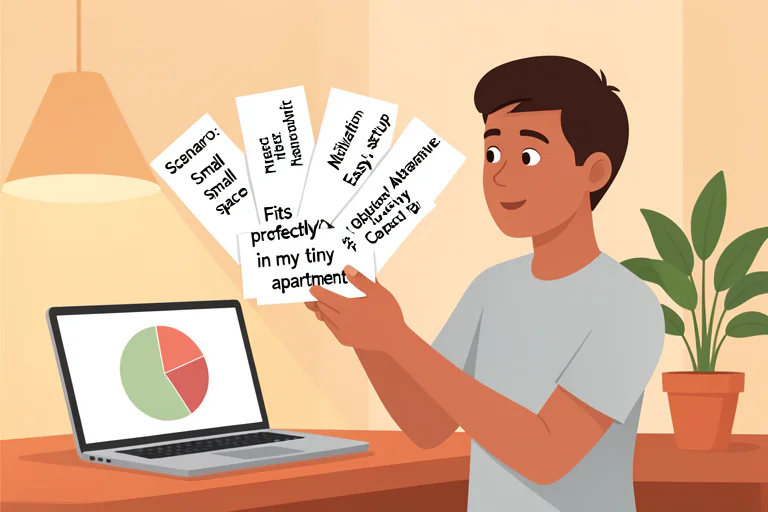
“I love this chair. It fits perfectly in my tiny apartment and looks much better than the other chairs I considered.”
At first glance, it is simply positive feedback.
But there are several signals inside it.
Customer scenario
Small apartment.
Customer goal
Find a chair that fits a limited space.
Positive experience
Product works well in that environment.
Aesthetic preference
Appearance matters.
Competitive evidence
The customer considered alternatives.
Decision criterion
Fit and appearance both mattered.
That is much more useful than:
Positive review.
AI's value is not only that it can read the sentence.
It is that it can help identify all of these layers across thousands of similar reviews.
What Can AI Learn From Customer Reviews?
There is no single answer.
Different levels of analysis reveal different types of customer intelligence.
A useful framework is:
Review
  ↓
Language
  ↓
Signals
  ↓
Context
  ↓
Customer Scenario
  ↓
Needs / Motivations / Objections
  ↓
Patterns
  ↓
Hypotheses
  ↓
Decision
The first layers are closer to observation.
The later layers involve interpretation.
That distinction matters.
AI is very good at processing and organizing evidence.
The further the analysis moves toward:
“What should the business do?”
the more validation becomes important.
1. AI Can Learn Customer Language
One of the simplest but most valuable things AI can identify is the language customers naturally use.
Customers may describe a product very differently from the way a company describes it.
A brand might say:
ergonomic workspace solution
Customers might say:
comfortable enough to sit in all day
Those are not equivalent expressions.
Customer language can reveal:
- how customers describe problems
- which words they use for desired outcomes
- what benefits they care about
- what objections they express
- how they compare alternatives
- how they describe successful outcomes
This can influence:
- product positioning
- product-page copy
- marketing messaging
- customer support
- product research
The important distinction is:
Customer language is evidence of how customers understand the problem.
It is not just a source of copywriting keywords.
2. AI Can Identify Customer Scenarios
A review often contains a hidden situation.
For example:
“We bought this because our living room is small and needed something that could fit without making the space feel crowded.”
The important information is not simply:
“Customer likes compact design.”
The deeper scenario is:
A customer with limited space needs functionality without making the room feel visually crowded.
That scenario may appear repeatedly across different reviews.
AI can help identify those recurring patterns.
A customer scenario may include:
- who the customer is
- where they use the product
- what they are trying to accomplish
- what constraints they face
- what they are comparing
- what outcome they want
This can be more useful than demographic segmentation.
3. AI Can Identify Customer Needs
Customers do not always state needs directly.
They often describe symptoms.
For example:
“I hate cleaning this every night.”
The explicit complaint is:
cleaning
The underlying need might be:
reduce daily maintenance effort.
Another customer might say:
“It took me forever to figure out how to install it.”
The deeper need may be:
get the product working quickly without uncertainty.
Another:
“I wasn't sure whether it would fit.”
The deeper need may be:
confidence that the product is suitable before buying.
AI can help connect these statements to recurring needs.
But the interpretation should remain a hypothesis until supported by enough evidence.
4. AI Can Identify Customer Motivations
Reviews are not only complaints.
They can reveal why customers value the product.
For example:
“I bought this because I wanted my kids to be able to use it without my help.”
That reveals a motivation around:
- independence
- convenience
- household usability
Another customer may say:
“I finally stopped worrying about it breaking.”
That may reveal:
- reliability
- risk reduction
- peace of mind
Another may say:
“It makes my home look much more organized.”
The product may therefore be delivering:
- functional value
- aesthetic value
- psychological value
AI can help identify recurring motivations across large datasets.
5. AI Can Identify Expectations
Expectations are particularly important because they often explain dissatisfaction.
Consider:
“I expected it to feel more premium for the price.”
The customer is not simply saying:
quality is bad.
They are describing an expectation gap.
A useful AI analysis can investigate:
Customer Expectation
       ↓
Actual Experience
       ↓
Expectation Gap
       ↓
Customer Reaction
This can reveal whether the underlying issue may involve:
- product quality
- positioning
- product-page communication
- pricing
- customer fit
- expectation setting
Expectation analysis is therefore much more useful than simply counting negative reviews.
6. AI Can Identify Objections
Some reviews reveal what made the customer hesitant before purchase.
For example:
“I almost bought the cheaper version because I wasn't sure the extra features were worth it.”
That contains:
- comparison behavior
- price sensitivity
- uncertainty
- perceived-value questions
- competitive alternatives
Another customer may say:
“I was nervous because I had never heard of the brand.”
That reveals a potential trust issue.
Another:
“I wasn't sure this would work with my setup.”
That reveals a fit or compatibility concern.
These are important because they connect post-purchase feedback with the earlier buying decision.
7. AI Can Identify Purchase Blockers
A customer review can also reveal the kind of uncertainty that may block a future shopper.
For example:
“I almost didn't buy because I couldn't tell whether it would fit.”
That could indicate:
fit uncertainty
Another:
“I was worried the quality wouldn't justify the price.”
Potential:
value / risk uncertainty
Another:
“I wasn't sure what was included.”
Potential:
clarity blocker
These findings can be connected with AI Shopper research.
That creates a useful loop:
Post-Purchase Review
      ↓
Customer Evidence
      ↓
Potential Buying Concern
      ↓
AI Shopper Investigation
      ↓
Purchase Blocker Hypothesis
The review does not prove that every future shopper has the same blocker.
It reveals a customer signal worth investigating.
8. AI Can Identify Alternatives and Competitive Choices
Customers often reveal their alternatives without being explicitly asked.
For example:
“I compared this with Brand B and Brand C before deciding.”
Or:
“I originally planned to buy Brand B but changed my mind because…”
This is valuable competitive evidence.
AI can extract:
- competitors mentioned
- reasons for comparison
- reasons for choosing
- reasons for rejecting
- specific features customers compared
- differences customers considered meaningful
This can help answer:
Why do customers choose this product instead of another one?
Or:
Why do some customers choose the competitor instead?
That is customer intelligence and competitor intelligence overlapping.
9. AI Can Identify Product Gaps
A review can reveal that the current product does not fully solve the customer's problem.
For example:
“I love the product, but I wish it had a way to…”
One request is not necessarily a product opportunity.
But suppose similar customers repeatedly describe:
- the same workaround
- the same missing function
- the same frustration
- the same desired outcome
Now the signal becomes more interesting.
AI can help group those statements.
The process becomes:
Individual Request
      ↓
Similar Requests
      ↓
Shared Customer Scenario
      ↓
Underlying Need
      ↓
Recurring Pattern
      ↓
Opportunity Hypothesis
The important word is:
hypothesis.
A recurring customer request is not automatically a good product opportunity.
You still need to examine:
- size of the affected segment
- severity
- willingness to pay
- competition
- feasibility
- business fit
10. AI Can Identify Customer Segments by Situation
Demographic segments are sometimes useful.
But reviews can reveal a different kind of segmentation.
For example:
Small-space customers
Need:
functionality without taking up too much space.
Families
Need:
shared usability and capacity.
First-time buyers
Need:
confidence and explanation.
Professional users
Need:
reliability and performance.
Replacement buyers
Need:
improvement over the product they already own.
These groups may not differ dramatically in age or location.
They differ in decision context.
That can be more useful for ecommerce decisions.
11. AI Can Identify Differences Between Customer Groups
Once customer scenarios are identified, AI can compare them.
For example:
| Scenario | Main value | Main concern |
|---|---|---|
| Small-space users | Fit | Capacity |
| Families | Shared use | Size |
| First-time buyers | Ease of use | Trust |
| Repeat buyers | Reliability | Price |
| Comparison shoppers | Features | Differentiation |
Now the business has something much more useful than:
82% positive sentiment.
It can see:
different customers are creating value and experiencing friction for different reasons.
That can affect:
- positioning
- product variants
- customer targeting
- website information
- marketing
- product decisions
12. AI Can Find Contradictions
This is an underrated capability.
Suppose one customer says:
“Very easy to install.”
Another says:
“Installation was incredibly difficult.”
A simple sentiment analysis sees:
- positive
- negative
A deeper AI investigation asks:
What is different between these customers?
Maybe:
- one had prior experience
- one used a different configuration
- one received better instructions
- one had a different installation environment
- one product batch changed
- the instructions were confusing only for a specific variant
Contradictions are not noise.
They can reveal customer context.
This is one of the areas where AI can help move customer research beyond simple averages.
13. AI Can Identify Changes Over Time
Customer reviews are not static.
Customer expectations can change.
The competitive market can change.
The product can change.
A problem that was minor six months ago may become more important today.
AI can compare review patterns across time.
For example:
Month 1
Few shipping complaints

↓

Month 3
More shipping concerns

↓

Month 5
Repeated delivery expectations

↓

Investigation
What changed?
The AI should not automatically conclude:
Delivery quality declined.
Instead, it can surface:
A meaningful shift worth investigating.
Then the business can compare:
- logistics changes
- customer mix
- competitors
- delivery promises
- seasonal effects
- product changes
Time-based customer intelligence turns reviews into an ongoing market signal.
14. AI Can Identify Language Differences Between Products
Suppose two competing products solve a similar problem.
Customers might describe them differently.
Product A:
“simple”
“easy”
“straightforward”
Product B:
“powerful”
“professional”
“advanced”
Those words may reveal different perceived positions.
AI can help identify these language differences.
The goal is not merely to count words.
It is to understand:
How do customers mentally position each product?
This can support competitive research.
15. AI Can Identify What Customers Do Not Say Directly
Some useful customer signals are implied.
For example:
“I ended up using it every morning before work.”
The customer never says:
“This product saves me time in my morning routine.”
But the behavior implies it.
Another:
“My daughter now uses it without asking me for help.”
That may imply:
increased independence.
Another:
“We stopped using our old product entirely.”
That may imply:
meaningful substitution.
AI can help surface these implicit signals.
But again, implicit meaning should be treated carefully.
The model is interpreting language.
The interpretation needs evidence.
16. AI Can Compare Customer Expectations With Customer Experience
This is particularly useful for products where the buying promise is important.
For example:
Expected
“Easy to assemble.”
Experienced
“Took me two hours.”
Now there may be an expectation gap.
Or:
Expected
“Premium materials.”
Experienced
“Feels cheaper than expected.”
Again:
expectation → experience → gap
This can reveal problems that pure sentiment analysis cannot explain.
17. AI Can Connect Reviews to Business Decisions
The ultimate purpose of extracting all these signals is not to create a more detailed review dashboard.
It is to answer:
What decision could this evidence improve?
For example:
Customer reviews
Customers repeatedly struggle with product fit.
↓
Customer intelligence
Specific customer scenario identified.
↓
Business decision
Improve product-fit information or investigate a product variant.
Customer reviews
Customers repeatedly compare the product with a competitor.
↓
Competitive customer intelligence
Specific competitor advantage identified.
↓
Business decision
Investigate positioning or product differentiation.
Customer reviews
Customers repeatedly mention an unexpected setup problem.
↓
Customer intelligence
Expectation mismatch identified.
↓
Business decision
Improve onboarding or product-page expectations.
Customer reviews
Customers repeatedly ask the same pre-purchase question.
↓
Customer intelligence
Information gap identified.
↓
Business decision
Improve decision-support content.
The review becomes valuable because it connects to a decision.
What AI Cannot Reliably Learn From Reviews Alone
This is equally important.
AI can learn a lot from customer reviews.
But there are things reviews cannot reliably answer by themselves.
True market size
A review dataset does not necessarily represent the whole market.
Willingness to pay
Customers saying:
“I'd pay $50.”
does not guarantee actual purchase behavior at $50.
Causality
A correlation in review language does not prove a cause.
Missing customers
People who never purchased may be invisible.
People who never review are invisible.
Customers who silently leave may be invisible.
Future demand
Existing reviews describe existing experiences.
They do not automatically prove future demand.
Reviews are evidence.
They are not the entire market.
AI Should Distinguish Three Layers
A strong review analysis should separate:
What customers explicitly said
Direct evidence.
What the evidence may mean
Interpretation.
What the business might do
Decision hypothesis.
For example:
Evidence
“I wish this came in a smaller size.”
Interpretation
Some customers may have a space constraint.
Decision hypothesis
Investigate whether a smaller version is commercially meaningful.
Do not collapse those into:
Customers want a smaller product.
The final statement is stronger than the evidence.
A Practical AI Review-Analysis Framework
A useful analysis can follow this structure:
1. Collect
Customer reviews and related evidence

2. Extract
Language, topics, scenarios, experiences

3. Understand
Needs, motivations, expectations, objections

4. Compare
Customer groups, products, competitors, time periods

5. Challenge
Contradictions and alternative explanations

6. Validate
Cross-check important patterns with other evidence

7. Connect
Map findings to ecommerce decisions

8. Decide
Determine what deserves action, testing, or more research
AI can help with most of the analytical work.
Humans still own the final judgment.
What Makes an AI Review Insight Useful?
A useful insight should answer at least four questions:
What happened?
What did customers actually say or describe?
Who experienced it?
Which customer situation or group is involved?
Why might it matter?
What need, friction, expectation, or motivation might be underneath it?
What decision could it affect?
Why should the business care?
If an AI output cannot answer these questions, it may simply be a summary.
Not an insight.
Example: Turning a Review Into Customer Intelligence
Consider:
“I bought this because I live in a tiny apartment. It looks great, but I wish the storage area were a little bigger.”
A simple AI analysis might output:
Positive review. Customer likes the appearance but wants more storage.
That is not wrong.
But it misses the larger picture.
A deeper analysis might produce:
Customer scenario
Small-space home.
Purchase motivation
Need to improve storage.
Positive value
Visual fit and appearance.
Friction
Storage capacity.
Customer tension
The customer wants more functionality without sacrificing space efficiency.
Potential underlying need
More usable storage without increasing the product footprint.
Evidence status
Potential pattern if repeated across similar customers.
Business implication
Investigate whether small-space customers represent a meaningful product opportunity.
That is much closer to customer intelligence.
Review Analysis Can Become a Research System
Once AI can repeatedly perform this type of investigation, customer reviews stop being something the marketing team checks occasionally.
They can become an ongoing research source.
For example:
New Reviews
      ↓
AI Analysis
      ↓
New Patterns
      ↓
Changes in Customer Scenarios
      ↓
Emerging Needs
      ↓
Research Questions
      ↓
Product / Customer / Competitive Decision
This creates a continuous customer-learning loop.
That is much more valuable than a monthly sentiment report.
The Most Valuable Question Is Often “What Changed?”
A static review analysis can tell you what customers say.
A continuous system can ask:
What is different from last month?
For example:
- new complaints
- changing expectations
- emerging customer segments
- new competitors
- new use cases
- new product gaps
- different customer language
- shifts in perceived value
This can help ecommerce teams identify changes before they become obvious in high-level business metrics.
Customer Reviews Can Become an Early Signal
Suppose conversion has not changed yet.
But customer reviews suddenly start mentioning:
“I expected…”
or:
“Compared with…”
or:
“I wish…”
That may signal a change in customer expectations.
It does not prove that conversion will decline.
But it can create an early investigation opportunity.
This is where AI customer intelligence becomes more interesting than retrospective analytics.
The system does not only explain:
What happened?
It can help identify:
What may be changing?
AI Review Analysis Should Be Connected to Other Customer Evidence
Reviews are powerful.
They become even more valuable when combined with:
- support conversations
- product questions
- return reasons
- surveys
- customer interviews
- competitor reviews
- website behavior
- purchasing behavior
For example:
Reviews
      +
Support
      +
Competitor Reviews
      +
Product Questions
      ↓
AI Investigation
      ↓
Customer Scenario
      ↓
Need / Objection / Expectation
      ↓
Decision
That is the broader customer-intelligence system.
Reviews are one major input.
They are not the entire system.
What AI Can Actually Learn
The most useful answer is therefore not:
“AI can understand your customers.”
That is too broad.
AI can help investigate specific, evidence-backed layers of customer understanding, such as:
- customer language
- customer scenarios
- needs
- motivations
- expectations
- objections
- purchase concerns
- product experiences
- competitive preferences
- recurring complaints
- desired outcomes
- product gaps
- differences between customer groups
- emerging patterns
- changing customer expectations
The farther the analysis moves toward:
“What should the company do?”
the more evidence and validation it needs.
The Miyeta Model
A useful way to think about AI review intelligence is:
Customer Review
      ↓
Signal
      ↓
Context
      ↓
Scenario
      ↓
Need / Motivation / Objection
      ↓
Pattern
      ↓
Evidence
      ↓
Hypothesis
      ↓
Decision
AI can accelerate the movement through this chain.
It cannot remove the need for evidence.
And it should not hide uncertainty.
Final Thought
The value of AI customer review analysis is not that AI can read thousands of reviews.
Humans can read reviews too.
The real value is that AI can make it much easier to ask deeper questions of a large body of customer evidence.
Instead of:
What are customers saying?
you can ask:
What situations are customers in?
What are they trying to accomplish?
What do they value?
What frustrates them?
What did they expect?
What alternatives are they considering?
Why do they hesitate?
What changed over time?
Which patterns appear across different sources?
What decision could this evidence improve?
That is a much richer form of customer research.
And it points toward the larger role AI can play in ecommerce:
not just summarizing customer feedback, but helping businesses investigate customers deeply enough to make better decisions.
Continue Exploring
AI Customer Intelligence for Ecommerce
AI for Ecommerce Decision Making
How to Analyze Customer Reviews With AI
Why Sentiment Analysis Isn't Enough for Ecommerce Customer Intelligence