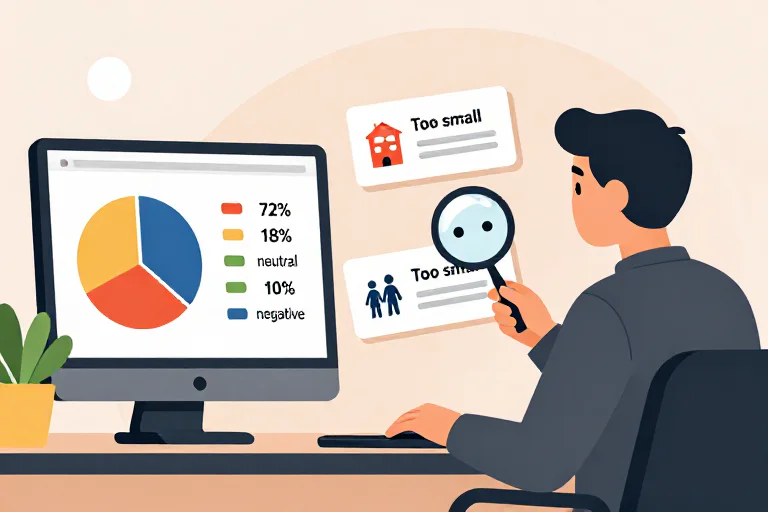
Sentiment analysis is one of the easiest ways to use AI on customer feedback.
Take thousands of reviews.
Ask AI to classify them as:
- positive
- neutral
- negative
Then report:
72% positive 18% neutral 10% negative
That can be useful.
But it is not customer intelligence.
It tells you how customers expressed themselves.
It does not necessarily explain:
- why they feel that way
- what situation they were in
- what they expected
- what they were trying to accomplish
- whether the issue affected the buying decision
- whether the same issue matters to other customers
- what the business should investigate next
This distinction becomes particularly important when ecommerce teams start using AI to understand customers.
Sentiment is a signal. It is not an explanation.
What Sentiment Analysis Actually Tells You
At its simplest, sentiment analysis answers:
Is the customer's language positive, negative, or neutral?
That can be useful for quickly understanding the overall tone of a dataset.
For example:
“The chair looks beautiful and feels very solid.”
Likely positive.
“The chair arrived damaged and the packaging was terrible.”
Likely negative.
“It is okay for the price.”
Likely neutral or mixed.
This type of classification can help with:
- monitoring feedback
- identifying negative reviews
- comparing products
- spotting changes in overall customer reaction
- prioritizing content for deeper analysis
The problem begins when sentiment is treated as the final answer.
A negative statement is not automatically a problem.
A positive statement is not automatically evidence of strong customer value.
And a neutral statement may contain the most useful information of all.
Negative Sentiment Does Not Tell You the Cause
Consider this review:
“I expected more for the price.”
Sentiment analysis can identify:
Negative.
But the business still does not know why.
Several explanations are possible:
- the product quality was lower than expected
- the product did not solve the customer's problem well enough
- the customer compared it with a cheaper competitor
- the customer expected more features
- the brand did not communicate the value clearly
- the customer was not the right fit
- the product page created an unrealistic expectation
These possibilities can lead to completely different decisions.
A price reduction might be appropriate in one case.
Better positioning might be appropriate in another.
A product change might be appropriate in a third.
Customer research is needed to distinguish them.
Positive Sentiment Does Not Tell You Why Customers Buy
The same problem exists with positive feedback.
Consider:
“Love this product.”
A sentiment model sees:
Positive.
But the business still needs to know:
Why?
Maybe the customer:
- loves the design
- loves the convenience
- loves the performance
- loves how the product fits a specific situation
- loves the product because it solved a problem no competitor solved
These are very different forms of value.
A business that only tracks positive sentiment misses the difference.
Suppose 1,000 customers say:
“Love it.”
That is encouraging.
But what if 700 of them actually value one specific feature?
That feature may be much more strategically important than the generic positive sentiment suggests.
The useful insight is not:
Customers are happy.
It is:
Which customer outcome is creating that positive reaction?
The Same Sentiment Can Mean Different Things
Consider three customers who all leave negative feedback.
Customer A
“Too expensive for something I would only use occasionally.”
Possible issue:
Low perceived value relative to usage.
Customer B
“Too expensive compared with the other brands I was considering.”
Possible issue:
Weak differentiation.
Customer C
“Too expensive for a brand I've never purchased from before.”
Possible issue:
Trust and purchase risk.
All three are negative.
All three mention price.
But the underlying customer problem is different.
That means a sentiment label collapses information that matters.
The useful analysis happens after the sentiment classification.
Sentiment Is Not the Same as Customer Need
This is an important distinction.
A customer can express a negative sentiment while revealing a valuable need.
For example:
“I hate how much time I spend cleaning this.”
The sentiment is negative.
But the underlying need may be:
Spend less time maintaining the product.
That is much more useful for product research.
Another customer might say:
“The setup was frustrating.”
The underlying need may be:
Get the product working quickly without uncertainty.
Another might say:
“I was worried this wouldn't fit.”
The underlying need may be:
Confidence that the product fits their situation before purchase.
The sentiment tells you how the customer experienced the situation.
The need explains what the customer actually cares about.
Sentiment Is Not the Same as a Purchase Blocker
This distinction is even more important for ecommerce.
Imagine a shopper writes:
“The product looks fantastic, but I can't tell whether it will fit my apartment.”
The sentiment may be strongly positive.
But the customer still has a potential purchase blocker.
The issue is not dissatisfaction.
It is uncertainty.
That means:
A positive customer can still be blocked from purchasing.
This is why relying only on positive/negative classifications can be dangerous for ecommerce.
Buying decisions depend on:
- relevance
- value
- trust
- risk
- fit
- information
- alternatives
- confidence
Sentiment is only one signal inside that decision.
A Customer Can Be Positive and Still Leave
Consider:
“I really like this product, but I decided to buy another one.”
Sentiment:
Positive.
Outcome:
No purchase.
If the ecommerce team only tracks sentiment, the analysis may conclude:
Customers like the product.
That is true.
But it misses the more important question:
Why did customers who liked the product choose something else?
Perhaps:
- a competitor was cheaper
- another product fit better
- shipping was faster
- the competitor had stronger proof
- the product lacked an important feature
- the customer trusted another brand more
This is why customer intelligence needs to connect sentiment with decision context.
A Customer Can Be Negative and Still Buy
The reverse is also possible.
Consider:
“Assembly was annoying, but this is still the best product I've found.”
Sentiment:
Negative or mixed.
Outcome:
Purchase.
If you optimize only for sentiment, you might treat assembly as a major product problem.
But the customer still believes the overall value is strong.
That does not mean the issue should be ignored.
It means the business needs to understand its actual impact.
The right question becomes:
Does the negative experience materially affect the customer decision?
That is more useful than:
Is the review positive or negative?
Sentiment Can Hide Customer Context
Consider these two reviews:
“Too small.”
“Perfect size for my small apartment.”
Both contain:
small
But the customer meaning is opposite.
Now consider:
“Expensive.”
and:
“Expensive, but worth every penny.”
The first may represent a value objection.
The second may represent strong perceived value despite a high price.
Natural customer language is contextual.
AI can analyze that context.
But the analytical framework needs to ask for it.
What Should AI Analyze Beyond Sentiment?
A stronger AI customer-intelligence workflow can investigate several layers.
1. Sentiment
How does the customer appear to feel?
Useful as an initial signal.
2. Customer Scenario
What situation is the customer in?
For example:
- small apartment
- family use
- professional use
- first-time buyer
- replacement purchase
3. Goal
What is the customer trying to accomplish?
4. Experience
What happened?
5. Expectation
What did the customer expect?
6. Friction
What made the experience harder?
7. Motivation
What created value?
8. Objection
What created hesitation?
9. Alternative
What else did the customer consider?
10. Business Implication
What decision could this evidence potentially affect?
This is the difference between:
sentiment analysis
and:
customer intelligence.
A Better Customer Feedback Model
Instead of:
Customer Feedback
      ↓
Sentiment
      ↓
Positive / Negative
use:
Customer Feedback
      ↓
Sentiment
      ↓
Customer Scenario
      ↓
Goal / Need
      ↓
Expectation
      ↓
Experience
      ↓
Friction / Motivation
      ↓
Buying Implication
      ↓
Business Decision
Sentiment remains part of the analysis.
It simply stops being the endpoint.
Why Context Matters More Than Sentiment Alone
Imagine an ecommerce team discovers:
15% of reviews are negative.
That statistic is difficult to act on.
Now imagine the analysis discovers:
Most negative reviews come from first-time buyers who expected the product to include an accessory that was not included.
That is much more actionable.
The possible decision could involve:
- product-page clarity
- packaging information
- expectation setting
- offer structure
Not necessarily product redesign.
The difference comes from context.
AI Is Particularly Useful for Context Extraction
This is where AI can add substantial value.
Humans can read a review and understand context.
But doing this across thousands of reviews is expensive.
AI can help identify:
- customer situations
- use cases
- expectations
- goals
- objections
- reasons for dissatisfaction
- reasons for satisfaction
- customer language
- competing alternatives
For example, given:
“I bought this because we have almost no storage space in our apartment. It looks great, but I wish it had a little more capacity.”
AI could potentially extract:
Customer scenario:
Small apartment

Goal:
Improve storage

Positive signal:
Design / appearance

Negative signal:
Limited capacity

Underlying tension:
Space efficiency vs capacity

Potential need:
More usable capacity without increasing footprint
That is far more informative than:
Sentiment: mixed.
AI Should Separate Observation From Interpretation
This becomes critical here.
Suppose AI outputs:
“Customers want a larger product.”
That may be an interpretation.
The evidence might actually be:
“Too small for my family.”
Those are different.
A good system should preserve the layers:
Observation
Customer says the product is too small for their family.
Context
Shared household use.
Interpretation
Capacity may be insufficient for family scenarios.
Hypothesis
There may be demand for a higher-capacity configuration.
Validation
Check whether similar family-use customers report the same issue and whether they represent a meaningful segment.
Decision
Investigate a larger configuration.
The AI should not silently collapse all six steps into:
“Build a bigger product.”
Sentiment Can Be Useful for Prioritization
This does not mean sentiment analysis is useless.
It can be very useful as an initial filter.
For example:
Find all strongly negative reviews mentioning delivery.
Then analyze those reviews more deeply.
Or:
Compare sentiment patterns across two products.
Or:
Identify where sentiment around a product attribute changed over time.
Sentiment can therefore answer:
Where should we investigate?
It is much weaker at answering:
Why is this happening?
That distinction is important.
Sentiment Can Help Detect Change
One particularly useful application is monitoring changes.
Suppose:
Product quality sentiment has gradually declined over three months.
That is a useful signal.
But the next step is not:
“Quality has declined.”
The next step is:
What changed in the customer experience?
AI can then investigate:
- new complaints
- new customer scenarios
- product changes
- supplier changes
- expectation changes
- competitor alternatives
- changes in usage
Sentiment becomes an alert.
Customer intelligence becomes the investigation.
Sentiment Across Products Can Also Be Misleading
Suppose:
Product A: 88% positive
Product B: 76% positive
It might look like Product A is clearly better.
But consider:
Product A has a simple use case and low purchase risk.
Product B is more complex and expensive.
Customers may have much higher expectations for B.
The raw sentiment percentages are not directly comparable without context.
This is another reason why customer scenarios and product context matter.
AI can help segment the evidence before comparison.
Competitor Analysis Needs More Than Sentiment Too
Suppose competitor reviews are:
85% positive.
That tells you the competitor has satisfied customers.
It does not tell you:
Why?
Maybe customers like:
- faster delivery
- better product fit
- simpler setup
- stronger durability
- clearer product information
- better customer support
- better value
Now imagine your product also has:
85% positive sentiment.
The two businesses could still win for completely different reasons.
The useful competitive question is:
What creates positive customer experiences for each competitor, and which customer situations explain the differences?
That is competitive customer intelligence.
The AI Prompt Should Not Stop at Sentiment
Instead of:
“Analyze the sentiment of these reviews.”
a better prompt is:
Analyze these customer reviews.

For each meaningful customer signal:

1. Classify the overall sentiment.
2. Identify the customer scenario.
3. Identify what the customer was trying to accomplish.
4. Identify the experience or problem described.
5. Identify the customer's expectation, if stated or strongly supported.
6. Identify the motivation, objection, or friction.
7. Identify any competitor or alternative mentioned.
8. Separate direct evidence from interpretation.
9. Explain what business decision this evidence might affect.
10. Identify what additional evidence would be needed before acting.

Do not treat sentiment as the explanation.

Do not convert a complaint directly into a product recommendation.
The prompt forces the model to go beyond:
positive / negative / neutral.
A Better Review Analysis Output
Instead of this:
| Sentiment | Count |
|---|---|
| Positive | 7,200 |
| Neutral | 1,800 |
| Negative | 1,000 |
you can build:
| Customer scenario | Signal | Possible meaning | Evidence strength |
|---|---|---|---|
| Small-space users | Size concern | Capacity / fit tension | High |
| First-time buyers | Price concern | Low trust or value uncertainty | Medium |
| Frequent users | Strong praise | High functional value | High |
| Comparison shoppers | Competitor praise | Differentiation gap | Medium |
| Family users | Setup complaints | Complexity in shared use | Medium |
Now the analysis begins to support decisions.
Sentiment Is a Starting Point, Not a Strategy
The most important distinction is:
Sentiment tells you the direction of the reaction. Customer intelligence investigates the reason behind the reaction.
That matters because ecommerce decisions are rarely:
“Customers feel negative.”
They are more like:
“Customers in this situation are uncertain about this aspect of the purchase.”
or:
“Customers who use the product this way see strong value, while another customer scenario does not.”
Those statements are much closer to something a business can act on.
From Sentiment to Customer Intelligence
The evolution can be thought of as:
Sentiment
   ↓
Signal
   ↓
Context
   ↓
Customer Need / Objection
   ↓
Evidence
   ↓
Hypothesis
   ↓
Decision
The farther the analysis moves down this chain, the more useful it becomes for ecommerce decision-making.
Sentiment remains useful.
It simply becomes one component of a larger system.
From Customer Intelligence to Decision Intelligence
There is an even bigger implication.
The ultimate purpose of understanding sentiment is not to create a better sentiment dashboard.
It is to understand:
What does this customer signal mean for a decision?
For example:
Negative sentiment
Could lead to:
Investigate product quality.
Positive sentiment
Could lead to:
Understand the specific value driver.
Mixed sentiment
Could lead to:
Investigate the customer scenario causing the difference.
Changing sentiment
Could lead to:
Investigate what changed in the customer experience.
The action depends on the context.
That is why customer intelligence should sit between customer evidence and business decision-making.
What AI Changes
AI makes it possible to move beyond simple sentiment classification across much larger amounts of customer evidence.
It can help:
- detect sentiment
- identify scenarios
- extract customer language
- compare groups
- connect related statements
- investigate potential causes
- identify contradictions
- generate hypotheses
- retrieve supporting evidence
But it should not automatically turn:
sentiment
into:
business decision.
The evidence still needs context.
The interpretation still needs validation.
The business still needs judgment.
A Practical Miyeta Framework
Miyeta's approach can be summarized as:
Customer Statement
      ↓
Sentiment
      ↓
Context
      ↓
Customer Scenario
      ↓
Need / Motivation / Objection
      ↓
Evidence
      ↓
Hypothesis
      ↓
Business Decision
Or more simply:
Sentiment tells you how the customer reacted. Context helps explain why. Evidence helps determine whether the explanation is credible. The decision determines what matters.
That is the difference between sentiment analysis and customer intelligence.
Final Thought
Sentiment analysis is attractive because it is simple.
It turns messy customer language into three clean categories:
positive
neutral
negative
But customers do not make ecommerce decisions using three categories.
They make decisions based on:
- needs
- context
- expectations
- trust
- value
- alternatives
- risk
- relevance
- experience
- timing
AI can help investigate these factors at a scale that traditional manual analysis cannot easily match.
But only if the analysis moves beyond sentiment.
So the useful question is not:
“Are customers positive or negative?”
It is:
“What is happening in the customer's situation, why might they be reacting this way, what evidence supports that interpretation, and what could it mean for the next ecommerce decision?”
That is where sentiment becomes customer intelligence.
And that is where AI becomes much more useful than a simple sentiment classifier.
Continue Exploring
AI Customer Intelligence for Ecommerce
AI for Ecommerce Decision Making
How AI Is Changing Ecommerce Customer Research
AI Customer Research vs Traditional Customer Research