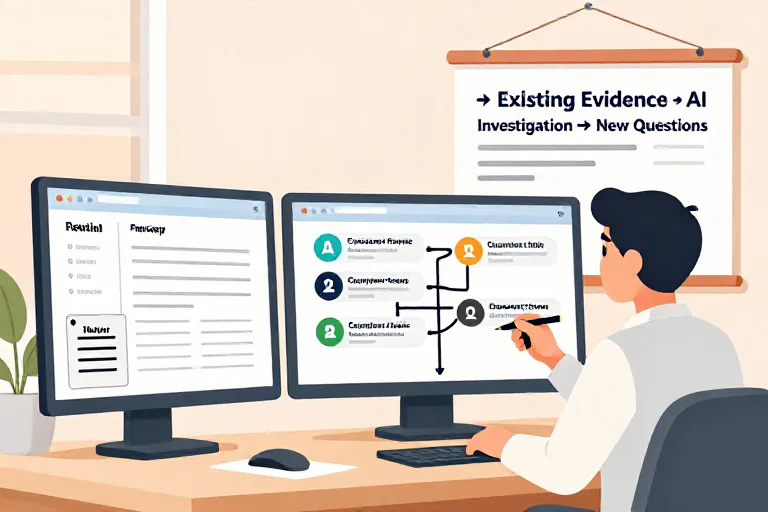
AI is changing customer research.
But that does not mean traditional customer research is becoming obsolete.
Surveys still matter.
Interviews still matter.
Focus groups still matter.
Usability research still matters.
Direct conversations with customers still matter.
The bigger change is that AI makes it possible to investigate a much larger amount of customer evidence, much more frequently, and from many more sources.
That creates a different research model.
The question is no longer:
“Will AI replace traditional customer research?”
A more useful question is:
“Which parts of customer research change when AI can continuously investigate customer evidence?”
For ecommerce, that distinction matters.
Because ecommerce businesses are already generating customer evidence every day.
The challenge is turning that evidence into useful understanding before an important decision needs to be made.
Traditional Customer Research Still Has an Important Role
Traditional research methods exist for good reasons.
A structured interview allows a researcher to ask follow-up questions.
A survey can collect standardized responses from a defined population.
A usability study can observe a participant trying to complete a task.
A focus group can reveal how people react to ideas in a social setting.
A properly designed research project can produce evidence that is difficult to obtain from passive customer data.
These methods should not be dismissed simply because AI can analyze text.
AI cannot automatically create the same kind of evidence as talking to a real customer.
An AI model can analyze what a customer previously said.
An interview can reveal something the customer has never written anywhere.
That distinction remains important.
Where Traditional Research Can Become Difficult for Ecommerce
The problem is not that traditional research is bad.
It is that ecommerce creates more customer evidence than a research team can continuously investigate using traditional methods alone.
A growing ecommerce company may have:
- thousands of product reviews
- support conversations every day
- customer questions
- return reasons
- search behavior
- competitor reviews
- product feedback
- customer comments
- purchase behavior
A formal research project might investigate one specific question.
But there may be dozens of other questions hiding inside the evidence.
For example:
Why do customers hesitate?
Why do some customers love the product while others dislike it?
Which customer scenarios create the most friction?
Why do customers choose a competitor?
What new expectations are appearing?
Which complaints are becoming more common?
It is difficult to launch a complete research project for every question.
AI changes the economics of investigating these smaller questions.
The Fundamental Difference
A useful way to compare the two approaches is:
Traditional research
Design a study to collect evidence for a question.
AI-assisted customer research
Investigate existing customer evidence to answer many questions continuously.
These are not replacements for each other.
They are different research modes.
One is designed around evidence collection.
The other is particularly powerful for evidence investigation.
Traditional Research Starts With Designed Evidence
Imagine you want to understand whether customers would use a new product feature.
A traditional research project might:
- Define the target customer.
- Design interview questions.
- Recruit participants.
- Conduct interviews.
- Analyze responses.
- Identify patterns.
- Form conclusions.
This is useful because the research team controls the questions and participants.
The evidence is intentionally collected.
That can be extremely valuable when the business needs information it does not already have.
For example:
“Would you pay for this?”
There may be no existing customer evidence that answers this directly.
You may need to ask.
AI cannot magically obtain that missing evidence.
AI Research Often Starts With Existing Evidence
Now consider a different question:
“What are customers already saying about this problem?”
The business may already have:
- reviews
- support tickets
- customer questions
- emails
- competitor reviews
- product feedback
The evidence exists.
The problem is analysis.
AI is particularly useful here.
It can help:
- retrieve relevant examples
- classify responses
- identify recurring scenarios
- compare customer groups
- extract patterns
- connect related statements
- investigate possible explanations
- compare multiple products
- identify contradictions
This creates a different starting point.
Instead of:
Question
↓
Collect New Evidence
↓
Analyze
you can have:
Question
↓
Existing Customer Evidence
↓
AI Investigation
↓
Interpretation
↓
Validation
AI Is Especially Good at Unstructured Customer Evidence
A lot of ecommerce customer evidence is unstructured.
Customers do not answer research questions neatly.
They write:
“I bought this for my daughter's room because we don't have much space, and it works better than I expected.”
That sentence may contain:
- customer context
- product use case
- space constraint
- expected outcome
- product evaluation
A survey might never ask the customer to describe that exact scenario.
A review simply contains it.
AI can help identify thousands of similar scenarios.
This creates a valuable research capability:
discovering patterns in evidence that was not originally collected for the current research question.
That is one of the strongest differences between AI-assisted analysis and traditional research.
But Existing Evidence Has a Major Limitation
There is a reason researchers still conduct interviews and surveys.
Existing evidence reflects what customers happened to say or do.
It does not necessarily tell you everything you need to know.
Suppose customers frequently mention:
“Too expensive.”
You can investigate what they mean.
You might discover:
- weak perceived value
- competitor comparison
- low trust
- low urgency
- customer fit
- expectation mismatch
But you may still not know:
“What price would make this customer comfortable buying?”
That question may require direct research.
This is where traditional research remains valuable.
AI can analyze what exists.
It cannot automatically create trustworthy evidence for questions that the existing evidence does not answer.
The Difference Between Observation and Inquiry
This is a useful way to separate the two models.
Traditional research is often inquiry-driven
You ask:
What do customers think about this?
Then collect evidence specifically for that question.
AI-assisted research is often evidence-driven
You have customer evidence already.
Then ask:
What can we learn from it?
Neither approach is inherently superior.
They answer different types of questions.
The most useful ecommerce research system combines both.
Traditional Research Is Strong at Creating New Evidence
Use direct research when the business needs information that does not exist.
Examples:
Testing a new concept
Would customers understand this product idea?
Testing willingness to pay
What price range feels acceptable?
Understanding a new market
What problems do people in this segment actually experience?
Exploring a new behavior
Why do people who have never bought this type of product avoid it?
Validating a hypothesis
We believe customers want X. Is that actually true?
These questions often require asking customers directly.
AI cannot replace that evidence.
It can help design, analyze, and synthesize the research.
AI-Assisted Research Is Strong at Investigating Existing Evidence
Use AI when the business already has large amounts of customer evidence.
Examples:
Customer reviews
What customer scenarios repeatedly appear?
Support conversations
What questions indicate unresolved customer uncertainty?
Competitor reviews
Why do customers prefer the competitor?
Product feedback
Which problems appear repeatedly across customer situations?
Existing research
What patterns appear across multiple research projects?
Mixed evidence
Do reviews, support conversations, and customer questions point toward the same issue?
These tasks can become much faster with AI.
AI Can Make Research More Continuous
Traditional research is often project-based.
A project starts.
The research is conducted.
The report is delivered.
The project ends.
AI makes another model possible:
Customer Evidence
      ↓
AI Investigation
      ↓
Emerging Pattern
      ↓
Research Question
      ↓
Validation
      ↓
Business Decision
      ↓
New Customer Evidence
      ↺
The research process does not necessarily end.
New customer evidence can trigger new questions.
This is particularly relevant to ecommerce because customer evidence is generated continuously.
The Researcher Becomes More of an Investigation Designer
AI changes the work of the person doing customer research.
The human no longer needs to spend as much time manually processing every piece of evidence.
Instead, more attention can move toward:
- defining research questions
- setting analytical context
- deciding what counts as evidence
- designing investigation frameworks
- identifying competing explanations
- evaluating uncertainty
- determining what needs direct validation
That is a different role.
The researcher becomes less focused on manually reading every line.
And more focused on:
designing how the evidence should be investigated.
This is one of the most important changes AI can bring to customer intelligence.
AI Does Not Remove Sampling Problems
There is another important limitation.
A model can analyze 100,000 reviews.
That does not mean the findings automatically represent all customers.
Reviews may overrepresent:
- highly satisfied customers
- highly dissatisfied customers
- unusually motivated customers
- specific markets
- specific product variants
- customers willing to write reviews
The same problem can happen with support conversations.
The evidence is large.
It can still be biased.
Scale does not automatically create representativeness.
This is why AI-assisted customer research still needs to ask:
Who is represented by this evidence?
And:
Who might be missing?
AI Also Does Not Solve Causality
Suppose AI finds:
Customers who mention shipping delays are more likely to leave negative reviews.
That is useful.
But it does not automatically prove:
Shipping delays caused the negative experience.
There may be other factors.
For example:
- the product itself was late
- expectations were already low
- a particular customer segment had more problems
- the same logistics issue affected product quality
AI can identify relationships.
Researchers still need to consider alternative explanations.
This is another reason traditional research and controlled experiments remain important.
AI Should Make Research More Rigorous, Not Less
There is a temptation to use AI because it feels fast.
But speed can create another problem:
conclusions are produced before the evidence has been challenged.
A strong AI-assisted research process should therefore make these distinctions visible:
Observed
What did customers actually say or do?

↓

Interpreted
What might that evidence mean?

↓

Hypothesized
What explanation should be investigated?

↓

Validated
What additional evidence supports or challenges it?

↓

Decided
What should the business do?
This is more important than whether the analysis was performed by a person or a model.
The research process needs to preserve the difference between:
evidence
and:
interpretation.
AI Can Also Improve Traditional Research
The relationship does not have to be:
Traditional research versus AI.
AI can support traditional research at almost every stage.
For example:
Before research
AI can help:
- summarize existing evidence
- identify gaps
- find recurring customer language
- generate interview hypotheses
- identify segments worth studying
During research
AI can help:
- organize interview notes
- retrieve supporting evidence
- identify recurring themes
- compare participants
- surface contradictions
After research
AI can help:
- synthesize findings
- compare new evidence with historical evidence
- identify unresolved questions
- connect findings with existing customer signals
The result is not:
AI replaces research.
It becomes:
AI expands the research process.
A Hybrid Research Model
The most useful model for ecommerce is often hybrid.
Existing Customer Evidence
        ↓
AI Investigation
        ↓
Initial Pattern
        ↓
Research Gap
        ↓
Traditional Research
        ↓
New Evidence
        ↓
AI Analysis
        ↓
Validation
        ↓
Decision
For example:
Step 1
AI analyzes 20,000 reviews.
It finds:
Small-space customers repeatedly struggle with product fit.
Step 2
The business does not immediately build a new product.
It identifies a research gap:
How important is this problem for small-space customers?
Step 3
The company interviews or surveys those customers.
Now it has new evidence.
Step 4
AI combines:
- interviews
- reviews
- support questions
- competitor feedback
The finding becomes stronger.
Step 5
The business makes a decision.
This is a much more useful model than asking either AI or traditional research to do everything.
AI Makes Small Research Questions More Practical
Traditional research has a cost.
Sometimes the question is important but too small to justify a full research project.
For example:
“Why do customers in this one segment repeatedly ask about storage?”
Maybe there are only a few hundred relevant customers.
A formal study may be difficult to justify.
But AI can make a quick investigation practical.
That creates a new research layer between:
casual observation
and:
full research project.
This is one of the most interesting opportunities in AI customer intelligence.
Businesses can investigate more questions before deciding which questions deserve deeper research.
The New Research Ladder
A useful way to think about it is:
Level 1 — Observe
What happened?
Level 2 — Investigate
What patterns appear in existing evidence?
Level 3 — Hypothesize
What might explain the pattern?
Level 4 — Validate
What additional evidence supports or challenges the explanation?
Level 5 — Decide
What should the business do?
AI is particularly powerful at Level 2 and increasingly useful at parts of Level 3.
Traditional research remains critical for Level 4 when new evidence is required.
Human judgment remains central at Level 5.
That division of labor is much more realistic than the idea that AI will simply “do customer research.”
Traditional Customer Research and AI Customer Research Solve Different Problems
A useful comparison:
| Traditional research | AI-assisted research |
|---|---|
| Creates new evidence | Investigates existing evidence |
| Often project-based | Can be continuous |
| Deep direct interaction | Broad indirect evidence |
| Controlled questions | Naturally occurring customer language |
| Smaller samples | Potentially much larger datasets |
| Strong for unknown questions | Strong for pattern discovery |
| Useful for validation | Useful for investigation |
| Higher collection cost | Lower analysis cost |
| Human-led interpretation | AI-assisted analysis |
The columns are not competitors.
They complement each other.
The Biggest Change: Research Becomes More Continuous
The important shift is not:
Traditional research → AI research.
It is:
Periodic research → continuous customer investigation.
Ecommerce teams do not have to choose between:
- surveys
- interviews
- customer reviews
- AI analysis
- behavioral data
They can connect them.
AI becomes the layer that helps move between the different sources.
For example:
Reviews
   +
Support
   +
Surveys
   +
Interviews
   +
Competitor Evidence
   +
Behavioral Data
        ↓
AI-Assisted Investigation
        ↓
Customer Understanding
        ↓
Decision
That is a much more powerful model of customer intelligence.
What AI Still Cannot Replace
There are situations where direct customer research remains essential.
For example:
When evidence does not exist
You need to ask customers.
When the business is entering a new market
Historical customer data may not represent the new audience.
When testing willingness to pay
You may need direct research or experiments.
When validating a future concept
Existing reviews cannot tell you everything about something that does not exist yet.
When causality matters
You may need controlled experiments or other stronger methods.
When decisions are high-risk
Additional evidence may justify the cost of deeper research.
AI can help with all of these.
It does not make them disappear.
The Real Advantage of AI Customer Research
AI's biggest advantage is not that it is “smarter than researchers.”
That is the wrong comparison.
The advantage is:
AI can make more customer evidence economically investigable.
That changes the research frontier.
Questions that were previously:
too small to investigate
too repetitive to investigate
too large to investigate manually
can become practical.
The result is not necessarily more reports.
It is more opportunities to ask:
“What is actually happening with our customers?”
before making a decision.
A Better Definition of AI Customer Research
AI customer research is not:
using AI to write a research report.
And it is not:
asking an AI what customers want.
A more useful definition is:
AI-assisted customer research is the use of AI to investigate customer evidence, uncover patterns and scenarios, generate and test hypotheses, and connect findings to business decisions.
That definition leaves room for traditional research.
It also avoids treating AI as an autonomous researcher.
The Miyeta Model
Miyeta's view can be summarized as:
Customer Evidence
      ↓
AI Investigation
      ↓
Customer Understanding
      ↓
Research Gap
      ↓
Direct Validation
      ↓
Decision
Sometimes the loop starts with existing evidence.
Sometimes it starts with a research question.
Sometimes AI reveals that more direct research is needed.
Sometimes the correct conclusion is:
We do not have enough evidence yet.
That is still useful research.
The Future Is Hybrid
The strongest ecommerce customer-research process is unlikely to be purely traditional or purely AI-driven.
It will combine:
Human questions
-
Direct customer research
-
Continuous customer evidence
-
AI-assisted analysis
-
Validation
-
Business judgment
The role of AI is to make the evidence easier to investigate.
The role of research is to make the questions worth asking.
The role of the business is to decide what to do with what it learns.
Final Thought
Traditional customer research and AI customer research should not be framed as:
old versus new.
A better framing is:
designed evidence versus scalable investigation.
Traditional research remains essential when the business needs evidence it does not yet have.
AI becomes increasingly valuable when the business already has more evidence than it can reasonably investigate.
The opportunity is to combine both.
Instead of researching customers only when a major project begins, ecommerce teams can continuously investigate the customer evidence being generated by the business and use traditional research when important questions remain unanswered.
That creates a better loop:
Observe
   ↓
Investigate
   ↓
Question
   ↓
Validate
   ↓
Decide
   ↓
Observe Again
That is what AI can change about ecommerce customer research.
Not the need to understand customers.
Not the need for evidence.
Not the need for human judgment.
It changes how much customer evidence a business can realistically investigate before making a decision.
Continue Exploring
AI Customer Intelligence for Ecommerce
AI for Ecommerce Decision Making
How AI Is Changing Ecommerce Customer Research