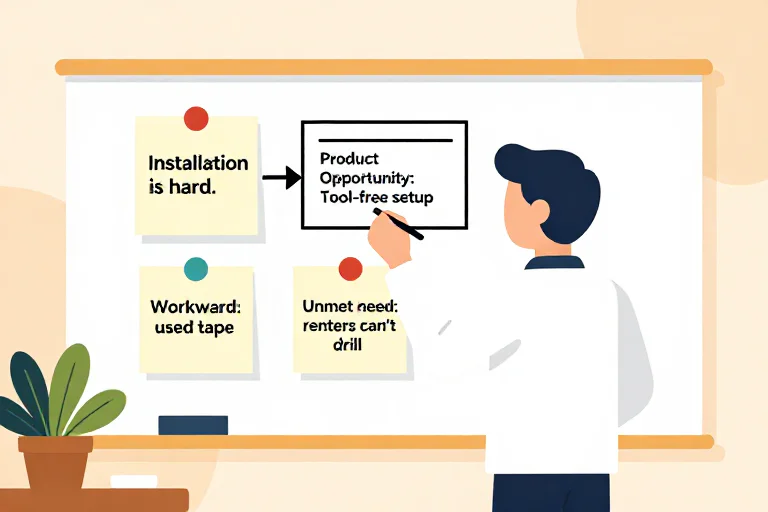
Most product research starts with a question like:
"What product should I build?"
That's often the wrong place to start.
If you ask AI directly, you'll probably get dozens of product ideas.
Some will sound clever.
Some will probably have already been built.
And most won't have much evidence behind them.
There is another way to approach product research.
Start with what customers are already saying.
Look at:
- product reviews
- complaints
- support conversations
- product questions
- social comments
- competitor reviews
- requests for missing features
- situations where existing products don't quite work
Then ask:
What problems are customers still trying to solve?
That's where AI becomes much more interesting.
Instead of using AI as a product-idea generator, you can use it as an investigation engine for discovering product opportunities hidden inside customer feedback.
A Product Opportunity Is Not the Same as a Feature Request
Consider this customer comment:
"I wish this had a longer cable."
The obvious conclusion is:
Add a longer cable.
But that may be too narrow.
Ask why.
Maybe customers have difficulty positioning the product because outlets are far away.
Or perhaps the real problem is that customers don't want visible cables.
Or perhaps they are installing the product in older homes where outlet placement is inconvenient.
A longer cable is only one possible solution.
The underlying opportunity might be:
Make installation flexible in environments with inconvenient outlet placement.
That's a much bigger insight.
AI can help you move from:
requested feature → underlying problem → scenario → unmet need → possible opportunity
This is where uncovering hidden customer needs from reviews with AI becomes more useful than simply collecting feature requests.
And that distinction matters.
Start With Problems, Not Product Ideas
Suppose you ask AI:
"Give me 20 new products for people who work from home."
You'll get ideas.
But where did those ideas come from?
Usually, nowhere specific.
A better starting point is customer evidence.
Give AI a collection of customer feedback and ask:
Analyze these customer comments to identify problems customers are still trying to solve.
Do not generate product ideas yet.
Identify:
- recurring frustrations
- unmet needs
- workarounds customers use
- situations where existing products fail
- things customers repeatedly wish were different
- compromises customers are making
- problems customers appear to have accepted as normal
For each finding, provide the supporting customer evidence.
Separate explicit customer requests from problems inferred from the feedback.
This is also the discipline behind finding customer pain points with AI from reviews, feedback, and support messages.
That final instruction is important.
A customer request is evidence.
An inferred opportunity is a hypothesis.
They should not be treated as the same thing.
The Most Interesting Opportunities Are Often Hidden in Workarounds
Customers don't always ask for a new product.
Sometimes they describe what they currently do instead.
For example:
"I use a towel underneath it so it doesn't move."
That's not a feature request.
But it's interesting.
The customer has created a workaround.
Another customer might say:
"I ended up buying a separate adapter."
Another:
"I had to modify it myself."
Another:
"I keep this next to it because otherwise..."
These comments reveal something important:
The customer is solving a problem that the product isn't solving completely.
Ask AI:
Identify workarounds customers describe in these comments.
For each workaround:
- what problem is the customer trying to solve?
- what are they currently doing?
- what does the workaround cost in time, money, effort, or inconvenience?
- why might the existing product fail to address the problem?
- does the workaround appear specific to a customer scenario?
- how many independent examples support the pattern?
Do not assume every workaround represents a product opportunity. Identify which ones appear worth investigating further.
This can be surprisingly productive.
Because customers often don't know how to describe the product they want.
They can, however, describe the problem they're currently hacking around.
Look for the Gap Between Expectations and Reality
Another strong source of product opportunities is expectation mismatch.
Consider:
"I thought this would..."
That sentence is valuable.
So are:
- "I expected..."
- "I assumed..."
- "I didn't realize..."
- "I wish I had known..."
- "It turned out..."
- "I thought it would be easier..."
These statements reveal a gap between what the customer expected and what the product actually delivered.
Ask AI:
Find statements where customer expectations differ from their actual experience.
Identify:
- what the customer expected
- what actually happened
- why the expectation may have existed
- whether the problem is product capability, communication, positioning, or customer misunderstanding
- whether the mismatch appears repeatedly
Do not automatically classify expectation mismatch as a product problem.
That last point matters.
Sometimes the product doesn't need to change.
The communication does.
Not Every Customer Complaint Is a Product Opportunity
This is where product research can easily go wrong.
Imagine ten customers complain:
"The instructions were confusing."
You could conclude:
Build a redesigned product.
But maybe the product itself works perfectly.
The opportunity might be:
- better instructions
- installation video
- clearer packaging
- better product-page education
- pre-purchase compatibility information
Similarly, customers might complain:
"I wish it came in five colors."
That doesn't automatically mean a five-color product line is a good opportunity.
You need to investigate:
- How often is this mentioned?
- By whom?
- In what scenario?
- Does color affect purchase decisions?
- Are customers actually abandoning the product because of it?
- Would additional colors create meaningful value?
- Is the request isolated?
This is why frequency alone isn't enough.
This is also why what negative reviews really tell you about your customers often depends on context, scenario, and business impact—not just complaint volume.
A frequently mentioned problem can still be commercially unimportant.
And an infrequently mentioned problem can be strategically important if it affects a valuable customer scenario.
Ask AI to Find "Unsolved" Problems
One useful distinction is between:
Problems customers experience
and
Problems customers don't have a satisfactory solution for.
Those aren't the same.
Ask:
Analyze these customer comments for problems that appear insufficiently solved by existing products.
Look for:
- repeated dissatisfaction despite otherwise positive product experiences
- customers combining multiple products to solve one problem
- customers creating workarounds
- customers modifying products themselves
- customers accepting recurring inconvenience
- requests that suggest existing solutions don't fit a particular scenario
- complaints that appear across multiple competing products
Rank findings by strength of evidence, not simply frequency.
Do not generate product ideas yet.
This last sentence keeps the AI grounded.
You're still researching the problem.
Competitor Reviews Can Reveal Product Gaps
Your own reviews only tell you what your customers experienced.
Competitor reviews can reveal something else:
What the market still hasn't solved.
Imagine customers across several competing products repeatedly say:
"I like everything about this except..."
That's interesting.
If the same limitation appears across multiple competitors, it may represent a broader market gap.
For example:
Competitor A customers complain about cleaning.
Competitor B customers complain about cleaning.
Competitor C customers complain about cleaning.
Now the opportunity isn't necessarily:
"Make another product."
It could be:
Investigate whether easier maintenance is an under-served value proposition in this category.
Ask AI:
Analyze customer feedback from multiple competing products.
Identify problems or unmet needs that appear across competitors.
Prioritize patterns where:
- customers repeatedly experience the same problem
- the problem occurs across multiple products
- customers describe workarounds or compromises
- existing alternatives do not appear to solve it well
Distinguish market-wide problems from complaints specific to one competitor.
This is a much stronger way to use competitor intelligence for product research.
Investigate the Customer Scenario Behind the Opportunity
Suppose AI finds:
Customers want easier installation.
That's still too broad.
Ask:
Which customers?
Maybe:
- renters
- older homeowners
- people with limited tools
- customers installing alone
- customers installing in unusual spaces
Now the opportunity becomes more specific.
For example:
"Make installation easier."
is vague.
But:
"A product designed for renters who cannot drill and need to install it without specialized tools."
is a much more testable opportunity.
Ask AI:
For each potential unmet need, identify the customer scenarios in which the problem becomes particularly important.
Describe:
- customer's goal
- environment
- constraints
- current workaround
- expected outcome
- frustration or risk
- why existing solutions may not fit
Do not create demographic personas unless the feedback provides evidence for them.
This is also where discovering hidden customer scenarios with AI becomes valuable.
This is where product research connects directly with customer intelligence.
You're not just discovering what people want.
You're discovering:
Who needs it, when, why, and under what constraints.
Separate "Want" From "Need"
Customers often ask for solutions.
But their requested solution may not be the actual need.
Suppose someone says:
"I want a smaller version."
The underlying need could be:
- limited storage
- limited living space
- portability
- easier installation
- less visual clutter
Those lead to very different products.
Ask AI:
For each explicit product request, investigate the underlying need.
Separate:
- requested solution
- problem
- desired outcome
- customer constraint
- possible underlying need
Identify alternative ways the underlying need could potentially be solved.
Do not assume the customer's requested feature is the best solution.
This prevents a common product-research mistake:
building exactly what customers asked for without understanding why they asked for it.
Find Customers Who Are Making Expensive Compromises
Some of the strongest product opportunities appear when customers are already paying a cost to solve a problem.
That cost might be:
- buying multiple products
- paying for customization
- spending significant time
- accepting poor usability
- replacing products frequently
- doing manual work
- creating DIY solutions
Ask AI:
Find customer comments describing costly compromises or workarounds.
Estimate the type of cost involved:
- money
- time
- effort
- inconvenience
- frustration
- repeated replacement
- complexity
Identify which problems appear important enough that customers are already paying a meaningful cost to solve them.
This is much more interesting than simply asking:
"What features do customers want?"
If customers are already spending money or effort to solve a problem, there is evidence that the problem has some value.
It still doesn't prove that a new product will succeed.
But it gives you a stronger starting point.
Now Let AI Generate Opportunities
Only after the problem investigation should you ask for product opportunities.
At this point, give AI the findings.
For example:
Based on the validated problem patterns above, generate potential product opportunities.
Each opportunity must directly connect to:
- a documented customer problem
- a specific customer scenario
- an existing workaround or unmet need
- evidence from multiple customer statements where available
For each opportunity, explain:
- problem being solved
- target scenario
- current alternatives
- why those alternatives appear insufficient
- proposed product concept
- what would make the concept meaningfully different
- assumptions that still need validation
Do not generate opportunities that cannot be traced back to the evidence.
Now the AI's creativity has constraints.
That's a good thing.
It’s also where choosing among AI-generated product ideas becomes part of the research process, not an afterthought.
The goal isn't to maximize the number of ideas.
It's to maximize the number of evidence-connected ideas worth investigating.
Score Opportunities by Evidence, Not Excitement
AI-generated product ideas can sound extremely convincing.
That's dangerous.
That’s why customer evidence matters when ecommerce numbers aren’t enough; a convincing idea is not the same as a supported one.
A better approach is to make AI score the evidence separately from the attractiveness of the idea.
For example:
| Opportunity | Evidence | Scenario clarity | Existing alternatives | Key uncertainty |
|---|---|---|---|---|
| A | Strong | Strong | Weak | Will customers pay more? |
| B | Medium | Strong | Medium | Is the problem frequent enough? |
| C | Strong | Medium | Strong | Can it be solved economically? |
Don't ask:
"Which product is best?"
Ask:
"Which assumptions are strongest, and which are weakest?"
That changes the research process.
A product opportunity is not validated because AI gave it a high score.
The score simply tells you where to investigate next.
Cross-Validate Before Calling It an Opportunity
Suppose you discover 15 reviews complaining about the same problem.
That's interesting.
But don't stop there.
Check:
- competitor reviews
- social discussions
- support questions
- community forums
- search behavior
- pre-sales questions
- product requests
Then ask AI:
Cross-validate this potential product opportunity across the available customer and market evidence.
Identify:
- evidence supporting the opportunity
- evidence contradicting it
- evidence that comes from independent sources
- customer scenarios where the problem is strongest
- signs that customers already have satisfactory alternatives
- unanswered questions
Do not treat repeated statements from the same source as independent validation.
Now you have something closer to customer intelligence.
Small Data Is Particularly Useful at This Stage
You don't need a massive dataset to discover a potential opportunity.
Imagine you find:
- 12 relevant reviews
- 7 support conversations
- 10 social comments
- 15 competitor reviews
That's not market validation.
But it may be enough to discover a pattern worth testing.
For example:
Customers repeatedly struggle to use the product in small spaces.
That can lead to a research question:
Is compactness merely a preference, or is there a meaningful customer segment whose current alternatives fail because of space constraints?
That's a very different question from:
"Should we build a smaller version?"
AI can help you get from the first question to the second.
Then you validate it.
The AI Should Also Try to Kill the Opportunity
This is an important step.
Once you have an exciting product opportunity, don't ask AI to make it sound better.
Ask it to destroy it.
For example:
Try to disprove this product opportunity.
Find evidence or plausible explanations suggesting:
- customers don't care enough about the problem
- existing alternatives already solve it
- the problem is limited to a very small scenario
- customers complain but don't act
- the requested solution is not commercially viable
- the problem may be caused by communication rather than product limitations
- the apparent demand is driven by a small number of unusually vocal customers
Identify what evidence would be needed before investing in the opportunity.
This is one of the places where using AI as a challenger can be more valuable than using it as a generator.
Product Research Becomes a Loop
The process can be summarized as:
Customer feedback
↓
Problems
↓
Context and scenarios
↓
Underlying needs
↓
Workarounds and compromises
↓
Unmet needs
↓
Potential opportunities
↓
Cross-validation
↓
Challenge the opportunity
↓
Human decision
Notice what isn't in the middle:
"Ask AI for 50 product ideas."
AI can generate ideas very easily.
The scarce resource isn't ideas.
It's evidence that an idea is worth investigating.
What AI Is Actually Good At Here
AI is particularly useful when you have messy information spread across many places.
For example:
- 200 reviews
- 50 support conversations
- 100 competitor reviews
- 50 social comments
A human can read these.
But the cognitive cost of repeatedly comparing them is high.
AI can help you ask questions such as:
Do these complaints describe the same underlying problem?
Or:
Are customers using workarounds for the same reason?
Or:
Does this unmet need appear only in one scenario?
Or:
Do competitor customers have the same problem?
Or:
Are customers asking for the same feature because of different underlying needs?
Those are difficult questions to answer manually at scale.
And they don't necessarily require a sophisticated analytics system.
Much of the valuable information is sitting in unstructured customer language.
But AI Does Not Validate a Product
This distinction should never disappear.
AI can help you discover:
- potential problems
- unmet needs
- scenarios
- workarounds
- customer motivations
- market gaps
- competing solutions
- hypotheses
It cannot prove:
- how many people will buy
- how much they will pay
- whether manufacturing is feasible
- whether acquisition costs will work
- whether the market is large enough
- whether the product will succeed
Those require additional evidence.
So the output of AI-assisted product research should not be:
"This product will succeed."
It should be:
"This problem appears worth validating, and here is why."
That is a much more useful conclusion.
The Most Valuable Product Ideas May Already Be in Your Data
This is why I think AI changes product research for smaller businesses.
You don't necessarily need to begin with:
"What can I invent?"
You can begin with:
"What are customers already struggling with?"
Your existing customer data may contain:
- repeated workarounds
- hidden scenarios
- unresolved frustrations
- unmet needs
- compromises
- missing information
- recurring requests
- competitor weaknesses
Those signals are already there.
The problem is that they are usually scattered across hundreds of pieces of messy language.
AI gives you a way to investigate them from different angles.
Final Takeaway
AI is very good at generating product ideas.
That is also why I wouldn't use it primarily for that.
The easier AI makes idea generation, the less valuable another list of 50 ideas becomes.
The more interesting use is to start with customer evidence.
Give AI the raw feedback.
Find the problems.
Investigate the scenarios.
Look for workarounds.
Separate requested features from underlying needs.
Compare competitors.
Cross-validate the pattern.
Then ask AI to challenge the opportunity rather than sell you on it.
The result isn't:
"AI found a great product idea."
It's something more useful:
"Customers in this specific situation appear to have this unresolved problem. Here is the evidence, here are the competing explanations, and here is what we still need to validate."
That's what turns customer feedback into product research.
And that's where AI can make product discovery substantially cheaper without pretending that AI can replace the actual validation process.