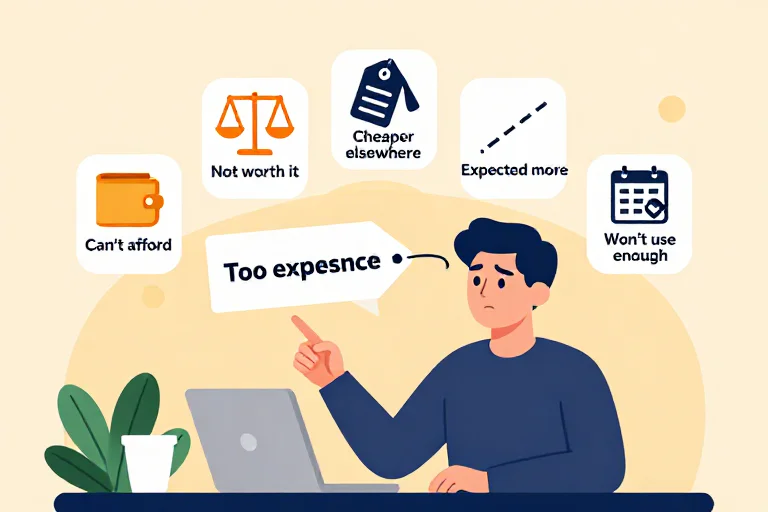
A customer says:
“It's too expensive.”
It sounds like a clear piece of feedback.
It isn't.
The customer has described the problem using the word price.
They haven't necessarily explained why the price became a problem.
They might genuinely be unable to afford the product.
They might think a competitor offers a better deal.
They might like the product but not use it often enough to justify the cost.
They might not understand why your product costs more.
They might expect more from the product.
They might not trust the product enough to risk paying that much.
Or they might simply be the wrong customer for the offer.
These are very different problems.
Yet they often end up in the same bucket:
Price objection.
That is where customer analysis can go wrong.
“Too Expensive” Is a Symptom, Not a Diagnosis
Consider these two customers.
Customer A
“I can't afford $150 for this.”
Customer B
“I can buy something similar for $80.”
Both might be classified as:
Price objection.
But the business problem is different.
Customer A may have an affordability constraint.
Customer B may be questioning the product's relative value.
Now consider:
Customer C
“I expected it to do more for that price.”
This is different again.
The problem may be expectation.
And:
Customer D
“I'm not sure this will work for me, so I'm not comfortable paying that much.”
Now the issue may be risk.
The price is involved in all four situations.
But the price itself may not be the root problem.
Why Counting Price Complaints Is Not Enough
Suppose you analyze 2,000 reviews and discover:
Price-related comments: 180
You might conclude:
Price is a major customer problem.
Maybe.
But what does “price-related” actually include?
It could contain:
- genuinely unaffordable customers
- customers comparing competitors
- customers expecting more
- customers who think the product is good but expensive
- customers who happily paid
- customers who wanted a discount
- customers who misunderstood what was included
- customers who thought the product was worth the money
Counting mentions doesn't distinguish these cases.
The useful question is not:
How many people mentioned price?
It is:
What did price mean to each customer in the context of their purchase decision?
Five Different Problems Can Look Like “Too Expensive”
A useful first framework is to investigate at least five possibilities.
1. Affordability
The customer simply cannot justify the absolute amount.
For example:
“I wanted it, but $200 is outside my budget.”
This is fundamentally different from:
“$200 is too much for what this product provides.”
The first is about the customer's financial constraint.
The second is about perceived value.
2. Weak Perceived Value
The customer can afford the product.
They simply don't believe the benefits justify the price.
For example:
“I could pay this, but I don't see what I'm getting that I can't get elsewhere.”
Now the investigation should move toward:
- benefits
- differentiation
- outcomes
- alternatives
- product communication
3. Competitive Comparison
Sometimes the customer isn't asking:
“Can I afford this?”
They're asking:
“Why should I pay more for this?”
Suppose:
Your product: $149
Alternative: $89
The customer may be willing to pay $149.
But only if the additional $60 has a convincing reason.
The issue isn't necessarily that your price is objectively too high.
The issue may be that the difference isn't justified from the customer's perspective.
4. Risk
Price becomes more important when the customer isn't confident about the outcome.
Imagine two products both cost $200.
One comes from a brand the customer already trusts.
The other comes from an unfamiliar brand.
The unfamiliar product may feel “too expensive” even if the absolute price is acceptable.
The customer's underlying question may actually be:
“What if I spend $200 and this doesn't work for me?”
Now trust and uncertainty become relevant.
5. Expectation
Sometimes the customer expected something else.
For example:
“For this price, I expected better materials.”
The problem may not be the price.
The problem may be the gap between:
expected experience
and:
actual experience.
This is especially important when analyzing negative reviews.
A product can be objectively good and still generate price complaints if the customer's expectations were set differently.
The Same Price Can Mean Different Things to Different Customers
Imagine a $300 product.
For one customer:
“That's too expensive.”
For another:
“That's reasonable.”
For another:
“That's surprisingly cheap.”
The price didn't change.
The customer's:
- situation
- alternatives
- expectations
- priorities
- perceived risk
- desired outcome
changed.
This is why price analysis should not be isolated from customer context.
AI Can Help Separate These Meanings
This is one of the places where AI becomes useful.
Instead of asking:
“Analyze these reviews for price complaints.”
give it a more specific investigation.
For example:
Find customer comments that mention price, cost, expense,
value, affordability, or comparisons with cheaper alternatives.

For each relevant comment, determine:

1. What situation was the customer in?
2. What were they trying to accomplish?
3. What alternative were they considering?
4. What did they expect from the product?
5. Does the comment indicate affordability,
   perceived value, competitive comparison,
   trust/risk, or expectation?
6. What evidence supports that interpretation?
7. What alternative interpretation is possible?

Do not assume that every price complaint means
the product price should be reduced.
That final instruction matters.
Otherwise AI may turn:
“too expensive”
into:
“lower the price.”
That's a recommendation without a diagnosis.
Look at Customers Who Complained and Still Bought
This is one of the most interesting comparisons.
Suppose you find 100 customers who mentioned price.
Separate them into:
Price concern + purchased

Price concern + did not purchase
Now the analysis becomes much more interesting.
Imagine:
Purchased:
“I thought it was expensive, but it was worth it.”

Did not purchase:
“Couldn't justify paying that much.”
Those customers both experienced price friction.
But only one group treated it as a purchase blocker.
That distinction matters.
A concern is not automatically a blocker.
Compare Buyers With Non-Buyers
If you have access to behavioral or customer research data, compare:
Buyers
- What did they value?
- What convinced them?
- What alternatives did they consider?
- What concerns did they overcome?
Non-buyers
- What stopped them?
- What information was missing?
- What alternatives did they choose?
- What risk remained unresolved?
Now you can ask a much better question:
What separates a price concern from a price-based purchase failure?
That's more useful than simply counting price mentions.
Price Can Expose a Positioning Problem
Suppose customers repeatedly say:
“Too expensive.”
Before lowering the price, ask:
Compared with what?
If customers compare your product with a cheaper alternative that solves the same problem equally well, you may have a competitive problem.
But if customers say:
“It's more expensive, but I understand why.”
then the product may have strong perceived differentiation.
Now suppose customers say:
“I don't understand what makes this different.”
The price objection may actually be revealing a positioning problem.
The customer isn't necessarily saying:
“Your price is too high.”
They may be saying:
“You haven't given me a reason to believe this is worth more.”
That's a very different problem.
Don't Confuse Price Sensitivity With Price Objection
These concepts are related but not identical.
A customer can be price-sensitive without explicitly complaining.
Another customer can complain about price while still purchasing.
Another customer can never mention price but abandon the purchase because the value wasn't clear enough.
So if you're investigating pricing, don't search only for the phrase:
“too expensive.”
Look for the broader decision context:
- comparisons
- alternatives
- hesitation
- expected benefits
- perceived risk
- value justification
- purchase timing
- discounts
- trade-offs
Customer language rarely arrives in clean analytical categories.
Cross-Validate the Finding
Suppose AI concludes:
“Customers think the product is too expensive because cheaper alternatives provide similar value.”
That's a hypothesis.
Now look for independent evidence.
Customer evidence
Do customers explicitly compare alternatives?
Product evidence
Are the differences between your product and alternatives clear?
Competitive evidence
Do competitors actually provide comparable features or outcomes?
Behavioral evidence
Do customers visit competitor pages before abandoning?
Commercial evidence
Do discounts materially change conversion?
Now the hypothesis becomes testable.
If the evidence conflicts, don't force a conclusion.
What If Customers Say “Too Expensive” but Conversion Is Fine?
That's another useful contradiction.
You may discover:
Price complaints: high

Conversion rate: stable

Repeat purchase: strong
It would be premature to conclude:
Pricing is broken.
Customers can dislike a price and still decide the product is worth paying for.
A complaint is not necessarily a business problem.
This is one reason customer feedback needs to be interpreted together with behavior.
What If Customers Never Mention Price?
That doesn't prove price isn't relevant either.
A customer may never write:
“Too expensive.”
They may simply choose another product.
This is why customer evidence should be combined with behavioral and competitive evidence when possible.
Sometimes the most important customer problem is visible indirectly.
A Better AI Workflow for Price Objections
Use a multi-step investigation.
Step 1: Find price-related evidence
Collect language around:
- price
- cost
- expensive
- cheap
- value
- worth
- discount
- alternative
Step 2: Extract context
For each relevant customer:
- situation
- goal
- product
- alternative
- expectation
- concern
Step 3: Classify the possible meaning
For example:
Affordability
Perceived value
Competitive comparison
Risk
Expectation
Unknown
Step 4: Compare buyers and non-buyers
Where possible, determine whether the concern actually affected the purchase.
Step 5: Cross-check
Compare with:
- behavior
- competitor evidence
- support conversations
- returns
- product questions
Step 6: Form a narrower hypothesis
For example:
“The strongest evidence points toward a value-communication problem among first-time shoppers rather than absolute affordability.”
That's much more useful than:
“Customers think we're expensive.”
The Business Question Is Not Always “Should We Lower the Price?”
Sometimes the answer may be yes.
But that should come after diagnosis.
Other responses might include:
- improving value communication
- clarifying differentiation
- changing the offer
- reducing perceived risk
- adding proof
- changing packaging
- targeting a different customer
- changing product configuration
- changing the product itself
The correct response depends on what “too expensive” actually means.
AI Should Investigate the Meaning Behind the Objection
This is where I think AI has a particularly useful role.
Humans are often very good at recognizing that:
“Something feels wrong.”
But manually separating thousands of customer statements into subtle categories is expensive.
AI can help with:
- finding relevant statements
- grouping similar contexts
- comparing customers
- identifying contradictions
- extracting scenarios
- connecting price concerns to alternatives
- identifying recurring expectations
But the analytical framework still matters.
If you only ask:
“What are customers complaining about?”
you'll probably get:
Price.
If you ask:
“What does price represent in the customer's decision?”
you can investigate something much deeper.
The Key Question
When a customer says:
“It's too expensive.”
don't immediately ask:
“How much cheaper should it be?”
Ask:
“Too expensive compared with what, for whom, in what situation, and for what expected outcome?”
That question turns a vague objection into something you can investigate.
And that is where customer intelligence becomes useful.
Related Research
- How to Find Customer Pain Points With AI From Reviews, Feedback, and Support Messages
- How to Discover Hidden Customer Needs From Reviews Using AI
- How to Use AI to Discover Hidden Customer Scenarios From Customer Feedback
- What Do Negative Reviews Really Tell You About Your Customers?
The Miyeta Approach
Don't treat the customer's chosen label as the diagnosis.
“Too expensive” is a description of the customer's conclusion.
The interesting question is what happened before they reached it.