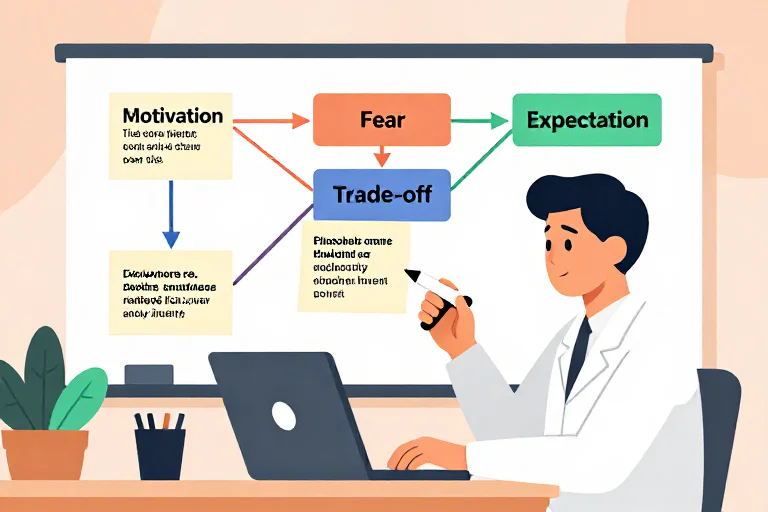
Customers rarely explain their decisions as clearly as businesses would like.
They don't usually write:
"My purchase decision was primarily driven by perceived convenience and reduced uncertainty."
They write:
"I just wanted something that wouldn't be a pain to deal with."
Or:
"I know it's more expensive, but I didn't want to keep replacing the cheap ones."
Or:
"I wasn't sure at first, but after reading the reviews I decided to try it."
These sentences contain more information than a simple positive or negative label.
They contain clues about:
- motivation
- expectations
- perceived risk
- emotional reactions
- trade-offs
- priorities
- trust
- frustration
- desired outcomes
- decision criteria
This is where AI can become useful for customer research.
Not because AI can "read customers' minds."
It can't.
The value comes from using AI to investigate patterns in how customers describe their experiences, choices, concerns, and expectations.
The important distinction is:
AI can generate psychological hypotheses from customer language. It cannot prove what customers were thinking.
That boundary is critical.
Customer Psychology Is Not Just Sentiment Analysis
A lot of customer-feedback tools stop at sentiment.
For example:
Positive: 72% Neutral: 18% Negative: 10%
That can be useful.
But it doesn't answer many of the questions a business actually cares about.
Consider this review:
"I love the design. It looks much better than the alternatives I've tried, although I wish it were cheaper."
The sentiment is mostly positive.
But there are several different signals inside it.
The customer may value:
- appearance
- differentiation
- comparison against alternatives
- aesthetic identity
And they may accept a higher price because the product provides something they value.
Now consider:
"It's expensive, but I guess I'll see how long it lasts."
Again, there is a positive-looking purchase decision.
But the psychology is different.
The customer is accepting financial pain while evaluating whether durability will justify it.
A sentiment score collapses these differences.
Customer psychology analysis, such as AI-assisted analysis of unstructured feedback, should try to preserve them.
Start With the Customer's Language
One mistake I see in AI customer research is starting with a psychological framework and forcing every customer into it.
For example:
- fear
- status
- convenience
- belonging
- achievement
- security
These categories can be useful.
But if you begin with them, the analysis can become confirmation bias.
Instead, start with the raw feedback.
Give AI the actual customer language.
Then ask it to identify recurring motivations, emotions, expectations, and decision patterns without forcing the data into a predefined psychological model.
For example:
Analyze these customer comments for psychological signals.
Start from the language customers actually use rather than assuming predefined psychological categories.
Identify recurring:
- motivations
- frustrations
- fears
- expectations
- emotional reactions
- perceived risks
- desired outcomes
- trade-offs
- decision criteria
For every interpretation:
- quote or reference the supporting customer language
- explain what is explicitly stated
- explain what is inferred
- indicate how confident the inference is
Do not claim to know a customer's internal mental state with certainty.
This changes the role of AI.
It isn't diagnosing people.
It's interpreting evidence—a core part of customer intelligence.
The Same Complaint Can Come From Different Psychology
This is one of the reasons raw categories aren't enough.
Imagine five customers say:
"The setup is difficult."
It is tempting to classify them all as:
Installation problem.
But their reasons could be completely different.
Customer A:
"I don't have much experience with this kind of thing."
Possible interpretation:
low confidence / fear of making a mistake
Customer B:
"I expected this to take five minutes."
Possible interpretation:
expectation mismatch
Customer C:
"I had to find additional tools."
Possible interpretation:
unexpected effort
Customer D:
"I tried it twice and couldn't get it working."
Possible interpretation:
frustration + loss of confidence
Customer E:
"It was annoying, but once installed it works perfectly."
Possible interpretation:
temporary friction with high final value
The surface complaint is identical.
The underlying experience isn't.
This is one of the strongest reasons to find customer pain points with AI from reviews, feedback, and support messages rather than just count complaint categories.
Ask AI to Separate Observation From Interpretation
This is probably the single most important instruction when using AI for customer psychology.
Ask it to produce two layers.
Layer 1: Evidence
What did the customer actually say?
Layer 2: Interpretation
What might that language suggest?
For example:
| Customer language | Evidence | Possible interpretation |
|---|---|---|
| "I didn't want to risk buying another one" | Customer explicitly mentions risk | Previous negative experience may increase perceived purchase risk |
| "I just wanted something simple" | Customer explicitly values simplicity | Complexity may be a major decision criterion |
| "It's expensive but worth it" | Customer accepts higher price | Perceived value may outweigh price sensitivity |
| "I kept checking reviews before ordering" | Customer describes repeated review checking | Social proof may be reducing purchase uncertainty |
Notice the wording.
Not:
"This customer is risk-averse."
Instead:
"The customer's language suggests that perceived risk may have influenced the decision."
That is a much more defensible conclusion—and a useful starting point for discovering hidden customer needs from reviews.
Step 1: Find What Customers Are Trying to Achieve
People don't buy products merely because products exist.
They buy them to achieve something.
Sometimes that goal is obvious.
Sometimes it isn't.
A customer buying a storage product might say:
"Finally, my desk doesn't look like a disaster."
The product feature is storage.
The desired outcome may be:
feeling in control of their environment.
A customer buying an expensive kitchen tool might say:
"I know there are cheaper ones, but I use this every morning."
The product feature is functionality.
The important decision factor may be:
repeated convenience makes the higher price acceptable.
Ask AI:
Analyze these customer comments for desired outcomes.
Do not focus only on product features.
Identify what customers appear to be trying to achieve in their lives, routines, work, environment, or specific situation.
Separate:
- the product function
- the practical outcome
- the emotional outcome
- the situational outcome
Provide evidence for each interpretation and distinguish explicit statements from inference.
This can reveal a very different picture of demand.
Step 2: Investigate the Emotion Around the Problem
Emotion is often present in customer feedback without being explicitly labeled.
Customers may write:
"I was so tired of..."
"I was relieved when..."
"I was embarrassed when..."
"I finally found..."
"It drove me crazy..."
"I was worried that..."
Those expressions are useful signals.
But don't simply ask:
"What emotions are present?"
Go one level deeper.
Ask:
What happened immediately before the emotion?
And:
What outcome appears to have caused the emotion to change?
For example:
"I was constantly worried it would fall off, but after a month it hasn't moved."
There are at least two useful signals:
Before: perceived risk.
After: confidence gained through experience.
The emotional transition may be more informative than the emotion itself.
Step 3: Find the Trade-Offs Customers Are Willing to Make
Customer psychology becomes particularly interesting when customers describe compromises.
For example:
"It's heavier, but I prefer it because it feels more solid."
This tells you something important.
The customer isn't simply looking for:
lightweight.
They are making a trade-off:
weight → perceived solidity
Another customer might say:
"It's not as pretty as the other one, but it was easier to install."
Now the trade-off is:
appearance → convenience
These trade-offs can reveal what customers actually prioritize—and often explain what sits behind a “too expensive” objection.
Ask AI:
Find explicit and implicit trade-offs in these customer comments.
Identify situations where customers appear willing to sacrifice one attribute in exchange for another.
For each trade-off:
- what is being sacrificed?
- what is being gained?
- what evidence supports the interpretation?
- does the trade-off appear scenario-specific?
- does it differ between customer groups or use cases?
Do not assume that a frequently mentioned feature is necessarily the most important decision factor.
This is much more useful than simply producing a feature wishlist.
Step 4: Investigate Why Customers Value Something
Customers often say:
"I love this feature."
That's not enough.
Ask:
Why?
Suppose customers repeatedly praise:
"Easy to clean."
The underlying value could be:
- saves time
- reduces daily effort
- avoids frustration
- feels more hygienic
- makes the product easier to maintain
- removes a recurring chore
The feature is the same.
The perceived value can be very different.
Ask AI:
For each frequently praised product attribute, investigate why customers appear to value it.
Move through these levels:
- What feature are they mentioning?
- What practical benefit does it provide?
- What problem does that benefit remove?
- What situation makes that problem important?
- What emotional or psychological outcome may result?
Provide customer evidence at each level.
Do not invent motivations that are not supported by the language.
This is essentially an AI-assisted value ladder built from actual customer language.
Step 5: Find What Customers Are Afraid Of Losing
Customer psychology isn't only about what people want.
It's also about what they want to avoid.
A customer may be trying to avoid:
- wasting money
- wasting time
- looking foolish
- making the wrong choice
- disappointing someone
- repeating a previous mistake
- dealing with complexity
- feeling uncomfortable
- having to replace something again
These motivations can be hidden inside ordinary complaints and may function as purchase blockers.
For example:
"I didn't want to buy another cheap one and replace it in six months."
The customer isn't simply asking for durability.
They are trying to avoid:
repeating a frustrating purchase cycle.
That changes the meaning of the product.
Step 6: Compare Buyers With Different Decisions
If your data allows it, compare people who made different choices.
For example:
- buyers vs non-buyers
- positive vs negative reviewers
- repeat buyers vs one-time buyers
- customers who chose premium vs budget products
- customers who returned vs kept products
Then ask AI:
Compare these customer groups and identify differences in motivations, concerns, expectations, and decision criteria.
Focus on differences in language and context rather than simply counting positive and negative words.
Identify:
- motivations stronger in one group
- concerns stronger in one group
- different desired outcomes
- different perceived risks
- different trade-offs
- different customer scenarios
Separate observed differences from possible explanations.
This is where customer psychology can become connected to actual business decisions—including why customers hesitate to buy.
Small Data Can Still Be Useful
You don't need tens of thousands of reviews to start investigating customer psychology.
Suppose you have 100 customer comments.
That's not enough to claim:
"72% of customers are motivated by convenience."
But it may be enough to discover:
"Several customers repeatedly describe the product as something that removes an annoying recurring task."
That is a useful signal.
You can then investigate it further.
Look for the same pattern in:
- support conversations
- Reddit discussions
- social comments
- competitor reviews
- product questions
- survey responses
If the same underlying motivation appears independently, confidence increases.
This is where cross-validation matters more than blindly increasing the number of rows.
Use Competitor Customers as a Psychological Reference
Customer psychology doesn't exist in isolation.
Your competitors are also solving the same or adjacent problems.
Suppose your customers say:
"I wanted something simple."
And competitor customers repeatedly say:
"I chose this because I didn't have to think about it."
Those statements may reveal a broader decision pattern.
You can ask AI:
Compare customer feedback about our product and competing products.
Investigate differences in:
- motivations
- perceived value
- emotional reactions
- purchase concerns
- desired outcomes
- trade-offs
- expectations
- situations of use
Focus on how customers describe their decisions, not simply which product receives more positive sentiment.
Identify potential differences in customer psychology and explain the evidence supporting each hypothesis.
This can reveal something more interesting than:
"Competitor X has better reviews."
You might discover:
Competitor X is perceived as safer.
Or:
Your product attracts customers who prioritize convenience over customization.
Or:
Competitor customers care more about aesthetics while your customers care more about reliability.
These are hypotheses worth investigating.
Don't Turn Psychological Inference Into a Customer Persona
There is a temptation to finish this kind of analysis by creating personas:
Sarah, 34, busy professional, values convenience and emotional security.
I would be careful with that.
A persona can be useful for communication.
But psychological inference from a small amount of feedback does not justify inventing a complete fictional person.
Instead, describe the observed pattern:
Scenario: customers with limited time who repeatedly emphasize reducing recurring effort.
That's grounded in evidence.
And it is often more useful than:
"Busy Sarah."
The goal is to understand customer behavior, not create fictional characters.
A Better AI Workflow for Customer Psychology
The workflow I would use is iterative—similar to a practical workflow for small ecommerce teams.
Pass 1 — Explore
Give AI the raw customer feedback.
Ask:
What psychological signals appear?
Don't force categories.
Pass 2 — Select
Choose the most interesting signals.
For example:
Why do customers repeatedly mention avoiding hassle?
Pass 3 — Deepen
Ask:
What situations produce this motivation?
Then:
What problem are they trying to avoid?
Then:
What outcome are they hoping to achieve?
Pass 4 — Challenge
Ask:
What alternative explanations could explain this pattern?
Pass 5 — Cross-validate
Compare:
- reviews
- support
- social comments
- competitor feedback
- other customer sources
Pass 6 — Decide
You decide whether the evidence is strong enough to change:
- product
- positioning
- messaging
- targeting
- customer education
- research priorities
The AI is the investigation engine.
It is not the decision maker.
One Prompt Is Not Enough
This is particularly important for psychological analysis.
You can give AI one giant prompt containing:
Analyze customer psychology, motivations, emotions, objections, needs, personas, scenarios, and opportunities.
You will probably get a long answer.
That doesn't necessarily mean you got a deep analysis.
Deep customer research is usually recursive.
You discover something.
Then investigate it.
Then challenge it.
Then compare it with another source.
Then investigate the contradictions.
For example:
Initial finding:
Customers value convenience.
Next question:
What does "convenience" actually mean to these customers?
Next:
Which situations make convenience especially important?
Next:
What are customers willing to sacrifice for it?
Next:
Do competitor customers describe the same trade-off?
Next:
Could the apparent convenience preference actually be caused by installation anxiety?
Now you're doing research.
Not just summarization.
The Most Valuable Output Is Often a Question
This is a subtle but important point.
A good AI analysis doesn't always end with a conclusion.
Sometimes its most valuable output is:
"This pattern is interesting, but we don't have enough evidence to explain it yet."
For example:
Customers who mention price also frequently mention durability.
That creates several possibilities.
Maybe:
- they think the product is expensive
- they need stronger durability evidence
- they are willing to pay more if durability is demonstrated
- the product is being compared with cheaper alternatives
- the price objection is actually a trust problem
The right next step isn't automatically:
Lower the price.
It is:
Investigate the relationship between price perception and expected durability.
That is what good customer intelligence should produce.
What AI Can—and Cannot—Tell You About Customer Psychology
AI can help identify:
- recurring motivations
- emotional language
- perceived risks
- decision criteria
- trade-offs
- expectations
- frustrations
- desired outcomes
- scenario-specific behavior
- alternative explanations
AI cannot directly prove:
- what someone secretly thought
- why every customer behaved a certain way
- population-wide psychological traits from a small sample
- causal relationships from comments alone
- that an inferred motivation is definitely true
This distinction should remain visible in every serious customer analysis.
Otherwise, AI can produce extremely convincing explanations that are simply unsupported.
The more psychologically interesting the conclusion is, the more important the evidence becomes.
Customer Intelligence Is About Going Deeper Than the Words
A review might say:
"Great product."
That's useful.
But it becomes much more interesting when you can investigate:
Why was it great?
Maybe:
"It saved me from doing something I hated."
Or:
"It finally worked in my particular situation."
Or:
"It made me feel confident that I bought the right thing."
Or:
"It looked better in my home than the alternatives."
Those are very different forms of value.
And they lead to very different business decisions.
That's why I don't think AI customer analysis should stop at sentiment, themes, or keyword frequency.
The interesting layer is what sits between the customer's words and the business decision.
Final Takeaway
Customer feedback is not a psychological test.
But it contains behavioral and emotional signals.
AI can help surface those signals from messy, unstructured language and connect them across:
- motivations
- situations
- expectations
- emotions
- risks
- trade-offs
- desired outcomes
The key is to treat psychological interpretation as a hypothesis-generation process.
Start with what customers actually said.
Separate observation from inference.
Investigate the context.
Ask why.
Challenge your first explanation.
Cross-check it against other sources.
Then decide what, if anything, the business should do.
The real opportunity isn't asking AI:
"What are my customers thinking?"
It's asking:
"What does the way my customers describe their problems, choices, frustrations, and outcomes allow me to investigate about how they make decisions?"
That is a much more useful question.
And unlike a simple sentiment report, it can lead somewhere.