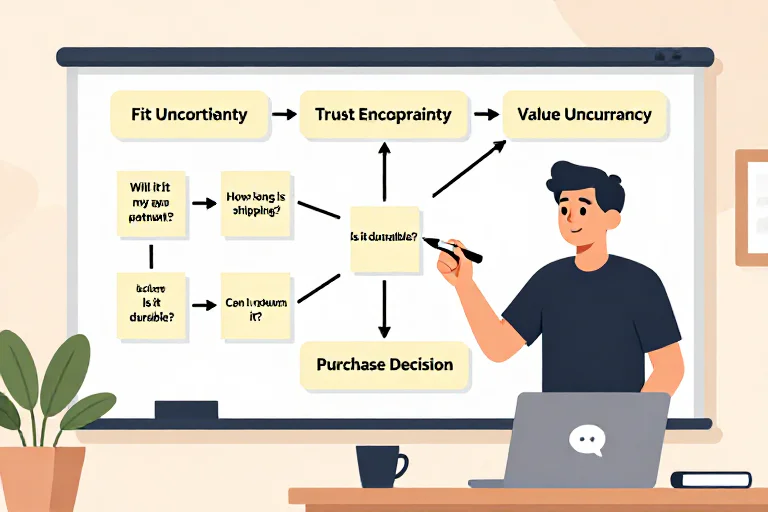
A customer question is easy to underestimate.
"Will this fit in my apartment?"
"Is this compatible with my device?"
"How long does shipping take?"
"Can I use this outdoors?"
"Is the material actually durable?"
These questions may look like requests for information.
But before a purchase, a question often represents something deeper:
the customer does not yet have enough certainty to make a decision.
That makes customer questions a valuable source of ecommerce customer intelligence.
Reviews tell you what customers experienced.
Support conversations tell you what customers struggled with.
Behavior tells you what customers did.
But customer questions can reveal something especially useful:
what customers need to know before they are willing to commit.
AI can help ecommerce teams analyze these questions at scale, group them into meaningful patterns, connect them with customer context, and identify where uncertainty may be affecting the buying decision.
A Customer Question Is Often a Decision Signal
Consider a shopper asking:
"Will this table fit in a small dining area?"
On the surface, this is a product-dimension question.
But the underlying decision may be:
"Can I safely buy this without discovering that it does not work in my home?"
That is a different problem.
The customer is not simply requesting a measurement.
They are trying to reduce uncertainty.
This distinction matters because the same question can have several layers.
Customer question
      ↓
Information requested
      ↓
Uncertainty behind the question
      ↓
Decision the customer is trying to make
      ↓
Potential purchase blocker
The useful insight is often several layers below the actual words.
Why Questions Are Different From Reviews
Reviews are retrospective.
A customer has already purchased and experienced the product.
That makes reviews extremely valuable for understanding:
- satisfaction
- disappointment
- product quality
- expectations
- use cases
- problems
- unexpected benefits
- returns
- value perception
But questions occur before the decision.
They can therefore reveal uncertainty before it becomes a purchase outcome.
Compare:
"Does this work with an iPhone 15?"
with:
"Stopped working after two weeks."
The first reveals pre-purchase uncertainty.
The second reveals post-purchase experience.
Both matter.
But they answer different questions.
A useful customer intelligence system should preserve this difference rather than mixing every customer statement into one sentiment score.
Questions Reveal What Customers Need to Know Before Buying
Imagine an ecommerce store selling outdoor furniture.
Customers repeatedly ask:
- Is this waterproof?
- Can it stay outside during winter?
- Does the fabric fade?
- How difficult is assembly?
- What happens if it gets wet?
- Can I leave it on a balcony?
These questions reveal more than missing information.
They reveal the customer's decision criteria.
The customer may care deeply about:
- weather resistance
- durability
- maintenance
- installation
- long-term ownership
That means the business can learn something about what actually matters in the buying decision.
The question is therefore not only:
"What information should we add to the product page?"
It is also:
"Why does this information matter enough for customers to ask about it?"
Customer Questions Can Reveal Different Types of Intent
Not every question represents the same kind of purchase intent.
A useful starting framework is to distinguish several categories.
1. Fit Questions
These ask whether the product is suitable for a particular situation.
Examples:
- Will this fit my apartment?
- Is this suitable for a small bathroom?
- Will this work with my setup?
- Is this large enough for four people?
The underlying concern is often:
"Will this product work for me?"
2. Compatibility Questions
These are common for technology, accessories, replacement parts, furniture components, and specialized products.
Examples:
- Does this work with Mac?
- Is it compatible with this model?
- Will this fit the existing mount?
- Does it work with this operating system?
The underlying concern is:
"Will I discover after buying that I cannot use it?"
Compatibility uncertainty can be a strong purchase blocker because the perceived cost of being wrong is high.
3. Quality Questions
Examples:
- Is this actually solid wood?
- How durable is it?
- Does the coating scratch easily?
- Is the fabric thick?
- How long does it typically last?
These questions reveal concern about the difference between the product description and the customer's expected experience.
4. Risk Questions
Some questions are really about reducing perceived risk.
Examples:
- What happens if it arrives damaged?
- Can I return it?
- Is there a warranty?
- What if it does not fit?
- Can I cancel the order?
The product may not be the problem.
The customer may simply be trying to understand the consequences of making the wrong decision.
5. Ownership Questions
These happen when the customer is thinking beyond the initial purchase.
Examples:
- How difficult is it to clean?
- Where can I get replacement parts?
- Does it need maintenance?
- How much does the filter cost?
- How often does it need charging?
These questions can reveal the total ownership experience customers are evaluating.
6. Value Questions
These are often indirect.
A customer may ask:
"What is the difference between this and the cheaper version?"
or:
"Why is this one more expensive?"
The customer is not necessarily objecting to the price.
They may be trying to understand the value difference.
This connects closely to the problem explored in why customers say "too expensive".
The Question Is Often More Important Than the Answer
Businesses naturally focus on answering customer questions.
That is necessary.
But from a customer intelligence perspective, the question itself may be more valuable.
Suppose customers repeatedly ask:
"Does this chair work for tall people?"
The obvious response is to add the chair dimensions.
But the deeper insight could be:
A meaningful customer segment is uncertain whether the product is designed for their body size.
That may affect:
- product positioning
- product photography
- product descriptions
- product dimensions
- comparison tables
- customer segmentation
- product development
The question therefore becomes a source of market intelligence.
AI Can Analyze Questions at a Much Larger Scale
A store might receive:
- 20 questions per day
- 600 questions per month
- thousands of support conversations per year
Reading individual questions is manageable.
Understanding the aggregate pattern becomes harder.
AI can classify questions into themes such as:
Compatibility
├── device compatibility
├── software compatibility
└── accessory compatibility

Fit
├── physical dimensions
├── use-case fit
└── customer-specific fit

Risk
├── returns
├── warranty
└── delivery damage

Ownership
├── maintenance
├── replacement parts
└── operating costs

Value
├── price comparison
├── feature comparison
└── durability
This gives the business a map of customer uncertainty.
But classification is only the beginning.
The More Interesting Question: What Happens After the Question?
Suppose customers frequently ask:
"Does this fit a 15-inch laptop?"
There are several possible outcomes.
Scenario A
They get an answer and purchase.
The question represented normal information gathering.
Scenario B
They ask, receive an answer, and leave.
The answer may have revealed that the product does not fit.
Scenario C
They ask, receive an answer, but still hesitate.
The question may be part of a larger uncertainty.
Scenario D
They ask repeatedly across different channels.
The information may be difficult to find or understand.
Scenario E
They never ask but abandon the product page.
There may be an unresolved uncertainty that customers do not express explicitly.
This is why customer questions become much more useful when connected to behavior.
Questions + Behavior Create Stronger Customer Intelligence
Imagine the following pattern:
Customer asks:
"Will this fit my small apartment?"

          ↓

Reads dimensions

          ↓

Views product images

          ↓

Returns to dimensions

          ↓

Leaves page

          ↓

Does not purchase
Now the business has more information than the question alone.
It can investigate whether product-fit uncertainty is affecting conversion.
Another customer might:
Customer asks:
"Will this fit my small apartment?"

          ↓

Receives answer

          ↓

Purchases

          ↓

Leaves positive review
The same question produced a different outcome.
That difference is important.
It suggests that questions should not automatically be treated as objections.
Some questions are simply steps in the buying process.
AI Should Distinguish Information Seeking From Objection
This is one of the most useful distinctions in customer question analysis.
Consider:
"How long does shipping take?"
This could mean:
Information seeking:
"I need the product by Friday."
or:
Purchase concern:
"I am worried that shipping will take too long."
The wording may be almost identical.
Context matters.
AI can compare the question with:
- conversation history
- product
- customer segment
- purchase behavior
- delivery information
- other questions
- eventual outcome
This allows the analysis to move from:
"Customers ask about shipping."
to:
"Customers asking about shipping before checkout appear particularly sensitive to delivery timing."
The second statement is much more useful.
Repeated Questions Can Reveal Product Page Gaps
Sometimes the problem is not that customers have unusual needs.
The problem is that the website does not answer obvious questions.
Suppose 15% of customer questions ask:
"What are the exact dimensions?"
If the dimensions are technically present on the product page, that creates another question:
Why are customers still asking?
Possible explanations include:
- the information is difficult to find
- the terminology is confusing
- the dimensions are shown in an inconvenient format
- images do not provide scale
- customers need dimensions in a particular context
- the information exists but does not answer the actual decision question
This is an important distinction.
Information availability is not the same as information usability.
AI can help identify this gap by comparing customer questions with the information already available on the site.
Questions Can Reveal Unmet Needs
Some customer questions expose needs that the product page never anticipated.
Imagine a store selling a standing desk.
Customers repeatedly ask:
- Can I use it with a treadmill?
- Is it stable when typing?
- Can I move it between rooms?
- Is it quiet enough for video calls?
- Can I store it vertically?
The company may have designed the product around:
adjustable height.
But customers may actually care about:
how the desk fits into different work environments.
That can reveal an opportunity to rethink positioning.
The question is no longer:
"What feature are customers requesting?"
It becomes:
"What job are customers trying to accomplish?"
This is where customer questions can become product research.
AI Can Connect Questions to Customer Segments
Different customers often ask different questions.
For example:
First-time buyer
→ "Is this difficult to install?"

Experienced buyer
→ "Can I replace the component myself?"

Budget-conscious buyer
→ "What is the difference from the cheaper version?"

Professional buyer
→ "Does this support commercial use?"

Gift buyer
→ "Can this be returned if the recipient doesn't like it?"
A single aggregate list of "top customer questions" would hide these differences.
AI can help cluster questions by:
- use case
- customer type
- experience level
- purchase stage
- product
- traffic source
- geography
- previous purchase behavior
This can reveal that what appears to be one customer problem is actually several different problems.
Customer Questions Can Help Define Better Segments
Traditional ecommerce segmentation often starts with:
- age
- gender
- location
- income
- device
- acquisition source
These variables can be useful.
But they do not necessarily explain the buying decision.
Customer questions can reveal decision-based segments.
For example:
The certainty seeker
Wants to minimize risk before purchasing.
Typical questions:
- Will it fit?
- Can I return it?
- Is it durable?
- What happens if it breaks?
The comparison shopper
Wants to understand differences.
Typical questions:
- What's different from the other model?
- Why does this cost more?
- Which one is better for X?
The use-case specialist
Already knows what they need.
Typical questions:
- Can it handle this specific use?
- Does it work with this setup?
- Is it suitable for this environment?
The ownership-focused buyer
Looks beyond the initial transaction.
Typical questions:
- How much maintenance does it need?
- Can I get replacement parts?
- What are the ongoing costs?
These are not necessarily demographic segments.
They are decision-context segments.
That can be more useful for ecommerce messaging and product research.
AI Should Preserve the Original Customer Language
There is another reason customer questions are valuable.
Customers describe problems in their own words.
Those words can contain information that standardized categories lose.
Suppose customers repeatedly say:
"I don't want something that becomes a pain to clean."
A simple taxonomy might classify this as:
Maintenance concern.
That is technically correct.
But the original phrase communicates something more:
The customer is not simply evaluating cleaning difficulty.
They are trying to avoid ongoing friction.
Customer language can therefore reveal:
- priorities
- fears
- expectations
- emotional reactions
- trade-offs
- mental models
AI should organize this language without completely replacing it.
The original customer wording should remain available as evidence.
A Practical AI Workflow for Customer Question Analysis
A useful workflow can be relatively simple.
Step 1: Collect questions
Gather questions from:
- product Q&A
- customer support
- live chat
- reviews
- search queries
- social comments
- sales conversations
Step 2: Normalize the language
Customers may ask the same thing in different ways.
For example:
- "Will it fit my apartment?"
- "Is this okay for a small apartment?"
- "Would this work in a tiny dining room?"
- "Is this too large for an apartment?"
AI can identify the shared underlying question:
Small-space suitability
Step 3: Identify the decision context
Ask:
- What is the customer trying to decide?
- What uncertainty are they trying to reduce?
- What information would help them decide?
- At what stage of the buying process did the question appear?
Step 4: Connect questions with outcomes
Where possible, compare questions with:
- purchase
- abandonment
- return
- support escalation
- review
- repeat purchase
This helps distinguish routine questions from meaningful purchase friction.
Step 5: Look for repeated patterns
The most useful patterns may involve:
- repeated questions
- increasing questions
- questions concentrated around one product
- questions concentrated in one customer segment
- questions that frequently precede abandonment
- questions that existing product content fails to answer
Step 6: Form hypotheses
For example:
Customers are asking about installation because the product appears easier to assemble than it actually is.
Or:
Customers asking about compatibility may represent a high-intent segment with insufficient product-page information.
These are hypotheses.
They should be tested against evidence.
Step 7: Turn findings into decisions
Possible actions include:
- improve product information
- add comparison content
- change product photography
- clarify compatibility
- create a buying guide
- modify messaging
- investigate a customer segment
- improve the product
- run an experiment
The output should be a decision or investigation path, not merely a list of question categories.
Customer Questions Are a Window Into the Buying Decision
A customer does not always tell you directly:
"I am uncertain whether this product is right for me."
Instead, they ask:
"Will this fit?"
They do not necessarily say:
"I don't trust the durability claim."
They ask:
"How long does this usually last?"
They do not necessarily say:
"I don't understand why this costs more."
They ask:
"What's the difference between this and the cheaper version?"
The question is the visible layer.
The underlying uncertainty is the more interesting layer.
Customer language
      ↓
Question
      ↓
Uncertainty
      ↓
Decision criterion
      ↓
Potential blocker
      ↓
Purchase behavior
AI is particularly useful in this chain because the number of customer conversations can quickly exceed what a team can manually analyze.
But the purpose should not be to make the AI answer every question and stop there.
The deeper purpose is to understand why customers need to ask the question in the first place.
Where Miyeta Fits
Miyeta treats customer questions as one of the signals that can help ecommerce teams understand the buying decision.
Questions can be connected with reviews, customer feedback, behavior, product information, and other customer evidence to investigate:
- what customers are uncertain about
- which questions repeat across customers
- which questions reveal different decision contexts
- where product information is insufficient
- which concerns may become purchase blockers
- what customers may be trying to accomplish
This fits into the broader idea of Customer Intelligence: understanding not only what customers say, but what their language reveals about their needs, expectations, and decisions.
AI can make the analysis scalable.
But the important question remains human:
What does this evidence mean for the decision we are trying to make?
The Best Customer Questions Are Not Always the Most Frequent
A final distinction is worth remembering.
The most frequently asked question is not necessarily the most strategically important.
A question asked 500 times may be easy to answer and have little effect on purchasing.
A question asked 30 times may reveal a serious uncertainty affecting a valuable customer segment.
Another question may appear only a few times but expose an entirely new use case.
This is why customer question analysis should not become another popularity ranking.
The goal is to understand the relationship between:
question → context → uncertainty → behavior → decision.
Once ecommerce teams start looking at customer questions this way, support conversations become more than support tickets.
They become customer evidence.