Product reviews tell ecommerce businesses what customers experienced. They do not always explain why those experiences mattered, what customers were trying to accomplish, or which unmet needs influenced their decisions.
A customer may describe a product as convenient, difficult to use, comfortable, unreliable, or worth the money. These descriptions are useful signals, but the business questions often lie beneath them.
What made the experience convenient? Which part of the product created difficulty? What was the customer trying to avoid? Under what circumstances did the product meet expectations, and when did it fall short?
Answering these questions requires more than sentiment classification or keyword extraction. It requires a disciplined approach to customer intelligence.
Miyeta uses AI to help investigate these underlying questions by organizing customer evidence, identifying recurring patterns, developing possible explanations, and translating those explanations into hypotheses that businesses can test.
The objective is not to claim that AI can read customers' minds. It is to make customer research more systematic while keeping the distinction between what the evidence shows and what the analyst believes it might mean.
Why Product Reviews Contain More Than Product Feedback
Traditional review analysis often begins with visible categories: positive or negative sentiment, product quality, price, delivery, usability, and customer service.
These categories are useful for organizing information. However, they do not necessarily explain the customer's decision.
Consider a general example from a pet-accessory category. Different customers may evaluate the same type of product according to fit, ease of adjustment, comfort, handling, or visibility in particular environments.
A simple classification system might assign these experiences to separate product attributes. A deeper investigation asks what each attribute helps the customer accomplish.
Fit may relate to confidence that a product will work for an individual animal rather than merely match a standard size. Ease of adjustment may relate to reducing repeated effort. Comfort may relate to avoiding an unwanted experience during everyday use. Handling may relate to maintaining control without creating other concerns.
These are possible interpretations of the needs behind the attributes, not facts that can automatically be inferred from a keyword.
The distinction matters because product features and customer needs are not interchangeable.
A feature describes what a product provides. A need describes the outcome, concern, or task that makes that feature relevant to a particular customer.
When ecommerce teams understand only the feature, they may improve specifications without addressing the reason customers value them.
When they investigate the underlying need, they can develop more useful questions about product design, product-page messaging, audience differences, and purchasing barriers.
What a Small Exploratory Review Study Can Reveal
To illustrate this approach, consider a small exploratory analysis of eight manually collected public review records from one pet-accessory category.
The purpose of this example is to demonstrate a research method, not to evaluate a particular brand, recommend a specific product, or make claims about the entire market.
The records differed in customer circumstances, reported experiences, and levels of satisfaction. Most were positive, with a smaller number expressing less favorable experiences.
Even within this limited sample, several useful research questions emerged.
1. A product attribute may represent different needs for different customers
A standard product specification does not necessarily capture the full range of individual circumstances.
For example, a product's fit may depend on body proportions, adjustment range, movement, and the way it is used. Two customers who appear to be evaluating the same attribute may therefore be concerned about different outcomes.
One possible underlying need is not simply finding the correct size. It is finding a reliable fit for an individual situation.
For an ecommerce business, this raises several questions:
- Does the product information explain how to assess fit beyond a basic size label?
- Are important limitations or compatibility conditions visible before purchase?
- Would additional measurement guidance help customers make a more confident choice?
- Are there customer circumstances that the current product range does not adequately serve?
The review sample can motivate these questions, but it cannot establish how common each problem is or whether a particular change would increase conversion.
That requires further evidence.
2. Ease of use depends on the stage of the customer experience
Usability is often treated as a single attribute. In practice, customers may evaluate different stages of use separately.
Initial setup, repeated use, ongoing adjustment, and adaptation to changing circumstances can create different kinds of effort.
A product may be straightforward to use once configured but inconvenient to adjust repeatedly. Another may require more effort at first but become easier with familiarity.
AI-assisted analysis can help separate these stages instead of placing every usability-related observation into one broad category.
The resulting business question becomes more specific: which stage creates friction, for which users, and under what conditions?
That is a more actionable starting point than a general conclusion that a product needs to be easier to use.
3. Customers may value an outcome more than a feature
Customers frequently evaluate features according to what those features enable them to do.
For instance, a control-related feature may matter because it helps a customer manage an everyday situation. An adjustment mechanism may matter because it reduces repeated effort. A material characteristic may matter because the customer is concerned about comfort.
These connections are hypotheses about motivation. They should not be presented as established psychological facts merely because they seem plausible.
A useful analysis records both the observable product attribute and the possible outcome associated with it. It then identifies what additional evidence would help determine whether that interpretation is correct.
4. Satisfaction does not eliminate uncertainty
A positive review can indicate that a product met a customer's expectations in a particular situation. It does not prove that the product will work equally well for every customer.
Likewise, a negative experience does not necessarily establish a general product defect.
Differences in circumstances, expectations, usage patterns, and evaluation criteria may explain why experiences vary.
For this reason, Miyeta's approach does not treat review sentiment as a direct measure of universal product performance. It treats customer feedback as evidence about particular experiences that may help generate and refine broader research questions.
How Miyeta Turns Reviews Into Customer Intelligence
AI can process large amounts of unstructured feedback quickly. But speed alone does not make an analysis reliable.
The value comes from structuring the investigation so that every important conclusion can be traced back to its supporting evidence and its limitations.
Step 1: Define the decision before analyzing the data
Customer research becomes unfocused when the objective is simply to discover interesting insights.
Before analyzing reviews, define the business decision the research is intended to inform.
Examples include:
- Should the product page provide more detailed compatibility guidance?
- Which usability problems deserve further investigation?
- Are different customer groups evaluating the product against different criteria?
- Which customer concerns should influence the next product iteration?
- What information might reduce uncertainty before purchase?
The question determines which evidence matters.
If the goal is to improve product-page clarity, an analysis of pre-purchase uncertainty may be more useful than a broad sentiment report. If the goal is to prioritize product improvements, recurring functional difficulties and their consequences may deserve greater attention.
AI should help answer a defined question rather than generate an unlimited list of disconnected observations.
Step 2: Preserve the context of each observation
A review should not be reduced to a keyword detached from the circumstances in which it appeared.
Where available, relevant context may include the customer's stated use case, the stage of the experience, the problem being addressed, and the outcome reported.
The analysis should retain enough context to understand what an observation actually supports while avoiding unnecessary reproduction of the source material.
This matters because the same attribute can have different meanings in different situations.
A usability concern during initial setup is not automatically evidence of a problem during repeated use. A positive experience in one environment does not establish equivalent performance in another.
Context helps prevent the analyst from combining superficially similar observations that answer different questions.
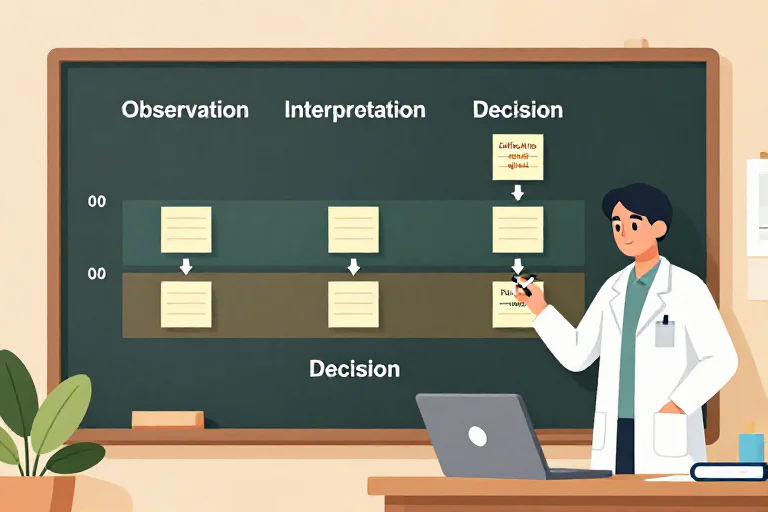
Step 3: Separate observations from interpretations
This is one of the most important controls in AI-assisted research.
An observation describes what the available evidence supports.
An interpretation proposes an explanation for why the observed experience occurred or mattered.
A hypothesis states a proposition that can be investigated with additional evidence.
A business decision determines what action, if any, should follow.
These are different levels of reasoning.
For example, a generalized research observation might indicate that customers have differing experiences with product adjustment. An interpretation might suggest that adjustment flexibility matters more in some usage contexts than others. A hypothesis might propose that clearer guidance about adjustment range will reduce uncertainty for a defined customer group.
The observation does not prove the interpretation, and the interpretation does not prove the hypothesis.
AI can help generate these connections, but the analysis must preserve the boundaries between them.
Without that separation, a plausible explanation can gradually become a supposed fact through repetition.
Step 4: Look for patterns without forcing agreement
AI can help group related observations, identify recurring concerns, and detect differences that a simple keyword report might miss.
However, grouping similar language is not the same as establishing a shared underlying need.
Two customers may mention the same product attribute for different reasons. Conversely, different descriptions may point toward a similar concern.
The analyst must therefore examine whether a proposed pattern is supported by the underlying contexts.
Contradictory evidence should remain visible. If some observations support a proposed explanation while others complicate it, the analysis should record that difference rather than forcing every record into a single narrative.
A useful customer-intelligence finding explains both what appears to recur and where the pattern may not apply.
Step 5: Record uncertainty and competing explanations
A strong analysis does not merely produce a conclusion. It records how confidently the available evidence supports that conclusion and what remains unknown.
For each significant finding, ask:
- How many independent observations support it?
- Are those observations sufficiently similar to justify grouping them?
- Could another explanation account for the same experience?
- Are important customer types or situations missing?
- Does the evidence describe an isolated experience or a potentially recurring pattern?
- What additional information would distinguish between competing explanations?
A small exploratory sample may reveal a promising signal, but it cannot establish market-wide prevalence.
This distinction is especially important when using AI because fluent explanations can create a false impression of certainty. A detailed explanation is not necessarily a well-supported explanation.
Miyeta's approach treats uncertainty as part of the research output, not as a disclaimer added after the conclusion has already been decided.
Step 6: Translate findings into testable hypotheses
The purpose of customer intelligence is not to produce a longer report. It is to improve decisions.
A useful finding should point toward a question that can be tested.
For example, if early evidence suggests that customers struggle to determine whether a product fits their particular circumstances, a team could investigate whether clearer measurement instructions reduce uncertainty.
That hypothesis can be tested through customer interviews, usability sessions, support inquiries, product-page experiments, or other appropriate sources of evidence.
The appropriate test depends on the question. A conversion experiment may help evaluate a change in page presentation, while interviews may be better suited to understanding the reasoning behind customer concerns.
The research should specify what outcome would support the hypothesis and what result would weaken it.
This prevents AI-generated recommendations from becoming unquestioned action items.
An Evidence Structure for Reliable AI Customer Research
To make the process repeatable, a customer-intelligence workflow can organize findings into a structured evidence record.
| Field | Purpose |
|---|---|
| Research question | Defines the business decision being investigated |
| Observation | Records what the available evidence supports |
| Context | Explains the circumstances relevant to the observation |
| Interpretation | Describes a possible underlying need or explanation |
| Alternative explanations | Identifies other plausible reasons for the same evidence |
| Counterevidence | Records observations that complicate the interpretation |
| Confidence and limitations | States how strongly the evidence supports the finding |
| Next evidence needed | Identifies what could confirm, weaken, or refine the interpretation |
| Decision relevance | Explains which business question the finding may inform |
This structure is more useful than a list of AI-generated insights because it preserves the reasoning behind each conclusion.
It also creates an audit trail. When new information becomes available, the team can revisit a particular interpretation instead of repeating the entire analysis or treating an earlier conclusion as permanent.
Importantly, confidence should not be assigned solely according to how often an AI model repeats a conclusion. It should reflect the quality, relevance, independence, and limitations of the supporting evidence.
What This Method Can—and Cannot—Establish
The exploratory study described above involved only eight manually collected records from one product category. It was not a random or representative sample, and the records were weighted toward positive experiences.
The analysis can demonstrate how AI-assisted research organizes evidence, develops possible explanations, and generates questions for further investigation.
It cannot establish the prevalence of a customer need across the market, prove a causal relationship between a product attribute and customer satisfaction, or predict the commercial impact of a proposed change.
Those conclusions require additional research.
More broadly, product reviews have inherent limitations. Reviewers are self-selected, experiences may be reported selectively, and the available records may omit customers who never purchased, never submitted feedback, or abandoned a purchase before using the product.
Reviews should therefore be interpreted alongside other relevant evidence where possible, including customer interviews, support conversations, product analytics, search behavior, and observed purchasing journeys.
These sources do not automatically agree. Their differences can be informative, but they must be evaluated in relation to what each source actually measures.
The goal is not to make AI sound more certain. It is to make the reasoning behind a business decision more transparent and defensible.
Why AI Customer Intelligence Requires Human Judgment
AI is useful for organizing unstructured feedback, identifying possible patterns, comparing competing interpretations, and generating follow-up research questions.
But the quality of the result still depends on the question being asked, the evidence being supplied, the assumptions being tested, and the decisions being made.
A model can generate an explanation that fits the available information while overlooking a different explanation. It can also produce a persuasive customer persona from a sample that is too small to support that level of detail.
Human judgment is needed to establish the research objective, assess whether an inference is justified, identify missing context, and decide which conclusions are strong enough to influence a business decision.
This does not mean every analysis must be performed manually. It means that AI should accelerate the investigation without removing the controls that make the investigation trustworthy.
Miyeta approaches AI-powered customer intelligence in this way: use AI to expand the range and speed of analysis, but keep observations, interpretations, hypotheses, and decisions distinguishable.
For a broader explanation of this approach, see how AI can help find customer needs that customers do not say directly.
From Review Analysis to Better Ecommerce Decisions
Product reviews are a useful starting point for understanding customer needs, but the real value emerges when analysis becomes part of a broader decision process.
A business can begin with a customer concern, investigate the context behind it, identify a possible unmet need, examine alternative explanations, and define a test that would produce stronger evidence.
That process connects customer feedback with product research, customer intelligence, and ecommerce decision-making.
It also changes the role of AI. Instead of treating a model as a machine that produces definitive answers from customer comments, the business uses it as a research assistant that helps organize evidence and develop better questions.
Miyeta's central principle is straightforward: AI can help uncover meaningful customer signals, but reliable decisions require evidence, context, and validation.
The objective is not to produce the largest number of insights. It is to identify which insights deserve attention, understand how strongly they are supported, and determine what the business should investigate or test next.
That is how AI-assisted review analysis can become a practical part of customer intelligence rather than another automated report.