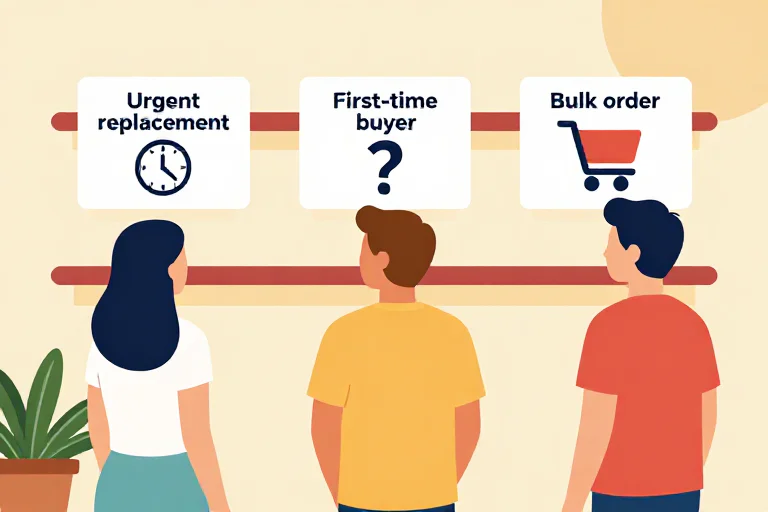
Most ecommerce customer segmentation starts with a familiar question:
Who are our customers?
The answer usually comes in the form of demographics, purchase history, location, customer value, or product category.
These segments can be useful.
But they often fail to answer the question that matters most when a business is trying to understand a purchase:
Why is this customer making this decision?
Two customers can have nearly identical demographic profiles and completely different reasons for buying.
Two customers can purchase the same product while solving different problems.
Two customers can have the same objection while being constrained by completely different circumstances.
This is why ecommerce segmentation should not stop at describing who customers are.
It should also examine the decision context in which they become buyers.
AI makes this possible at a scale that is difficult to achieve through manual customer research alone. It can analyze reviews, questions, support conversations, search behavior, product interactions, and purchase evidence to discover recurring patterns in how customers approach decisions.
The objective is not to create more customer personas.
It is to identify segments that help a business make better decisions.
Demographics Describe Customers. Context Explains Decisions.
Imagine an ecommerce store selling ergonomic office chairs.
A traditional segment might look like:
Men, 30–45, working in technology, living in large cities.
That may describe a real group.
But it does not tell the business why these customers are shopping.
Within that group, one customer may be:
- replacing a broken chair immediately
- setting up a home office for the first time
- upgrading after experiencing back discomfort
- furnishing an entire company office
- looking for a chair for occasional use
These customers may share demographics.
Their decisions do not.
Their priorities may be completely different.
The replacement buyer may prioritize availability.
The first-time buyer may need education.
The customer experiencing discomfort may prioritize ergonomic support.
The business buyer may prioritize durability and price at volume.
The occasional user may prioritize affordability.
If the company creates one generic customer profile for all of them, it loses the most important information.
The useful segment is not simply who they are.
It is what situation they are in and what decision they are trying to make.
What Is a Decision-Context Segment?
A decision-context segment groups customers according to the circumstances and reasoning surrounding a decision.
It can include:
- the trigger that caused the customer to start shopping
- the problem they are trying to solve
- the urgency of the decision
- their existing solution
- their perceived risks
- their constraints
- the outcome they want
- the trade-offs they are willing to make
- the information they need
- their familiarity with the category
- the alternatives they are considering
For example, an ecommerce business might discover four recurring segments:
Urgent replacement buyers
Something stopped working and the customer needs a replacement quickly.
Typical priorities:
- availability
- delivery
- compatibility
- reliability
Careful researchers
The purchase is important enough that they spend significant time comparing alternatives.
Typical priorities:
- reviews
- specifications
- comparisons
- warranty
- long-term value
Problem-driven buyers
The customer is motivated by a specific problem rather than by interest in the product itself.
Typical priorities:
- whether the product solves the problem
- proof
- relevant use cases
- confidence
Convenience-driven buyers
The customer already knows roughly what they want and wants to minimize the effort required to complete the purchase.
Typical priorities:
- simplicity
- availability
- easy checkout
- familiar brands
- clear information
These segments can overlap.
A customer can be both a problem-driven buyer and a careful researcher.
That is another reason not to treat segmentation as a rigid classification exercise.
Why Traditional Segmentation Often Misses This
Traditional segmentation is usually built from structured fields.
For example:
Age
Location
Gender
Order value
Purchase frequency
Product category
These fields are easy to store and analyze.
Decision context is harder.
The information may be distributed across:
- review text
- customer questions
- support tickets
- search queries
- product comparisons
- page behavior
- returns
- survey responses
- interviews
- product usage
- purchase timing
The database does not necessarily contain a field called:
"Customer is urgently replacing a broken product."
But the evidence may be there.
A customer might:
- search for a replacement
- ask about delivery
- compare compatibility
- purchase within an hour
- mention that their old product stopped working
No individual field defines the segment.
The segment emerges from the relationship between them.
This is where AI can be particularly useful.
AI Can Discover Segments From Evidence
AI does not need to be given the segments in advance.
Instead, it can help identify recurring patterns across customer evidence.
For example, imagine 10,000 customer conversations.
The AI might discover repeated combinations such as:
Pattern A
"Need it this week" "Current one broke" "Is this compatible?" "Can you ship immediately?"
Pattern B
"Which is better?" "How does this compare?" "What's the difference?" "Is the extra cost worth it?"
Pattern C
"Will this solve..." "I have this problem..." "Has anyone used this for..." "Does it work with..."
These are not merely topic clusters.
They may represent different decision processes.
The first group is trying to solve an urgent replacement problem.
The second is reducing uncertainty between alternatives.
The third is evaluating whether the product can solve a specific problem.
That distinction is commercially useful.
The Important Part Is Not the Cluster
There is a common mistake in AI segmentation.
A system produces five clusters.
Everyone becomes excited because the model found five "customer personas."
But the clusters themselves are not the goal.
The important question is:
What can we do differently because these segments exist?
Suppose AI identifies:
Segment A: urgent buyers
Segment B: careful researchers
That becomes useful only when the business can connect those segments to different decisions.
For example:
Urgent buyers may need:
- delivery information near the top of the page
- stock visibility
- compatibility information
- simplified product selection
Careful researchers may need:
- comparison tables
- detailed specifications
- reviews
- demonstrations
- warranty information
Now segmentation is connected to action.
Without that connection, segmentation becomes another report.
Segment Customers by the Decision They Are Making
A useful way to approach AI segmentation is to ask:
What decision is this customer currently trying to make?
For example:
Should I buy this category at all?
This customer may need education.
Which product should I choose?
This customer needs comparison and differentiation.
Can this product solve my specific problem?
This customer needs evidence and relevant use cases.
Can I trust this product?
This customer needs risk reduction.
Is the premium worth it?
This customer needs value justification.
Should I buy now or later?
This customer may need urgency, timing, or incentive information.
These are fundamentally different decision states.
And a customer can move between them.
That means customer segmentation can be dynamic rather than static.
A Customer Can Change Segments During One Journey
Consider someone buying a mattress.
At first:
"I need a new mattress."
They are exploring the category.
Then they learn about different materials.
Now they are comparing products.
Then they become concerned about firmness.
Now they are trying to determine product fit.
Then they discover that returns are difficult.
Now the decision becomes about risk.
The customer has not changed.
Their decision context has changed.
This matters because ecommerce teams often treat the customer journey as a sequence of page views.
A more useful interpretation is:
The customer is moving through different decision states.
AI can help identify these transitions from behavioral and qualitative evidence.
That can reveal where the customer is becoming uncertain.
Decision Context Is Often Hidden in Customer Language
Customers rarely say:
"I am currently in the product-comparison stage of my decision process."
They say:
"What's the difference between these two?"
They rarely say:
"I have elevated perceived purchase risk."
They say:
"What happens if it doesn't fit?"
They rarely say:
"I have low category knowledge."
They say:
"Which one should I choose?"
This is why language can be powerful evidence.
AI can interpret these natural expressions and connect them to broader decision patterns.
But interpretation needs to remain grounded in evidence.
If ten customers ask:
"Which one should I choose?"
we should not automatically conclude that the product range is too complicated.
Other explanations may exist.
Perhaps the products are genuinely difficult to differentiate.
Perhaps the customers are first-time buyers.
Perhaps the product page does not explain the differences clearly.
Perhaps the category itself is unfamiliar.
The AI should surface these possibilities rather than prematurely selecting one.
Combine Behavioral and Qualitative Evidence
The strongest segments often emerge when multiple evidence sources point in the same direction.
Suppose an ecommerce business suspects it has an urgent replacement segment.
Customer language shows:
- "need this quickly"
- "old one broke"
- "replacement"
- "ASAP"
Behavior shows:
- short research sessions
- few product comparisons
- high availability-page engagement
- fast purchase after landing
Purchase data shows:
- high conversion when inventory is available
- strong sensitivity to delivery dates
Now the segment has stronger evidence.
The point is not that AI "discovered the truth."
The point is that several independent signals support the same hypothesis.
This is much closer to how reliable customer intelligence should work.
AI Should Compare Competing Segment Explanations
Another useful approach is to ask AI to challenge its own segmentation.
Suppose a group of customers frequently reads reviews before buying.
One explanation is:
They are careful researchers.
But alternatives might include:
- they are worried about product quality
- the category is unfamiliar
- the product is expensive
- the reviews are unusually detailed
- they are comparing competitors
- they have had a bad previous experience
These explanations imply different actions.
A good AI-assisted workflow should therefore ask:
What evidence supports this segment?
and:
What other explanations could produce the same behavior?
This reduces the risk of turning statistical clustering into false certainty.
Segments Should Be Defined by Meaningful Differences
Not every difference deserves a segment.
Suppose AI identifies:
- customers who read five reviews
- customers who read six reviews
- customers who read seven reviews
That does not necessarily create three useful segments.
A segment should exist because the customers have a meaningful difference in:
- need
- context
- decision criteria
- risk
- behavior
- desired outcome
- response to an intervention
For example:
Customers who need immediate replacement
versus
Customers making a planned upgrade
is meaningful because their decision processes are different.
The distinction can influence:
- merchandising
- messaging
- content
- product recommendations
- inventory priorities
- promotions
That is a useful segment.
AI Can Also Find the Customers You Are Missing
One of the most interesting uses of contextual segmentation is discovering underserved groups.
Suppose the business thinks its market consists of:
Customers looking for a premium product.
AI analysis of customer evidence may reveal another recurring group:
Customers who like the premium product but cannot justify the price because they only need it occasionally.
That group may have been hidden inside a broad "price-sensitive" category.
The problem may not be that they want a cheaper version.
They may want:
- a smaller version
- a simpler version
- a rental option
- a lower-commitment product
- a product designed for occasional use
This is where segmentation becomes product research.
The segment reveals a potentially different customer need.
That can lead to a product hypothesis.
From Segmentation to Product Decisions
Contextual segmentation can help answer questions such as:
- Which customer needs are underserved?
- Which use cases are poorly supported?
- Which customer groups are forced to compromise?
- Which segment is most dissatisfied?
- Which segment is growing?
- Which segment is most sensitive to a particular blocker?
- Which segment values a feature enough to justify a higher price?
For example, imagine a product receives strong reviews overall.
The average rating is excellent.
But one contextual segment repeatedly complains about setup complexity.
That may not be a general product problem.
It may indicate that the product is poorly suited to first-time users.
The solution could be:
- onboarding changes
- simpler configuration
- better documentation
- a beginner version
- a guided setup experience
The average review score would not reveal this.
Contextual segmentation can.
From Segmentation to Marketing Decisions
The same principle applies to messaging.
A generic message might say:
"A powerful solution for modern businesses."
That tells different customers almost nothing.
A context-aware message could speak directly to the decision:
Need a replacement quickly? See compatibility, availability, and delivery information first.
Or:
Comparing several options? See exactly what changes between each model.
Or:
Not sure whether this solves your problem? Explore real customer use cases.
These messages are not simply personalized because personalization is fashionable.
They correspond to different customer decisions.
That is the real value.
A Practical AI Segmentation Process
A useful process can be organized into seven steps.
Step 1: Start with a business decision
Do not begin with:
"Find customer segments."
Begin with:
"We need to understand why customers choose different products."
or:
"We need to understand why some customers hesitate to buy."
Step 2: Gather diverse evidence
Combine:
- reviews
- questions
- support conversations
- surveys
- interviews
- search queries
- product behavior
- purchase data
- return data
Step 3: Identify recurring decision contexts
Look for:
- purchase triggers
- urgency
- intended use
- constraints
- risks
- desired outcomes
- alternatives
Step 4: Cluster patterns
Ask AI to identify groups with meaningfully different decision processes.
Step 5: Challenge each cluster
Ask:
- What evidence supports it?
- What evidence contradicts it?
- What alternative explanation exists?
- Is this actually a meaningful difference?
Step 6: Connect segments to behavior
Determine whether each context differs in:
- product selection
- information consumption
- conversion
- price sensitivity
- returns
- customer satisfaction
Step 7: Turn the strongest segments into decisions
Use the findings to inform:
- product development
- product-page content
- messaging
- recommendations
- customer experience
- pricing
- research priorities
The output should not be a collection of personas.
It should be a better understanding of which customers are making which decisions, under which circumstances, and why.
Why This Is More Powerful Than Traditional Personas
Traditional personas often describe:
"Sarah, 34, marketing manager, lives in New York, earns $120,000, likes premium products."
This may help a team visualize an audience.
But it does not necessarily explain the purchase.
A decision-context segment might say:
"Customers upgrading from an existing solution who already understand the category, compare durability and long-term value, and are willing to pay more when the difference is clearly demonstrated."
That description is much closer to an ecommerce decision.
It tells the business what information matters.
It also suggests what evidence to investigate next.
That makes it much more useful for product, marketing, and ecommerce decisions.
Where Miyeta Fits
Miyeta treats customer segmentation as part of a broader AI-powered customer intelligence problem.
The goal is not to produce more attractive personas or generate arbitrary clusters.
The goal is to understand:
- what customers are trying to accomplish
- what triggered their decision
- what constraints they face
- what they are uncertain about
- how they evaluate alternatives
- how those contexts change behavior
- what the business should investigate next
AI is useful because these signals are often scattered across thousands of pieces of customer evidence.
But AI should not be allowed to turn weak patterns into unquestioned customer truths.
A useful system should preserve the distinction between:
Observed evidence
Interpretation
Hypothesis
Decision
That distinction is central to how Miyeta approaches customer intelligence.
The Best Segment May Not Be a Customer Type
The most useful customer segment is not always:
"Who is this person?"
Sometimes it is:
"What situation are they in?"
That shift changes how ecommerce teams interpret customer data.
A customer who looks identical on paper can behave completely differently because the decision they are making is different.
And a customer who looks different demographically can behave similarly because they are solving the same problem under similar constraints.
This is why decision context can be a more useful foundation for AI-powered customer segmentation.
The goal is not to predict every customer perfectly.
It is to uncover meaningful differences in how customers make decisions—and use those differences to improve what the business does next.
Understand the customer. Understand the decision. Then decide what to change.