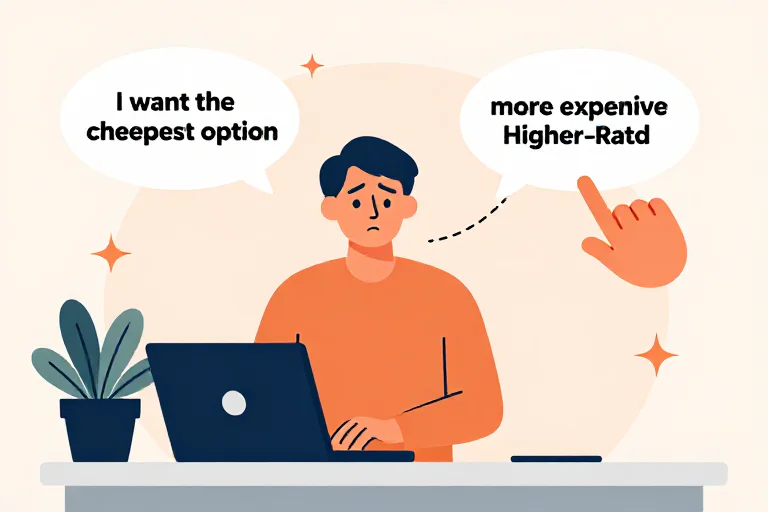
Customers tell ecommerce businesses what they think.
They also show businesses what they do.
Those two sources of evidence are useful, but they are not always consistent.
A customer may say that price is the most important factor, but repeatedly choose a more expensive product.
Someone may complain about a complicated product page but still complete the purchase.
A shopper may say they want more features while their actual buying behavior suggests that simplicity matters more.
These contradictions are not necessarily problems with the data.
They can be some of the most valuable customer signals an ecommerce team has.
The challenge is that traditional analytics and basic feedback analysis usually examine these sources separately.
Analytics shows behavior.
Reviews and surveys show what customers say.
Customer intelligence becomes much more useful when the two are examined together.
AI makes this comparison increasingly practical because it can process large amounts of qualitative feedback alongside behavioral and product data, identify contradictions, group similar patterns, and help teams investigate what those contradictions might mean.
This is one of the areas where Miyeta approaches ecommerce intelligence differently: the goal is not simply to summarize customer evidence, but to understand what different pieces of evidence may mean for an actual business decision.
Customers Do Not Always Explain Their Own Behavior
The first mistake is assuming that customers always know exactly why they made a decision.
They often do not.
A customer might describe a purchase using a simple explanation:
"I bought it because it was cheaper."
But the actual decision may have involved several factors:
- it was cheaper than the alternatives
- the product looked less risky
- the reviews were reassuring
- delivery was faster
- the design appeared more suitable for their home
- the product was available immediately
- the customer had already encountered the brand before
Price may have been the easiest explanation to communicate.
It does not necessarily mean price was the only important factor.
The same problem occurs with customer surveys.
If you ask:
"Why did you choose this product?"
you are likely to receive a simplified explanation.
But if you examine what the customer did before purchasing, what they compared, what information they searched for, what questions they asked, and what alternatives they rejected, the decision may look very different.
This does not mean behavioral data is automatically more truthful.
It means the two forms of evidence describe different parts of the decision.
What Customers Say and What Customers Do Are Different Evidence
Customer statements and customer behavior should not be treated as competing datasets.
They answer different questions.
What customers say can reveal:
- motivations
- frustrations
- preferences
- expectations
- objections
- perceived problems
- emotional reactions
- language customers naturally use
What customers do can reveal:
- what they actually consider
- where they hesitate
- which products they compare
- what information they seek
- where they leave
- which options they return to
- which paths eventually lead to purchase
Neither source is complete by itself.
Consider a simple example.
An ecommerce store selling office chairs discovers that customers frequently say:
"I want a comfortable chair."
This statement is not particularly actionable.
The business might assume that it needs to improve cushioning.
But behavioral evidence shows that shoppers who eventually purchase spend significant time looking at:
- chair dimensions
- seat depth
- weight capacity
- adjustment range
- warranty information
The actual decision may have less to do with a vague concept of comfort and more to do with uncertainty about whether the chair will physically fit the customer.
The customer said "comfortable."
Their behavior reveals the specific uncertainty behind that word.
That difference matters.
Why Contradictions Are Valuable
Businesses often try to remove contradictions from customer research.
A better approach is to investigate them.
Suppose customers say:
"I care about quality more than price."
But purchase data shows that most customers choose the lowest-priced option.
There are several possible explanations.
Maybe:
- Customers genuinely value quality but cannot justify paying more.
- The quality difference is not visible enough.
- The higher-priced products do not communicate their advantages.
- Customers say quality matters because it sounds more reasonable than saying price matters.
- The price difference is larger than the perceived quality difference.
- Customers are balancing quality against another constraint, such as budget or delivery time.
The behavioral data does not tell you which explanation is correct.
The customer statement does not tell you either.
The contradiction tells you that there is a question worth investigating.
That is the important distinction.
A contradiction is not an answer. It is a research signal.
AI Can Help Find These Contradictions
This is where AI becomes particularly useful.
An ecommerce business may have thousands of:
- reviews
- support conversations
- product questions
- survey responses
- search queries
- product comparisons
- product-page interactions
- purchase records
- returns
- cancellation reasons
A human analyst can examine samples.
AI can help connect patterns across much larger collections of evidence.
For example, an AI-assisted workflow could identify customers who repeatedly describe a product as:
- expensive
- premium
- worth paying for
and then compare those statements with actual product choices.
The result might reveal that customers who mention "quality" frequently choose the mid-priced product rather than the premium product.
That creates a much better question:
What does "quality" mean to these customers, and where does the premium product fail to communicate enough additional value?
That question is more useful than either a sentiment score or an average order value.
Start With a Decision, Not a Contradiction
There is a danger here.
AI can find contradictions everywhere.
Not every contradiction matters.
A useful analysis starts with a business decision.
For example:
- Should we change our product positioning?
- Should we introduce a cheaper product?
- Should we emphasize durability?
- Should we change our product-page content?
- Should we target a different customer segment?
- Should we investigate why customers abandon a particular product?
- Should we change how we explain premium pricing?
The question determines which evidence matters.
Suppose the decision is:
Should we reposition this product as a premium product?
Now the comparison becomes more focused.
You could examine:
What customers say
- "well made"
- "beautiful"
- "expensive"
- "worth it"
- "high quality"
What customers do
- compare it with cheaper alternatives
- spend more time reading warranty information
- look for discounts
- abandon when shipping costs appear
- purchase during promotions
- choose a lower-priced competitor
Now the business has something to investigate.
Perhaps customers appreciate the product but do not perceive enough additional value to pay the premium.
That is very different from simply concluding:
"Customers like the product."
Compare Evidence at the Customer-Decision Level
One of the most useful ways to perform this analysis is to organize evidence around a decision rather than around a data source.
Instead of having separate analyses for:
Reviews
Analytics
Support
Surveys
you can ask:
What evidence explains this customer's decision?
That changes the structure of the investigation.
A single customer journey might contain:
- Search for a product.
- Open several products.
- Read reviews.
- Ask about dimensions.
- Compare prices.
- Return to the original product.
- Leave without purchasing.
The customer's eventual non-purchase is only one behavioral outcome.
The surrounding evidence explains more.
Perhaps the customer asked about dimensions because they were worried about fit.
Perhaps the product page did not answer the question.
Perhaps the customer then searched Google for the information.
Perhaps a competitor provided the answer more clearly.
Now the issue is no longer simply:
"Why did the customer leave?"
It becomes:
"Did unresolved fit uncertainty prevent the customer from becoming confident enough to buy?"
That is a much stronger customer-intelligence question.
AI Can Connect Qualitative and Behavioral Evidence
The value of AI is not simply that it can summarize more text.
Its greater potential is connecting evidence that traditionally lives in separate systems.
Imagine an ecommerce business has these datasets:
Reviews
Customers repeatedly mention:
- confusing sizing
- uncertainty about fit
- unexpected dimensions
- difficulty imagining the product in their space
Customer questions
Customers frequently ask:
- "Will this fit under a standard desk?"
- "How deep is the seat?"
- "Is this suitable for a small apartment?"
Behavioral data
Visitors frequently:
- view the dimensions section
- return to product specifications
- switch between similar products
- leave after visiting shipping information
Individually, none of these signals proves that fit uncertainty is causing lost sales.
Together, they create a much stronger hypothesis.
AI can help surface that relationship.
The resulting insight might be:
Customers may not primarily have a product-interest problem. They may have a confidence problem caused by uncertainty about physical fit.
That insight can lead to a concrete experiment:
- improve dimensions content
- add comparison visuals
- add room-size examples
- clarify fit scenarios
- answer common questions earlier on the page
Now customer intelligence has become a business decision.
But AI Should Not Pretend the Contradiction Is Resolved
This is an important limitation.
AI is very good at finding patterns in language and connecting evidence.
It is not automatically good at determining causality.
If customers who read the warranty page purchase more often, several explanations are possible.
Maybe the warranty increases confidence.
Maybe customers who were already more interested in purchasing are simply more likely to read the warranty.
Maybe those customers have different purchase intent.
Maybe another variable explains both behaviors.
AI should therefore generate hypotheses, not manufacture certainty.
A useful output might look like:
Observed pattern
Customers who mention durability frequently also spend more time reviewing warranty information.
Possible interpretation
Durability may be an important risk-reduction factor for this customer segment.
Alternative explanation
Customers with higher purchase intent may naturally consume more product information.
Evidence needed
Compare warranty engagement with purchase intent, product category, price sensitivity, and other behavioral signals.
That is far more valuable than an AI-generated statement such as:
"Customers buy because of the warranty."
Look for Repeated Contradictions, Not Isolated Ones
One unusual customer behavior should rarely change a strategy.
The stronger signal is repetition.
For example:
A single customer says:
"I don't care about delivery speed."
That tells you very little.
But if hundreds of customers say delivery speed is unimportant while behavioral data consistently shows that customers choose products with earlier delivery dates, the contradiction becomes interesting.
Even then, you need to investigate the context.
Perhaps customers do not consciously consider delivery speed as a preference.
They simply treat slow delivery as unacceptable.
That distinction matters.
Customers may not say:
"Delivery speed is an important purchase criterion."
Instead, they may behave as if:
"If delivery takes too long, I will not consider the product."
The second statement describes a purchase constraint rather than a preference.
This is one reason customer intelligence should examine decision context rather than rely only on direct survey questions.
The Same Pattern Can Mean Different Things for Different Customers
Another important issue is segmentation.
A contradiction may disappear once customers are grouped by context.
Suppose customers say:
"Price is not important."
But overall data shows strong price sensitivity.
The average can be misleading.
Perhaps:
- first-time buyers are highly price-sensitive
- repeat buyers care more about convenience
- professionals prioritize reliability
- gift buyers prioritize appearance
- urgent buyers prioritize delivery
- experienced customers understand the product differences better
The same product can therefore have several different decision processes.
AI can help identify these patterns by clustering customers according to:
- needs
- questions
- purchase context
- objections
- product use cases
- behavioral patterns
- decision criteria
This can produce more useful segments than demographic categories alone.
Instead of:
Women aged 25–34
you might discover:
Customers buying for small living spaces who are primarily trying to reduce fit and ownership risk.
That segment description is directly connected to a business decision.
A Practical AI Workflow
A useful workflow does not require a sophisticated AI infrastructure.
Step 1: Define the decision
Start with a concrete business question.
For example:
Why are customers choosing the cheaper competitor?
Step 2: Collect statements
Gather relevant:
- reviews
- surveys
- interviews
- support conversations
- product questions
- search queries
Step 3: Collect behavioral evidence
Look at:
- product views
- comparison behavior
- page sequences
- return visits
- cart behavior
- purchases
- cancellations
- returns
Step 4: Ask AI to identify patterns
Do not immediately ask:
"Why do customers buy?"
Instead ask AI to identify:
- repeated statements
- recurring behaviors
- decision criteria
- objections
- contradictions
- unusual patterns
- differences between customer groups
Step 5: Compare the evidence
Look specifically for:
What customers say
versus
What customers repeatedly do
Then identify where the two align and where they diverge.
Step 6: Generate competing explanations
For every meaningful contradiction, ask:
- What could explain this?
- What evidence supports each explanation?
- What evidence contradicts it?
- What information is missing?
Step 7: Decide what to test
Turn the strongest hypothesis into:
- a content experiment
- a product-page change
- a pricing test
- a product change
- a segmentation hypothesis
- additional customer research
This is where analysis becomes useful.
What This Reveals About Customer Intelligence
Customer intelligence is sometimes reduced to:
"Understand what customers think."
That is too narrow.
A stronger definition is:
Understand the relationship between what customers say, what they do, what they need, and the decisions they make.
That requires multiple forms of evidence.
Customer statements provide interpretation.
Behavior provides observable evidence.
Product and market context provides constraints.
AI can help connect these sources.
But the purpose is not to produce a more impressive customer report.
The purpose is to improve the quality of a business decision.
This is also why customer intelligence is different from ordinary ecommerce analytics.
Analytics might tell you:
Conversion fell 18%.
Customer feedback might tell you:
Customers are complaining about price.
Customer intelligence asks:
Which customers are affected, what decision are they struggling with, what evidence supports the price explanation, and what alternative explanations should we investigate?
That additional layer is where the business value appears.
Where Miyeta Fits
Miyeta is built around the idea that ecommerce teams need more than dashboards and more than summaries of customer feedback.
The useful question is often not:
"What did customers say?"
It is:
"What can we reasonably learn by comparing what customers say with what they actually do?"
That comparison can reveal:
- hidden decision criteria
- purchase friction
- unresolved uncertainty
- differences between customer segments
- gaps between perceived and communicated value
- behavioral patterns that customers cannot easily explain
- hypotheses worth testing
Miyeta approaches this as AI-assisted customer intelligence: use AI to investigate customer signals, connect evidence, surface competing explanations, and help ecommerce teams make better decisions.
The AI does not need to know the answer before the investigation begins.
It needs to help you ask a better question.
The Most Useful Customer Signal May Be the Contradiction
Customers are not perfectly consistent observers of their own behavior.
Neither are analytics systems perfect explanations of customer motivation.
That is why the strongest customer intelligence often comes from putting the two together.
When customers say one thing and repeatedly do another, do not immediately decide which source is "correct."
Ask why they differ.
The gap may reveal:
- an unspoken need
- a hidden constraint
- a decision shortcut
- a communication problem
- a segment difference
- a purchase blocker
- or simply a misunderstanding in the original research question
The contradiction itself is not the insight.
The explanation behind the contradiction is what matters.
And AI can make the investigation of those contradictions much faster, broader, and more systematic.
For ecommerce teams, that creates a more useful path from customer evidence to customer understanding—and from customer understanding to better decisions.