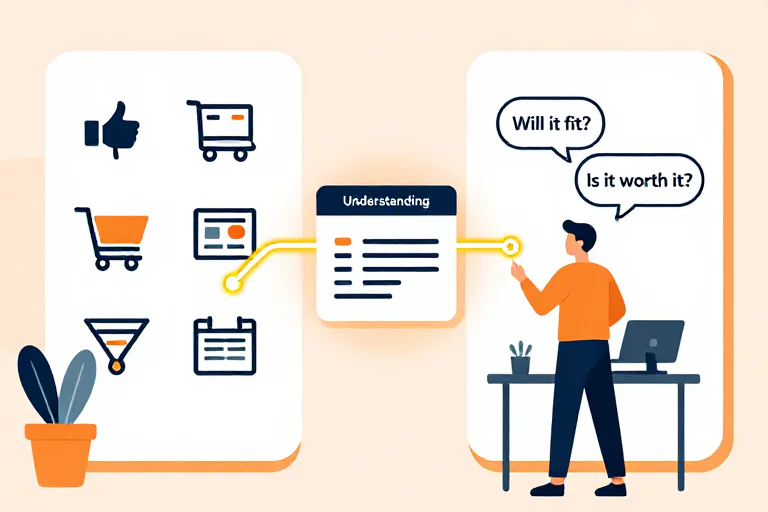
Ecommerce businesses can see almost everything customers do.
A customer visits a product page.
They scroll.
They view images.
They read reviews.
They compare products.
They add something to their cart.
They leave.
They come back three days later.
They purchase.
Or they never return.
Modern ecommerce analytics can capture enormous amounts of this behavior.
But there is still a difficult question:
What does the behavior actually mean?
A customer spending three minutes on a product page might be highly interested.
Or they might be confused.
A customer returning to a product page five times might be close to purchasing.
Or they might be comparing it with competitors.
A customer adding a product to their cart might have strong purchase intent.
Or they might simply be checking the final price.
Behavior is observable.
Meaning is not.
This is where AI customer intelligence can extend traditional ecommerce analytics.
Miyeta's approach is to use AI not simply to describe customer behavior, but to investigate the context, motivations, uncertainties, and possible explanations behind that behavior.
Ecommerce Analytics Already Knows a Lot About Behavior
Traditional analytics is very good at answering questions such as:
- How many people visited?
- Which pages did they view?
- How long did they stay?
- Which products were added to cart?
- Where did customers leave?
- Which traffic sources convert?
- Which products generate revenue?
This information is essential.
A typical customer journey might look like:
Landing page
    ↓
Category page
    ↓
Product page
    ↓
Reviews
    ↓
Cart
    ↓
Checkout
    ↓
Purchase
Analytics can measure each stage.
The problem begins when the business asks:
Why did the customer move from one stage to another?
That question requires interpretation.
The Same Behavior Can Mean Completely Different Things
Consider a customer who visits a product page six times.
A dashboard might classify this as:
High engagement.
But there are several possibilities.
Possibility 1: High purchase intent
The customer likes the product and is preparing to buy.
Possibility 2: Comparison
The customer is comparing the product with alternatives.
Possibility 3: Uncertainty
The customer cannot determine whether the product is right for them.
Possibility 4: Price hesitation
The customer wants the product but is waiting for a discount.
Possibility 5: Research
The customer is collecting information without immediate purchase intent.
The behavior is identical.
The interpretation is different.
This is why customer behavior analysis should not stop at behavioral metrics.
Behavior Needs Context
A behavioral event is more useful when combined with context.
Consider:
Customer viewed the product page five times.
By itself, this tells us very little.
Now add:
- they also read the warranty
- they opened the dimensions section
- they viewed reviews
- they searched for alternatives
- they asked about returns
The interpretation changes.
The customer may not simply be "highly engaged."
They may be trying to reduce purchase risk.
The evidence now suggests:
Repeated product views
        +
Reviews
        +
Dimensions
        +
Warranty
        +
Returns
        ↓
Possible interpretation:
Purchase uncertainty / risk evaluation
The important word is possible.
These signals create a hypothesis.
They do not prove the customer's internal motivation.
AI Can Connect Behavioral and Qualitative Evidence
This is one of the most useful applications of AI customer intelligence.
Traditional analytics primarily works with structured events:
- page view
- click
- add to cart
- purchase
- return
Customer research works with unstructured information:
- reviews
- questions
- feedback
- conversations
- comments
AI can help connect the two.
For example:
Behavior

Customers repeatedly view dimensions
        ↓
Language

Customers ask "Will this fit?"
        ↓
Reviews

Customers mention sizing problems
        ↓
Outcome

Higher returns among certain customers
        ↓
Potential explanation

Product-fit uncertainty
Now the business has something more useful than a dashboard metric.
It has a customer hypothesis supported by multiple types of evidence.
Why Behavioral Data Alone Often Cannot Explain Intent
Suppose a customer abandons checkout.
There are many possible explanations:
- unexpected shipping cost
- payment problem
- delivery timing
- trust
- distraction
- price
- technical issue
- comparison shopping
- changed mind
Analytics sees:
Checkout abandoned.
It does not automatically know which explanation is correct.
This is an important limitation of behavioral analytics.
Behavior tells you what happened.
It often cannot tell you why.
AI Does Not Magically Solve This Problem
It is important not to overstate what AI can do.
An AI model looking only at behavioral events cannot reliably determine a customer's private motivation.
If the data says:
Product view
→
Review view
→
Cart
→
Exit
AI should not confidently conclude:
"The customer thought the product was too expensive."
There is insufficient evidence.
A better AI-assisted analysis would say:
Several explanations are possible. Price, shipping, trust, and comparison behavior should be investigated.
This distinction is important because customer intelligence is only useful when uncertainty is preserved.
AI Is Most Useful When More Evidence Exists
Suppose we add more information.
The customer:
- viewed the product several times
- opened the shipping information
- asked whether shipping could be expedited
- compared the product with a cheaper alternative
- abandoned checkout after shipping costs appeared
Now the price/shipping hypothesis is stronger.
Still not proven.
But much more supported.
This creates a useful principle:
AI becomes more useful when it can connect multiple independent signals.
Customer Behavior Is Often a Sequence, Not a Collection of Events
Another limitation of dashboards is that individual events are often treated independently.
But customer decisions happen over time.
Consider:
Search
  ↓
Product discovery
  ↓
Product comparison
  ↓
Review reading
  ↓
Question
  ↓
Return visit
  ↓
Cart
  ↓
Purchase
Each event means something different depending on what came before it.
A product-page visit immediately after an advertisement may mean discovery.
A product-page visit after reading competitor reviews may mean comparison.
A product-page visit after asking a support question may mean decision confirmation.
Context changes interpretation.
AI Can Analyze Customer Journeys as Decision Processes
Instead of asking:
"Which pages did customers visit?"
we can ask:
"What decision was the customer trying to make at each stage?"
For example:
Stage 1: Discovery
Question:
Is this product relevant to me?
Stage 2: Evaluation
Question:
Is this better than my alternatives?
Stage 3: Risk evaluation
Question:
What could go wrong?
Stage 4: Commitment
Question:
Am I confident enough to spend money?
Stage 5: Post-purchase
Question:
Did the product deliver what I expected?
This creates a different way of interpreting behavioral data.
The journey becomes a sequence of decisions rather than simply a sequence of clicks.
Customer Behavior Can Reveal Uncertainty
One of the most useful concepts in customer behavior analysis is uncertainty.
Customers often behave differently when they are uncertain.
Possible signals include:
- repeated product visits
- unusually extensive review reading
- repeated comparison
- frequent returns to specifications
- questions before purchase
- long pauses between actions
- repeated searches
- switching between products
None of these proves uncertainty.
But together, they can create a useful hypothesis.
For example:
Repeated comparison
        +
Repeated review reading
        +
Compatibility question
        +
No purchase
        ↓
Possible purchase uncertainty
This can lead to a much better investigation than simply reporting:
Conversion is low.
Different Customers Can Have Different Decision Journeys
Aggregate analytics can hide customer differences.
Imagine two shoppers.
Shopper A
Search
↓
Product
↓
Purchase
A simple, high-confidence decision.
Shopper B
Search
↓
Product A
↓
Reviews
↓
Product B
↓
Competitor
↓
Product A
↓
Support question
↓
Return visit
↓
Purchase
Both eventually purchase.
But they are not making the same decision.
Shopper B may need much more information and reassurance.
This matters for:
- product page design
- content
- merchandising
- customer support
- product positioning
Customer Behavior Can Reveal Different Decision Styles
Rather than segmenting customers only by demographics, businesses can sometimes identify different decision contexts.
For example:
Fast deciders
They quickly identify a suitable product and purchase.
Comparison shoppers
They examine multiple alternatives before committing.
Risk-sensitive shoppers
They spend more time reading:
- reviews
- warranty information
- returns
- specifications
Use-case researchers
They investigate whether the product works for a specific situation.
Value-focused shoppers
They spend more time comparing:
- price
- features
- alternatives
- bundles
These are behavioral patterns, not fixed personality labels.
That distinction matters.
The goal is not to claim:
"This customer is a risk-averse person."
The evidence may only support:
"This customer exhibited more risk-evaluation behavior during this purchase."
That is a much safer and more useful conclusion.
AI Can Help Compare Successful and Unsuccessful Journeys
One powerful use case is comparing customer journeys that produce different outcomes.
For example:
Purchasers
Frequently:
- view product details
- read selected reviews
- return to the product page
- check shipping
- purchase
Non-purchasers
Frequently:
- compare several products
- revisit dimensions
- open returns
- leave after shipping information
The question becomes:
What differs between the journeys?
AI can help identify patterns.
But again, correlation should not immediately become causation.
The finding might generate a hypothesis:
Customers who repeatedly inspect shipping information may be more likely to abandon.
That hypothesis can then be tested.
AI Can Find Contradictions in Customer Behavior
Behavior becomes particularly interesting when it contradicts stated preferences.
For example:
Customers say:
"Price is the most important factor."
But customers who spend more time reading durability reviews are more likely to purchase the premium model.
Possible interpretation:
Customers may use price as an initial filter, but durability may determine the final decision.
This is a more nuanced understanding of the buying process.
Another example:
Customers say:
"I want something simple."
But they spend substantial time comparing technical specifications.
Possible interpretation:
They want simplicity in use, not simplicity in capability.
These distinctions can be difficult to discover through surveys alone.
The Customer Journey Is Not Always Linear
One of the biggest mistakes in ecommerce analysis is assuming that customers follow a clean funnel.
Real journeys often look more like:
Search
  ↘
   Product A
      ↘
      Reviews
         ↘
        Search
           ↘
          Competitor
             ↘
           Product B
              ↘
             Product A
                ↘
              Question
                 ↘
                Purchase
Customers go backward.
They compare.
They leave.
They return.
They change their minds.
They gather information.
This behavior is not necessarily a problem.
It can be part of normal decision-making.
The analytical question is:
Where does additional research help the customer become confident, and where does it indicate unresolved uncertainty?
AI Can Help Identify Decision Friction
A useful concept is decision friction.
Decision friction occurs when customers need more effort than expected to become confident enough to act.
Potential signs include:
- repeated comparisons
- repeated questions
- excessive information searching
- unclear product differences
- repeated returns to specifications
- frequent abandonment after key information
- high pre-purchase support demand
AI can help cluster these signals and investigate what is creating the friction.
For example:
Customer behavior

Repeated comparisons

        +

Customer questions

"What's the difference?"

        +

Product page behavior

Repeated switching between variants

        ↓

Possible friction

Product differentiation is unclear
The business can then investigate whether clearer positioning improves the customer experience.
Behavior Becomes More Valuable When Connected to Customer Language
Behavior tells you what happened.
Language can provide clues about why.
Consider:
Behavior:
Customers repeatedly open the returns page.
Language:
Customers ask:
"What happens if this doesn't fit?"
Now the behavior has context.
The business may investigate:
Is return-policy engagement primarily a sign of normal information gathering, or does it indicate concern about product fit?
That question is much more useful than simply tracking return-page views.
A Practical AI Workflow for Customer Behavior Analysis
A useful process can be built around seven steps.
1. Define the business question
Do not start with:
Analyze customer behavior.
Start with:
Why do high-intent visitors fail to purchase?
or:
What causes customers to compare products repeatedly?
The question determines what evidence matters.
2. Map the relevant behaviors
Identify:
- product views
- searches
- comparisons
- review interactions
- cart activity
- checkout
- purchases
- returns
Only use behaviors relevant to the question.
3. Add qualitative evidence
Connect behavior with:
- reviews
- questions
- support messages
- survey responses
- customer language
This provides context.
4. Segment the behavior
Compare:
- purchasers vs non-purchasers
- new vs returning customers
- products
- customer types
- traffic sources
- use cases
Avoid assuming that aggregate behavior represents everyone.
5. Identify patterns and contradictions
Look for:
- repeated behavior
- unusual sequences
- behavior differences
- contradictions
- possible friction points
6. Generate competing explanations
For every meaningful pattern, ask:
What else could explain this?
This is critical.
Without it, AI can easily turn patterns into false conclusions.
7. Turn the analysis into a decision
The final output might be:
- a product-page experiment
- better product information
- a new customer segment
- a product research question
- a pricing investigation
- a content opportunity
- a support improvement
- a product change
The analysis should eventually connect to something the business can do.
What AI Should Not Do
AI customer behavior analysis becomes dangerous when it becomes overly confident.
It should not say:
"Customers abandoned because the price was too high."
unless there is strong evidence.
It should not say:
"This customer is price-sensitive."
based only on one behavior.
It should not say:
"Customers want this feature."
because several customers requested it.
Instead, it should distinguish:
Observation

What happened?

↓

Evidence

What supports it?

↓

Interpretation

What might it mean?

↓

Alternative explanations

What else could explain it?

↓

Confidence

How strong is the evidence?

↓

Decision

What should happen next?
This makes AI analysis much more trustworthy.
From Behavioral Analytics to Customer Intelligence
Traditional analytics is still the foundation.
It tells you:
What happened?
AI customer intelligence adds:
What might explain it?
And decision intelligence adds:
What should we investigate or decide next?
The relationship can be represented as:
Ecommerce analytics
        ↓
Customer behavior
        ↓
Customer language
        ↓
Customer context
        ↓
AI-assisted investigation
        ↓
Possible explanations
        ↓
Human judgment
        ↓
Business decision
This is not a replacement for analytics.
It is an additional layer above it.
Miyeta's Approach to Customer Behavior
Miyeta approaches ecommerce customer intelligence differently from a conventional analytics dashboard.
The goal is not simply to show another visualization of customer activity.
It is to investigate what customer behavior may reveal when combined with other evidence.
For example:
A customer repeatedly views a product.
Instead of immediately labeling this as "high intent," Miyeta's approach would ask:
- What did the customer view before returning?
- Did they compare alternatives?
- Did they read reviews?
- Did they ask questions?
- What information were they looking for?
- Did they eventually purchase?
- Did similar customers behave the same way?
The objective is to move from behavioral events toward customer decision context.
That is the foundation of AI customer intelligence.
The Goal Is Not to Predict Every Customer
There is a temptation to make customer intelligence sound like perfect prediction.
That is not necessary.
An ecommerce team does not need an AI system that claims to know exactly why every individual customer behaves the way they do.
It needs a system that helps answer questions such as:
- Which customer patterns deserve investigation?
- Which explanations are supported by evidence?
- Where are customers experiencing uncertainty?
- Which segments behave differently?
- What information is missing?
- What should we test next?
That is a much more practical goal.
Better Customer Understanding Starts With Better Questions
Instead of asking:
"What does our dashboard say?"
Ask:
"What customer decision is this behavior evidence of?"
Instead of:
"Why did conversion drop?"
Ask:
"Which part of the customer decision became harder?"
Instead of:
"Why did customers leave?"
Ask:
"What uncertainty or friction existed immediately before they left?"
Instead of:
"Which customers convert?"
Ask:
"How do different customer groups reach confidence differently?"
These questions move ecommerce analytics closer to customer intelligence.
Conclusion: Behavior Is Evidence, Not an Explanation
Customer behavior is one of the most valuable sources of ecommerce evidence.
But behavior alone does not tell the whole story.
A click is not an intention.
A long session is not necessarily interest.
A cart addition is not necessarily commitment.
An abandonment is not necessarily price resistance.
These events need context.
AI can help ecommerce teams connect behavioral data with customer language, questions, reviews, product information, and outcomes.
The result is not perfect knowledge of the customer.
It is something more practical:
better hypotheses, better investigations, and better decisions.
That is the role of AI customer intelligence.
And that is the direction Miyeta is building toward:
Understand your customers. Make better decisions.